Maybe Donald Trump is serious about making the head of the UFC his press secretary. Maybe it's a bit, a Saturday-night Truth Social riff meant to get everyone talking. Either way, it tells us what this White House thinks the job is.
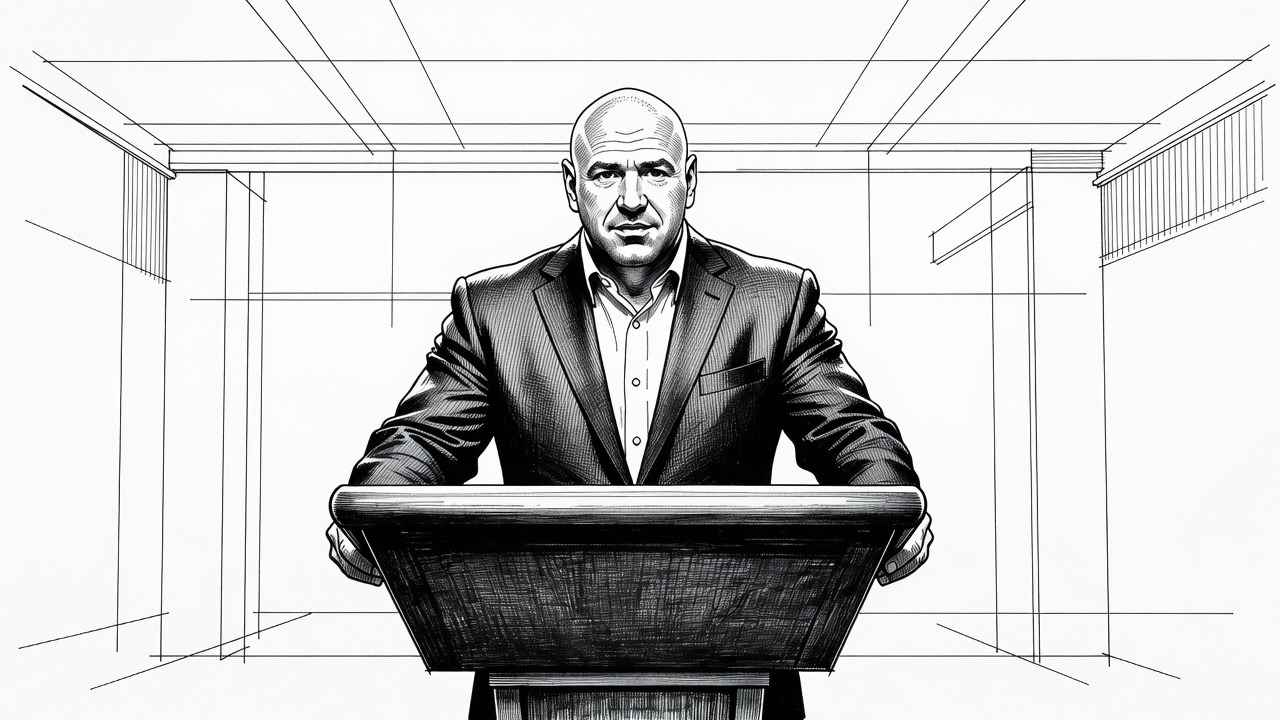
Trump didn't say he wanted someone to explain the government's decisions to the people who pay for it. He said he wanted Dana White and a team of fighters, including Khabib Nurmagomedov, Daniel Cormier and Amanda Nunes, to "defend the administration against political opponents." That is a description of a bodyguard detail, not a press office. Dana White answered by posting a picture of himself at the briefing-room podium and announcing a "new chapter." The briefing room is now a prop in a promotional campaign.
The press secretary is paid by taxpayers to stand at a public podium and face people whose job is to ask uncomfortable questions on behalf of everyone else. Those questions are the only daily, institutionalized moment when a president's account of events can be challenged in public. Defending the administration against opponents is what the campaign apparatus, the party and the president's own social media feed are for. The briefing room was never supposed to be a fight card.
This White House has also spent a year dismantling the thing the podium is supposed to serve. It took control of the press pool away from the correspondents' association. It froze out the Associated Press over a dispute about what to call a body of water. It has treated access as a reward for flattery. Now it floats a promoter as the face of the operation. The pattern is consistent: if the press can't be controlled, replace it with performance.
The vacancy itself shows how little the performance is hiding. Karoline Leavitt left in August. Her successor, Katie Zacharia, lasted five days. Two people in a row have not wanted to stand at that podium for long, and the answer is not to ask why. The answer is to find someone for whom the job is a show. Dana White is a talented showman and a loyal friend. He spoke at the Republican convention, and the president has talked about staging a UFC event on White House grounds. That he is now being considered for the nation's most visible communications job should make anyone who cares about the line between public office and private brand ask what, exactly, that line is.
White has no obvious obligation to the public interest. He runs a business, sits on corporate boards, and depends on a regulatory and media environment that this president shapes. No one is suggesting a press secretary must be a monk. But Americans should at least be told whether the person speaking for the government is speaking for the government.
The temptation for Democrats is to laugh, and it's a real temptation, because the image of Cormier fielding a question on tariffs writes its own jokes. But the laugh is the trap. A president who makes everything a spectacle wins whenever attention is the prize, and the more absurd the proposal, the less anyone asks about the substance: why the post is empty, why the briefings have become rare and combative, why access now depends on loyalty.
So take the stunt seriously enough to reject its premise. The briefing room belongs to the public. A government confident in its policies does not need cage fighters to defend them. It needs a spokesperson willing to answer questions, and a president willing to be asked.