Whenever French workers take to the streets, a familiar commentary follows: the French are allergic to reform, they love a strike, they can't be governed. It is lazy, and this week it is wrong.
Look at what people are actually demanding. Wages that keep up with rent, food and energy. Schools with enough teachers. Public services that work. Nobody is marching for a utopia. They are asking that a paycheck still buy what it bought a few years ago. It is hard to think of a more modest demand, or a more reasonable one.
The numbers fight is revealing too. The Interior Ministry says 600,000 marched; the CGT says 1.6 million. The truth is somewhere in between, and the government's count is not neutral, because a smaller crowd is a smaller problem. But even on the ministry's own figures, hundreds of thousands of people gave up a day's pay, which many of them can't spare, to say the same thing. When people at the bottom of the pay scale pay to protest, it's a sign something has broken.
What has broken is the political bargain. For years, French wage earners have been told to be patient while the state repairs its finances. Emmanuel Macron raised the retirement age to 64 in 2023 by forcing it past parliament, against overwhelming public opposition. Then he dissolved the National Assembly, lost his majority, and left a succession of prime ministers to run a country they cannot command. Sébastien Lecornu now offers a meeting with the unions, which is what governments do when they want the cameras to see them listening.
The question nobody in power wants asked is why the burden of fiscal repair keeps landing on those with the least slack. When the Assembly debated a modest minimum tax on fortunes above €100 million, the so-called Zucman tax, it was voted down, even though polls showed it was popular. A 2% levy on the very richest was treated as radical. Cuts to services, a squeeze on wages and a longer working life are treated as common sense. That is not economics. It is a ranking of whose sacrifice counts.
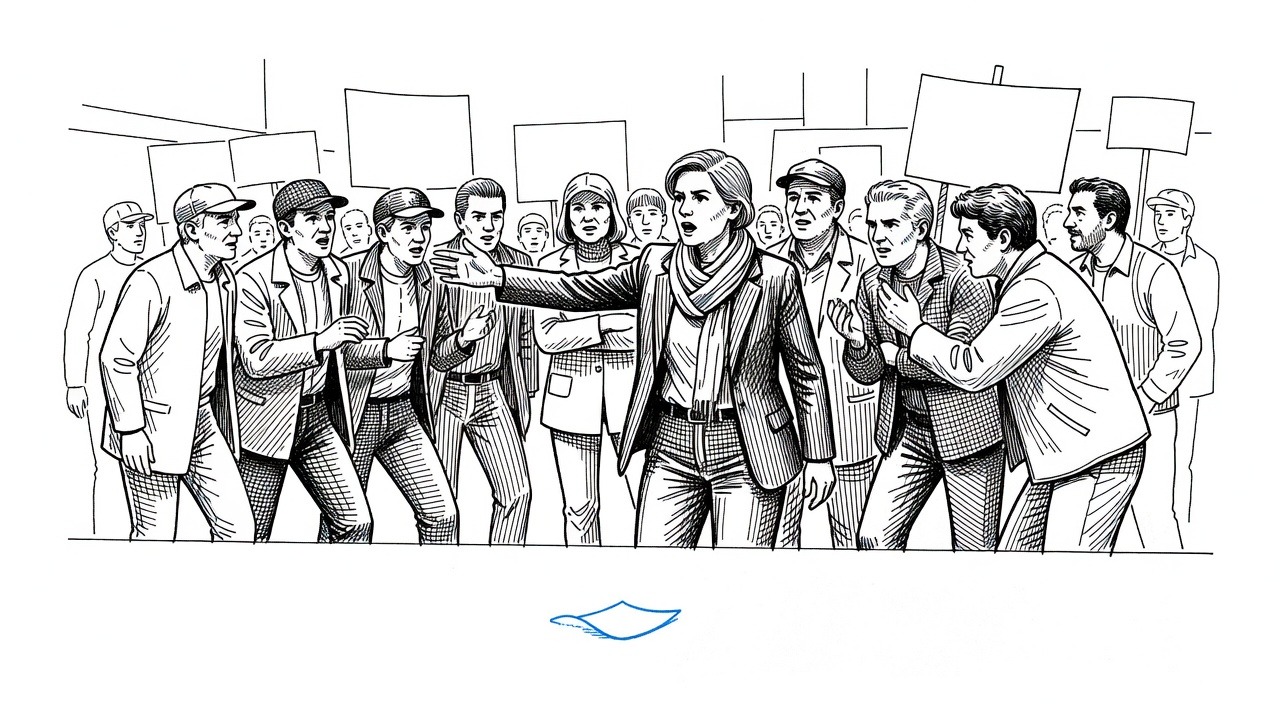
Then there is the burned car in Lyon and the tear gas. They will dominate the evening news, as they always do. Condemn the violence; it is stupid and it hands the government its talking points. But a car fire in Lyon is not the story of a day on which well over half a million people marched mostly in good order. Anyone who uses the arson to discredit the marchers is hoping you will stop looking at the wages.
The Left should not feel smug, though. Street power is not the same as political power. French unions can fill the boulevards, and the parties that claim to speak for them still struggle to turn that energy into a budget, a coalition or a law. A one-day strike followed by another one-day strike risks becoming ritual, a release valve that lets the pressure out without changing the system. Sophie Binet is right that wages are not keeping pace with living costs. The harder task is to say what the movement will accept in exchange for calling it off, and to make that demand concrete: wage indexation, a tax on extreme wealth, funded schools and hospitals.
The government has a choice. It can keep treating this as a public-order problem, or it can read it as a verdict. A country whose teachers, rail workers and students all say the same thing on the same day is not being unreasonable. It is telling its leaders the deal no longer works.
How it may affect me
If you're traveling in France, expect more disruption to trains, metro and schools around the Saturday protest, and check operators' notices before you go. Some tourist sites, like the Eiffel Tower, may close at short notice.