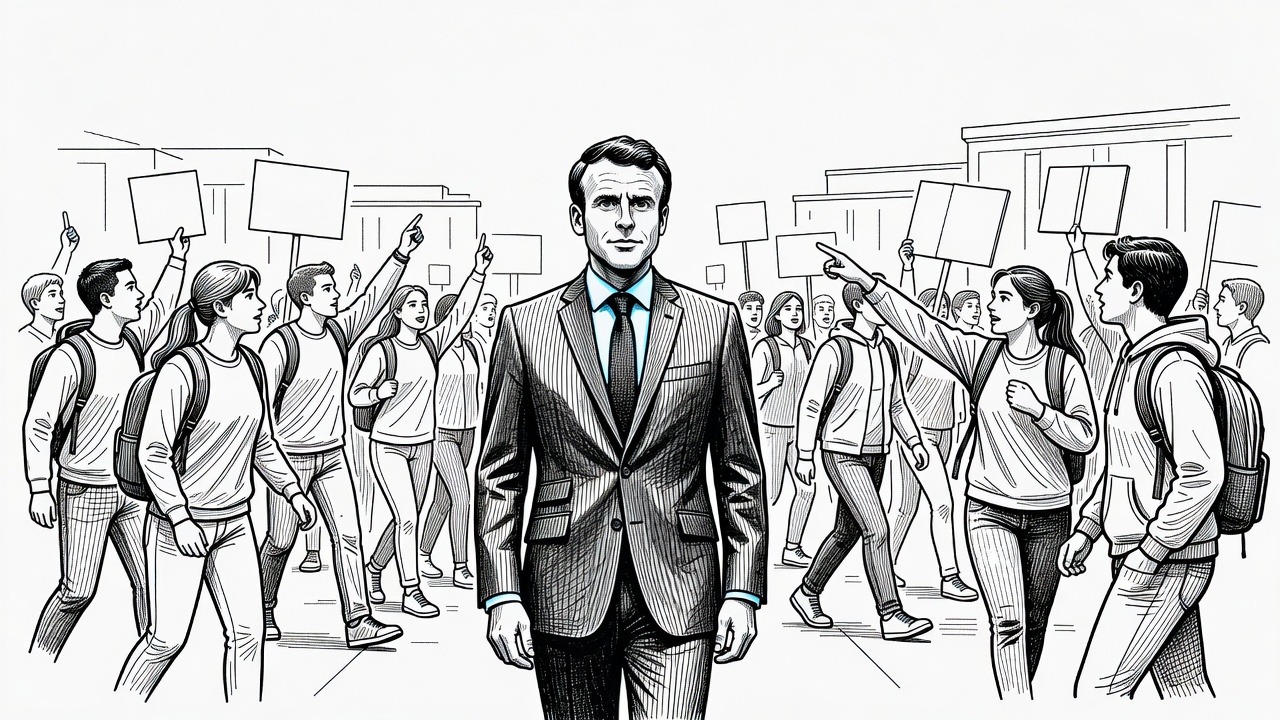
Seventy thousand police and gendarmes for 320,000 protesters. That is roughly one officer for every four or five people in the street, and the state's own count of arrests by mid-afternoon was 27. Judge a government by what it fears, and Emmanuel Macron's France fears its own young people.
The question is why a generation that is supposed to be sullen, atomized and glued to its phone keeps showing up for a third straight weekend. The answer isn't mysterious. Young people are being handed the bill for a political order they never got to vote on. They face an education system that protesters say is underfunded, rents and grocery prices that outrun entry-level wages, and a labor market built on short contracts. Meanwhile the government's answer to every fiscal squeeze is that those with the least accumulated wealth should tighten first.
The most serious opposing argument deserves a fair statement. France already spends more of its national income on the public sector than almost any rich democracy, its deficit and debt are real constraints, and street demands for more investment can sound like an unpriced wish list. Blockading schools also punishes the students doing it. All of that is worth saying. But 'the money isn't there' is never a neutral statement of fact. It is a choice about priorities, and France has found money for tax cuts aimed at capital and business, and for a policing apparatus that can deploy 70,000 officers on a Saturday. A state that can afford that can afford to explain why classrooms and student budgets come last.
Then there is the matter of how Macron has governed. He lost his parliamentary majority in 2022. In 2023 he raised the retirement age to 64 and pushed it through using constitutional maneuvers that bypassed a final vote, over the opposition of nearly every union in the country. People who learn that lesson at 17 or 20 do not conclude that the system listens. They conclude that the ballot box is where grievances go to die and the street is the only place left that gets answered. If officials are shocked that the young have stopped trusting institutional channels, they should look at who closed them.
The pattern of policing matters too. Tear gas in Lyon, water cannons in Toulouse, restrictions on Paris before anything had happened. Every demonstration that begins with a government prediction of violence invites exactly that. The protesters are also raising police conduct and civil liberties, and a response built on mass deployment and preemptive restriction proves their point better than any speech.
The Left has its own test here, and it should be honest about it. Unions and the parties opposed to Macron have joined the movement. That is welcome, but the worst thing they could do is treat it as a vehicle for their own positioning ahead of the next election. A youth movement that is organizing through blockades and shared anger has something the old Left's machinery lost years ago: credibility with people who don't trust anyone with a title. Leaders who show up to claim it will lose it. The task is to carry its demands into budgets and legislation, not to put a party logo on them.
That these protests are also reported in Germany and elsewhere in Europe is not a coincidence. It suggests a generation across the continent reaching the same conclusion about housing, wages and schools. Governments can keep treating that as a public-order problem. They will find that a generation told to wait and absorb the costs eventually stops asking permission.
How it may affect me
If you live in or are traveling to France, expect possible disruption next week: student blockades are planned at universities and high schools, and Paris has had security restrictions in place. Check local transport and school notices, and avoid unauthorized gatherings, where police have used tear gas and water cannons.