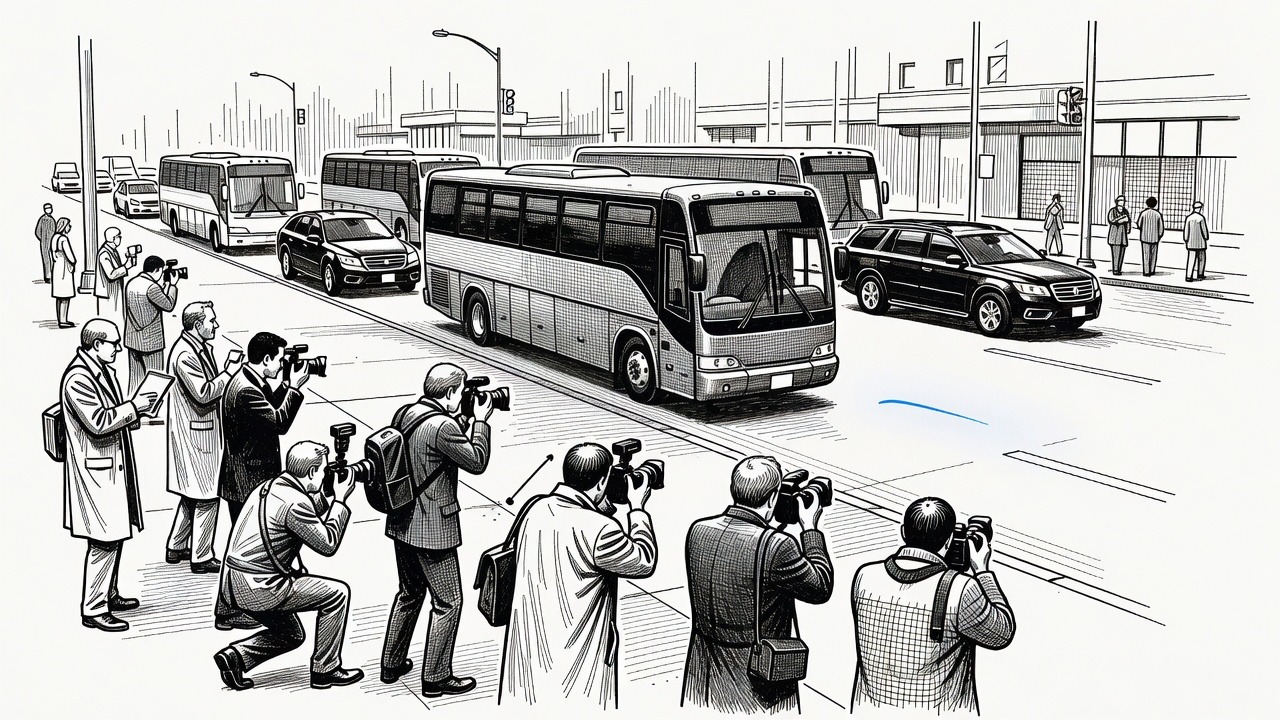
Two thousand people are left in Oleshky. Before the war, the city held roughly ten times that number. Those who remain are, in the main, the ones who could not leave: the old, the sick, the poor, people with no relatives in Lviv and no savings for rent in Poland. For them, a few hours of silence on a Friday, enough to get buses and ambulances in and some residents out, counts as a historic mercy. That tells us how low the world has set the bar.
Let's be plain about who owes what. Russia invaded, Russia occupies Oleshky, and under the Fourth Geneva Convention an occupying power is responsible for the welfare of the civilians it rules. That is the law, not a favor. A humanitarian corridor that needs a negotiated, localized truce, with the ombudsman of the invaded country haggling for safe passage, is an admission that the occupier has not met that duty. Civilians should not have to wait for a pause to be fed.
The skeptic's objection is serious, and the Left should not dodge it. A local ceasefire can be theater. Moscow can point to the buses and claim it is the humane party while the war grinds on everywhere else. Evacuations from occupied territory can also be coerced, filmed and used as propaganda. Those risks are real, which is why this cannot be left to the belligerents alone. Independent monitors, the Red Cross and the UN should be present and should report publicly on who is leaving, where they are going, and whether anyone was forced. If the pause is genuine, scrutiny costs nothing.
The scrutiny should work in both directions. The principle that protects civilians in Oleshky also protects civilians in Dnipro, where a Russian strike on a rail platform killed at least 14 people on Thursday. Rail platforms are where people go to escape. Striking one is not collateral damage in some abstract sense. It means shelling the exits. The same week that produced a hopeful humanitarian pause also produced a massacre of commuters and evacuees. Both are the same war and the same Russian command.
This is where the Western Left has to be clear about its own obligations. For too long, parts of the progressive world have treated Ukraine as a seminar topic, a debate about NATO expansion and escalation risk, when it is a place where working people wait on platforms and in basements. A left worth the name starts from the protection of ordinary people against armed power. That means supporting air defense, which is a humanitarian program as much as a military one. Every interceptor that stops a missile over a station is a form of civilian protection. It means pressing for access, monitoring and prisoner and civilian exchanges. And it means refusing both of the lazy postures on offer: the war-hawk habit of treating civilians as a rhetorical asset, and the peace-at-any-price habit of treating them as a price someone else should pay.
The Oleshky pause shows that restraint is possible when someone insists on it. If shooting can stop for a few hours to move 2,000 people, then the claim that nothing can be done for civilians is false. What's missing is pressure, attention and the will to make humanitarian access a standing demand rather than an occasional favor.
The measure of this story is not that the guns went quiet in one city. It is that everyone involved treated that as remarkable, and that by Thursday, 14 more people had died waiting for a train.