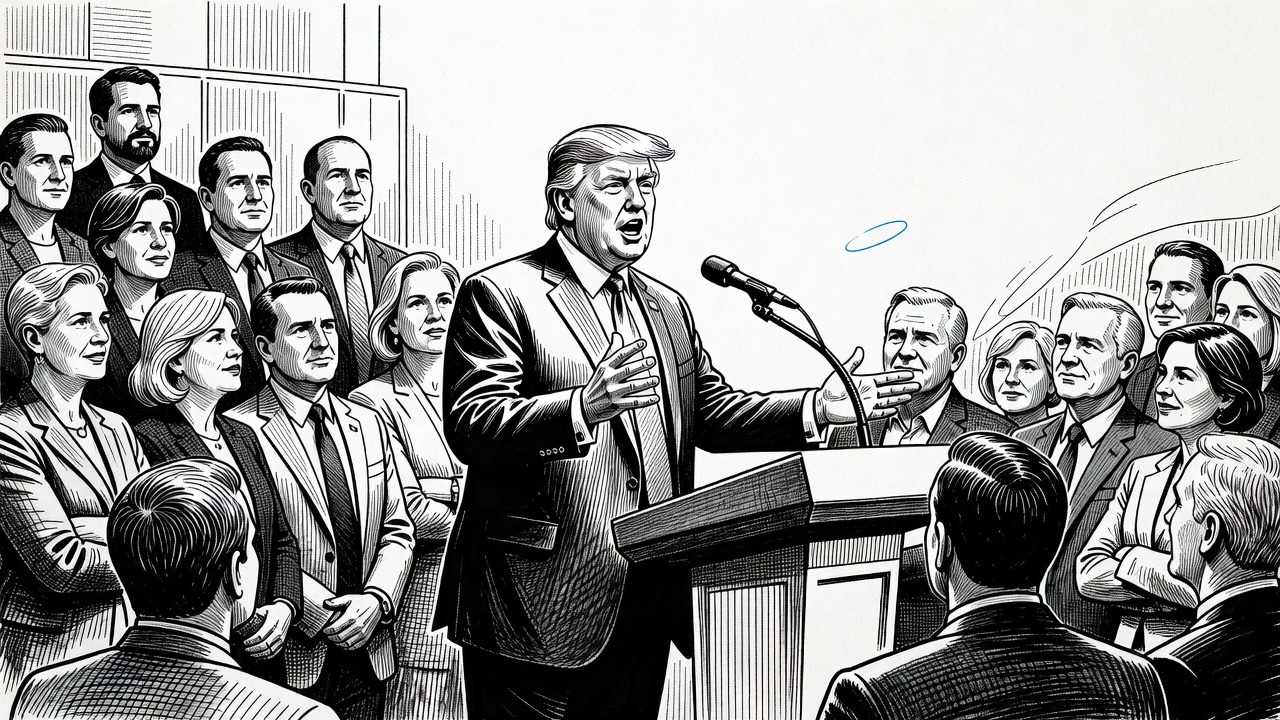
Start with what we know and what we don't. We don't know whether Mario Alberto Morales is guilty. An indictment is an accusation, and he is entitled to the presumption of innocence like anyone else. We do know that a man with a broken leg was hit by a Jeep Grand Cherokee after he ran on foot from a vehicle in Houston, and that the first account of it came from the agency whose officer was driving.
That account was that Miguel Parra-Hernandez ran in front of the vehicle. Maybe so. But that is a press office's version, and a press office is not a fact-finder. Harris County District Attorney Sean Teare's office, after presenting evidence to a grand jury of ordinary county residents, alleges something different: that Morales intentionally hit him. Those two claims can't both be true, and the point of a criminal process is to find out which one is.
The agency's credibility is part of why this matters. Over the past year, DHS statements about enforcement incidents in several cities have been disputed by video, by sworn testimony and by federal judges. In Chicago, a federal judge found that a senior Border Patrol official had not been truthful about the use of force. When an agency has earned that record, its first draft of events deserves no deference. "He ran in front of the car" has been said to excuse a lot of things.
The strongest counterargument deserves a real answer. Federal officers have a genuine legal shield: Supremacy Clause immunity, which can block state prosecution of a federal agent whose conduct was authorized by federal law and was necessary and proper. The principle is old and sensible. No state should be able to prosecute federal officers into paralysis. Officers also make fast decisions in chaotic moments. And Teare is an elected Democrat in the middle of a national fight over immigration enforcement, so skeptics will assume politics is at work.
But every one of those points is an argument for a courtroom, not for exemption by assertion. Morales can invoke immunity, and the case will probably be moved to federal court, where a judge will test whether striking a fleeing man with a car was "necessary and proper." Test that claim. Don't assume it. And ask what the claim amounts to here. Parra-Hernandez was on foot, running away, and ended up under a vehicle. Whatever he is suspected of, immigration enforcement is largely civil, and a car is a two-ton weapon. If the DA's allegation is right, "necessary" is a very hard word to apply.
The Left should also be honest about its own history. For years, many Democrats were comfortable talking about police accountability and uncomfortable with prosecutors who actually pursued it. If we celebrate this indictment because the officer works for an agency we despise, and flinch when a local cop faces the same scrutiny, then we don't believe in accountability, only in scoring points. The principle has to hold for everyone: no one who uses lethal force gets to be the sole judge of whether it was justified, whether the badge is local or federal, and whether we like the politics of the agency or not.
That is also why the right's likely response, that this is lawfare against law enforcement, is so revealing. The same movement that preaches law and order insists that one class of armed officials should be answerable to nobody but their employer. A grand jury is not lawfare. It is one of the oldest checks in the American system, and it is made of neighbors, not bureaucrats.
If Morales acted lawfully, a trial or a judge will say so, and he will be cleared in public instead of by a spokesperson. If he did not, then the country should want to know that a federal badge did not make hitting a fleeing man with a car lawful. Either way, the process is the point, and the agency that wanted to skip it should be the most nervous about it.