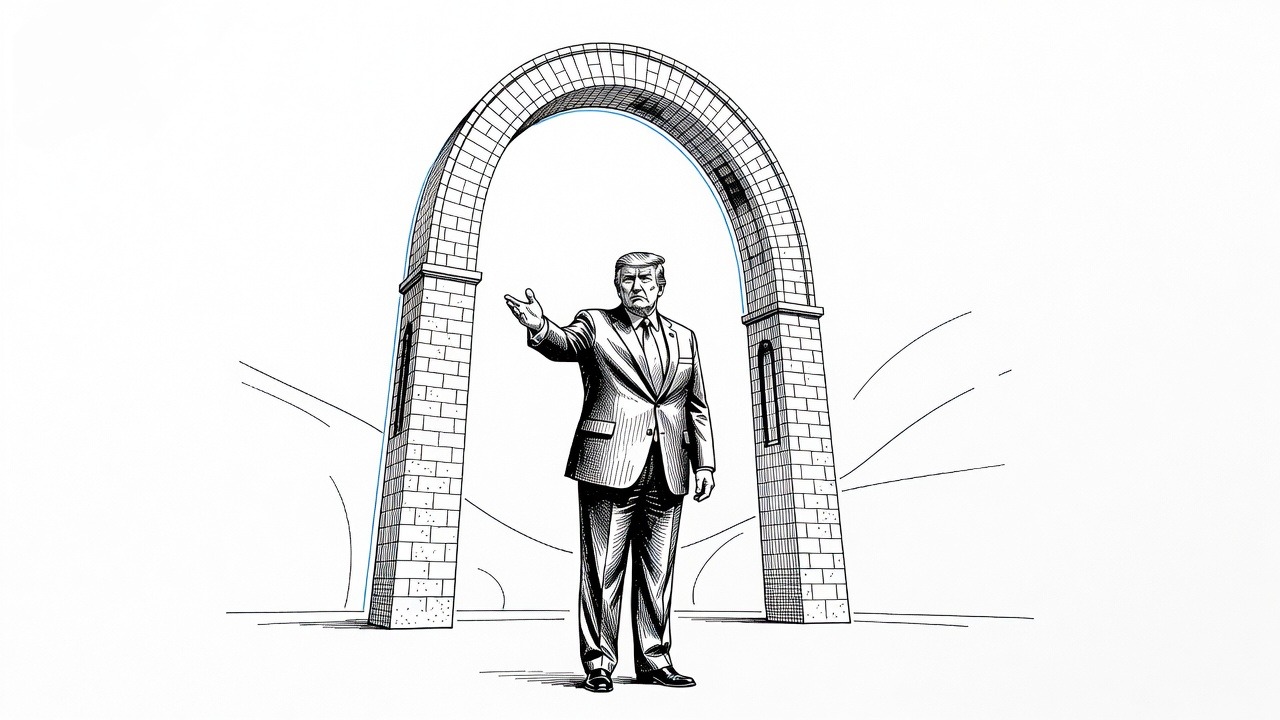
Look at the two stories together and a pattern appears that no single lawsuit captures. A president wants a 250-foot arch on the line between the Lincoln Memorial and Arlington National Cemetery. He also wants a public golf course rebuilt with federal money, and a Democratic congressman is worried enough about who ends up owning it that he's asking appropriators to block a sale to Trump himself. Each project comes with a respectable public explanation. Each looks different once you ask who benefits.
Start with the arch. Defense Secretary Pete Hegseth and Homeland Security Secretary Markwayne Mullin now say it would play a defensive role against drone strikes. Nobody should accept that without evidence. A monumental stone arch is a vanity object with a security rationale stapled on after the fact. If the administration has a real counter-drone plan, it can show the engineering and let Congress and the public examine it. National security is the magic phrase that ends questions, and it is being invoked to shield a monument to the man who wants it built.
Then there is the Justice Department's argument that the plaintiffs, three Vietnam veterans and a historian, have no standing. This is the quiet scandal. The harm here is to a shared public space, to a sightline that belongs to everyone. Because it belongs to everyone, the administration says no one in particular can complain. The more public the asset, the weaker the right to defend it. That logic would let any president do almost anything to the National Mall, so long as the damage is spread thinly enough.
The timeline shows how this works. Construction could begin as early as Nov. 5 if the National Capital Planning Commission signs off, and the first six months would be underground. Foundations are poured and ground is broken, and a court later asked to stop the arch is looking at a half-built fact. Whether the project needs congressional authorization is a serious question. Letting a president pour concrete while it is argued is how an executive turns a legal dispute into a done deal.
The golf course is smaller and more revealing. The Park Service says a seawall has settled and created hazardous conditions. Maybe so, and seawalls are a legitimate use of public money. But Judge Ana Reyes saw enough to require 10 days' written notice before irreparable changes. That is a modest remedy, and the administration's need for it should itself raise suspicion. Rep. Jared Huffman's concern is simple: taxpayers pay for improvements, then the property's most obvious private buyer is a president who has spent his adult life in golf real estate. The White House says it wants a safe and affordable public facility. Fine. Then it should have no objection to putting that in law, with a bar on any sale or transfer to the president, his family or his businesses.
Democrats should not leave this to two district judges. Judges can delay, but they cannot legislate, and the standing doctrine will keep trimming what they can reach. The real check belongs to Congress, which controls the money and the Mall. Appropriations riders are boring and effective, and Huffman is right to push them. Every Democrat on the relevant committees should attach their name to language barring federal funds for the arch without explicit authorization and barring any sale of public park land to the president or his associates.
The question is not whether Trump likes monuments or golf. Presidents have vanities. The question is whether the commons can be remodeled by the person in charge of it, with a security rationale offered on request and a standing objection ready for anyone who sues. That is not stewardship. It is the treatment of public property as a personal portfolio, and Congress should stop it before the first shovel hits the ground.