Wall Street will spend Wednesday evening asking whether Ford can "manage" a supplier disruption within its full-year forecast. That is a fine question for a shareholder. It is the wrong one for everyone else.
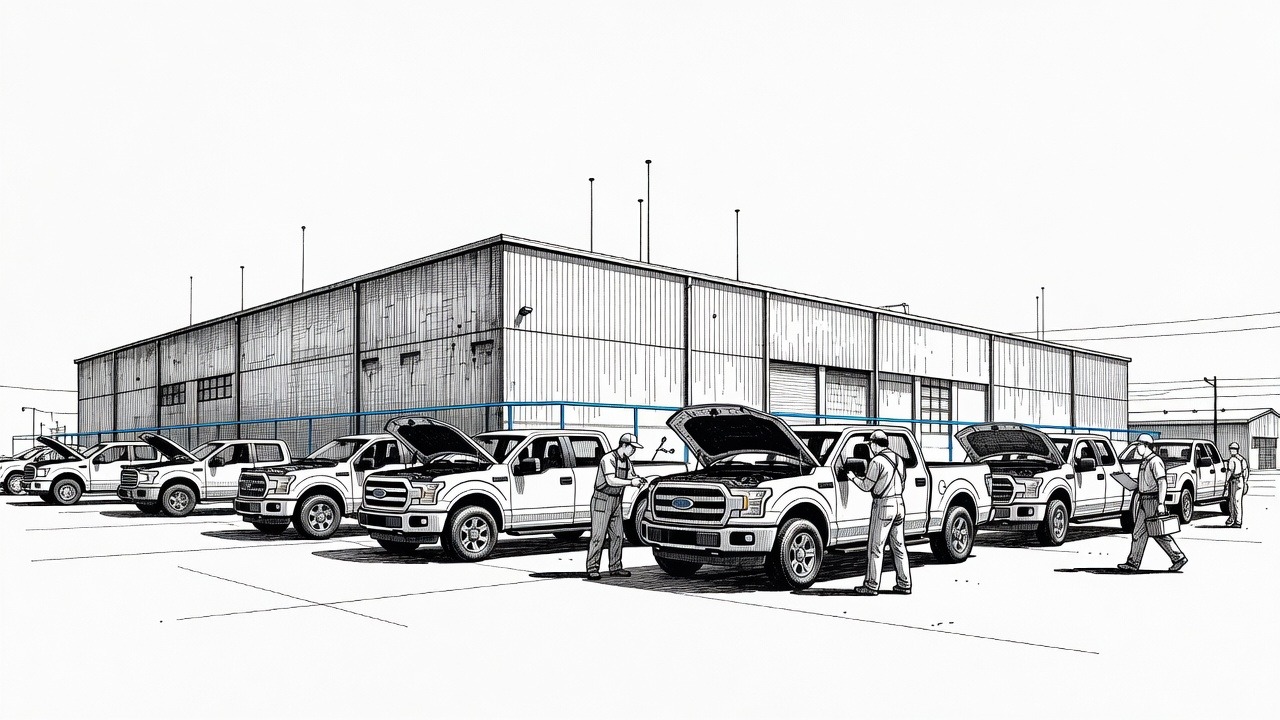
The facts are plain. F-150 output fell from more than 57,500 vehicles in August to fewer than 43,000 in September, a drop of roughly a quarter in a month, because something went wrong at a supplier. Ford still expects $10 billion to $11 billion in adjusted EBIT this year. It is also bracing for a $2 billion cost headwind from commodities, computer-memory components and freight. Analysts expect a slightly weaker quarter, 40 cents a share against 45 a year ago. That is a dip, not a crisis, and the company says the damage fits inside its guidance.
So the first thing to notice is where the shock goes. When a corporation this profitable says a disruption is manageable, it means the pain has somewhere to land. Historically that place has been the plant floor, the supplier's payroll and the sticker price. Ford owes the public a plain account of who absorbed the lost trucks: how many hours were cut, how much pay was lost, which small suppliers were squeezed. An earnings call built around per-share figures will not volunteer it.
The second thing is the structure that makes one supplier's problem a company-wide slowdown. For decades the auto industry sold the world on lean, just-in-time sourcing. It kept inventory low, pushed risk down the chain and booked the savings as efficiency. Every disruption since the pandemic has shown that the efficiency was partly an accounting trick. The risk never disappeared. It was moved onto workers and smaller firms with less cushion. Ford's best-selling, most profitable product line can lose a quarter of its monthly output because the system has almost no slack. Shareholders collected the gains from that design, and others pay when it fails.
The memory-chip line in that $2 billion headwind deserves more attention than it will get. Automakers are now competing for components with an AI buildout whose buyers have far deeper pockets than anyone building a pickup. Whatever one thinks of the technology, that is a public cost. Ordinary manufacturing and the people who buy its products are paying more so a handful of giant firms can race one another for computing capacity. Nobody voted on that tradeoff. It simply shows up as a line item on Ford's call, and eventually on a truck buyer's loan.
The broader pattern is the one working people already recognize. Costs rise, supply chains snap, and the language of resilience turns out to mean that someone else will be resilient on the company's behalf. Management promises investors it will hit the number. Families who counted on overtime or on affordable vehicles get no such guidance.
There is a fair counterargument. Ford is a manufacturer in a hard business, and it is still employing tens of thousands of Americans while making things. Protecting profits is how it stays solvent. That is true, and a profitable Ford is better for Michigan and Ohio than a failing one. But a company projecting double-digit billions in EBIT can afford to hold real buffer inventory, dual-source critical parts and guarantee that a supplier's breakdown does not become a worker's lost paycheck. Those are choices, and Ford has been making the opposite ones.
When the executives come on at 5 p.m., the question worth asking is not whether Ford will meet guidance. It is why a company this large keeps building a system in which a single failure costs everyone but the shareholders.