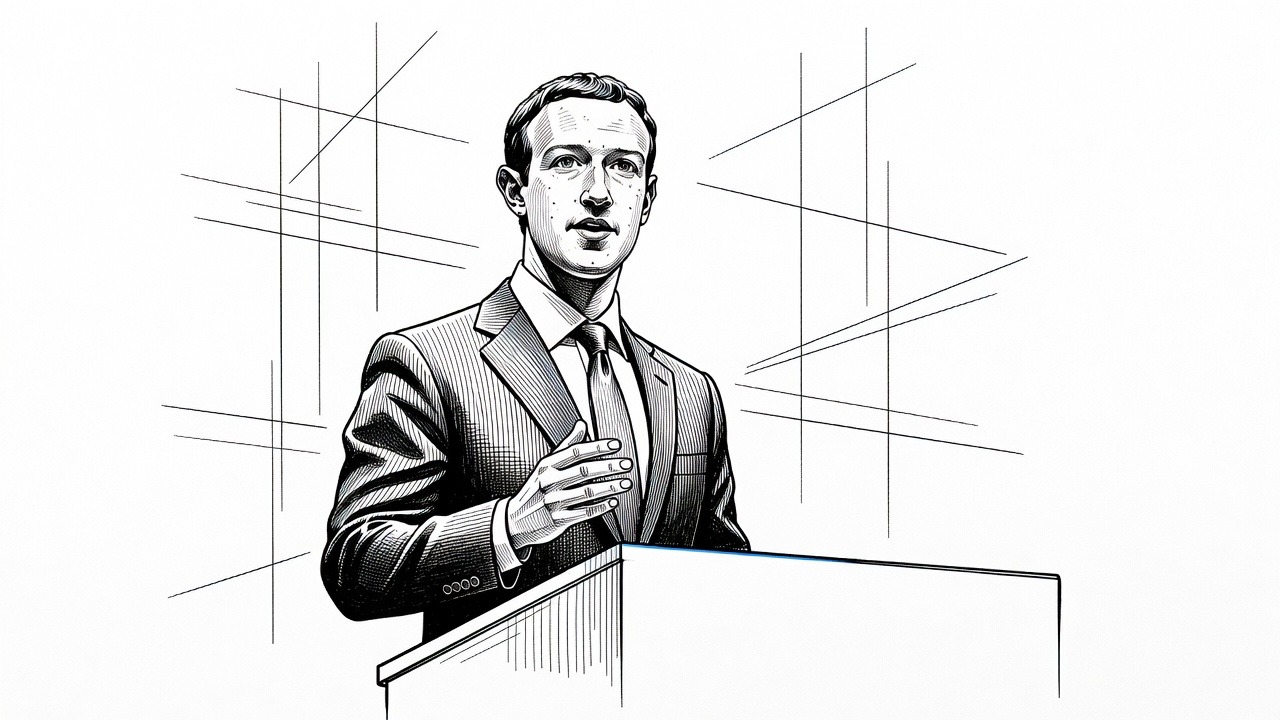
Meta made $64.6 billion in revenue last quarter, up 26%. By any ordinary standard, it is one of the greatest money machines in history. And it is now going to the public markets for $95 billion, because even that machine cannot keep pace with the company's appetite for data centers. Capital spending guidance of $135 billion to $145 billion this year is not a business plan so much as a wager of civilizational size, and Mark Zuckerberg wants you to cover part of the bet.
Notice the structure. The public is invited to supply the capital: pension funds, index funds, anyone with a 401(k) that tracks the S&P 500, which is nearly everyone with a retirement account. The public is not invited to supply direction. Zuckerberg's Class B shares give him majority voting control no matter how many new shares Wall Street absorbs. So $95 billion of other people's money will fund a "superintelligence" project whose goals, safeguards and timelines are set by one man who cannot be outvoted. Call it what you like, but it isn't capitalism's accountability story. It is a monarchy with an investor-relations department.
The market's reaction, a 1.6% pop, tells you everything about the moment. Investors reward the spending because they fear being left out, not because anyone has shown how Muse or any other AI agent produces returns commensurate with a quarter-trillion-dollar buildout. When the justification is that everyone else is doing it too, you are looking at the early architecture of a bubble. If it holds, the gains flow to the controlling shareholder and the engineers with equity. If it bursts, the losses flow to the retirement accounts, the suppliers, the construction towns and the communities left with half-used industrial sites.
Then there's the cost nobody lists in a market update. Data centers eat electricity at the scale of small cities. Utilities build generation and transmission to serve them, and regulators decide who pays. In several regions, grid operators have already seen capacity costs surge as data-center demand climbs. Meta's financing flexibility, with debt, equity and "partnerships" such as off-balance-sheet structures, lets it move fast. Ordinary ratepayers get no equivalent flexibility. Their bill is the bill. The danger is that a household in Louisiana or Ohio ends up subsidizing a chatbot company's growth through its monthly power statement, with no vote and no stake.
This is also the same company that has spent years telling workers and the public that belt-tightening is necessary. It has cut staff in waves, even as it plans to spend more than the GDP of many countries. Capital is abundant for compute. Patience for people is scarce.
None of this requires hostility to technology. AI may deliver real advances in medicine, science and productivity. But the Left should refuse the premise that private balance sheets alone get to decide how a technology this consequential is built, powered and governed. Democratic government has levers, and they are not exotic. Require large-load customers to pay the full cost of the grid capacity they trigger, so no household subsidizes them. Make energy, water and emissions disclosure mandatory and public. Attach binding community benefit and labor standards to local tax abatements. Revisit dual-class structures that let founders raise public capital while keeping unchecked control. Treat systemic concentration of AI financing as a financial-stability question, not just a tech story.
Meta is asking the public to trust it with $95 billion. Trust should be earned through governance, not purchased through a premarket stock bump. If the company wants the public's money, the public is entitled to a say in what it builds, what it burns, and who pays when the wager goes wrong.
How it may affect me
If you own a broad index fund or 401(k), you likely already hold Meta, and new share issuance means your savings are financing this buildout. If you live near a major data-center hub, ask your state utility commission how large-load customers are charged, because those rules help determine whether your electric bill absorbs grid-expansion costs.