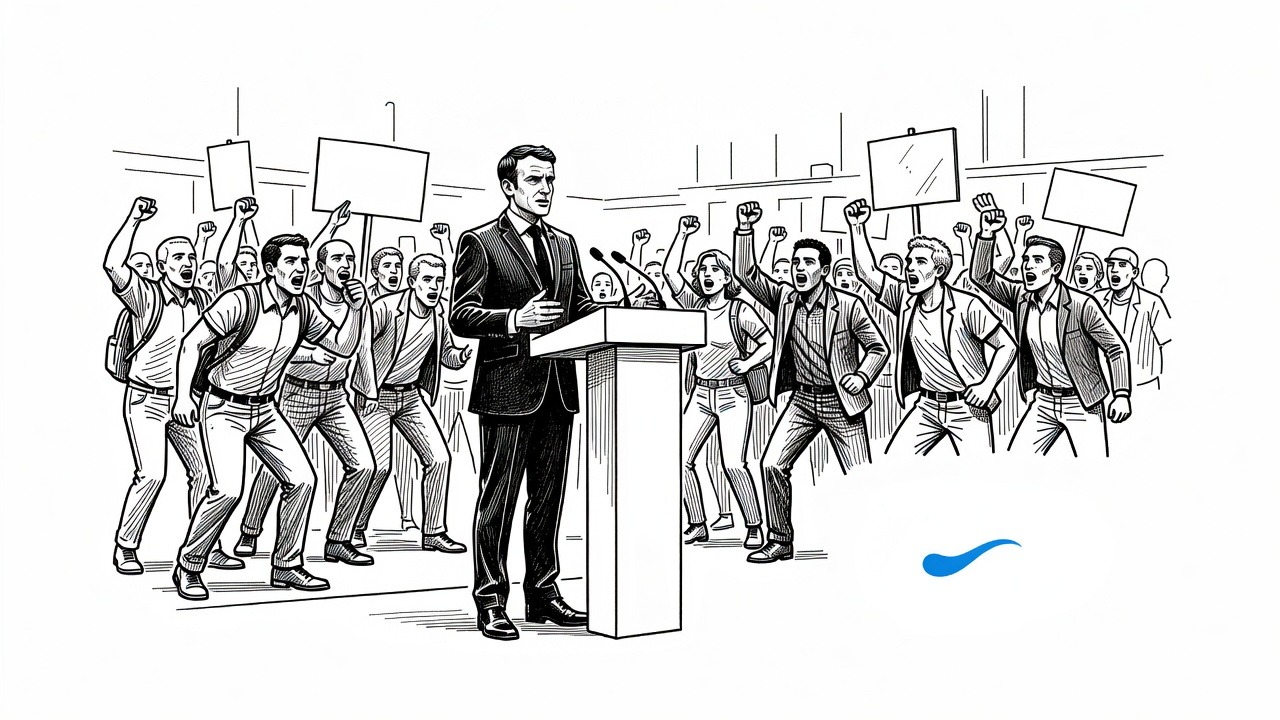
Emmanuel Macron says there will be no repeat of last weekend's violence. Fine. Nobody serious defends burning things. But look at what the sentence does. It makes the story about order, when the real question is why so many French people believe the only way to be heard is to blockade, strike and, in the worst moments, smash. A president who treats that as a policing problem has already misread it.
The same news cycle supplies the answer. The government wants to cut the deficit from 5.4% of GDP to 5%. Moody's keeps France at Aa3 with a negative outlook and says the outlook could stabilize if the deficit falls. Read between the lines: the ratings agency, the bond market and the Élysée all agree on the destination, and the only dispute is who pays. Once again the bill is aimed at those who can least avoid it, through frozen benefits, squeezed services and a retirement age raised to 64 by a government that bypassed a vote in the Assembly.
Then there is the figure the story gives us: more than 2,000 businesses directly affected by Tuesday's disruption. The chambers of commerce counted it promptly. Where is the equivalent count of households who cannot afford a good life on the wages they earn, of hospital shifts stretched thin, of towns where the train and the clinic are gone? Disruption is only measured when it inconveniences capital. The daily disruption of ordinary life never makes the ledger.
Moody's cites "political fragmentation" that could weaken legislative institutions. That is true, and it is Macron's doing. He dissolved the Assembly in 2024, saw the left-wing alliance come first, and then refused to give it a real chance to govern. He has spent two years running a country in which he has no majority, leaning on prime ministers who last months, and then he acts surprised that politics has fractured. You cannot override Parliament on pensions, ignore the election result, and then lecture the public about institutional stability.
And the fiscal hole did not fall from the sky. Since 2017 this presidency has abolished the broad wealth tax, introduced a flat tax on capital income, and cut corporate rates from 33% to 25%, all promised to unleash investment that would trickle down. The deficit now has to be closed, and the people asked to close it are not the beneficiaries. This is the fairness question, and it is not abstract. Polls have repeatedly shown large majorities in France backing a minimum tax on the very richest, including the proposal associated with economist Gabriel Zucman. The public is not irrational. It has done the arithmetic and noticed who got the gifts.
The Left should not be let off, either. Violence, even from a small minority, is a gift to a government that would rather talk about disorder than about distribution. Every smashed window rescues Macron from the argument he is losing. The unions and the parties behind them have a stronger weapon than rage: a credible, costed alternative, a coalition willing to defend it in the Assembly, and the discipline to take yes for an answer when a compromise improves workers' lives. Opposition that only says no is exactly what Macron wants to run against.
But the first duty belongs to the one holding power. If Macron wants calm, he can start by not demanding that people accept austerity to reassure Moody's while the richest are untouched. Stability is not something a government can order from the streets. It has to be earned with a budget that most people can recognize as fair. Until then, promising no repeat of last weekend is a promise he cannot keep.