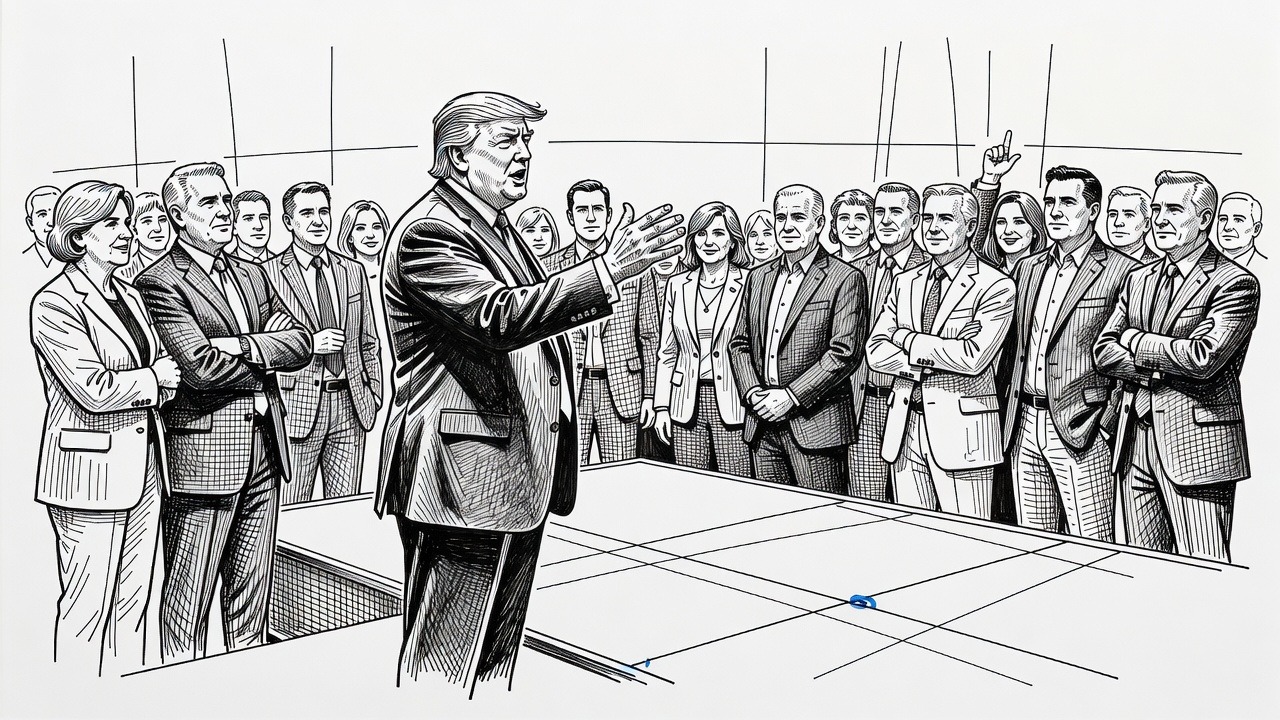
Rick Jackson wants Georgia voters to believe two things at once: that he is his own man, answerable only to the state, and that he deserves the enthusiasm of a president arriving Friday to rally the faithful on his behalf. You can't have both. The distance is the sales pitch. The rally is the delivery.
The pitch is easier to make when you have already spent more than $100 million on your own campaign. Money like that buys name recognition and airtime, and it buys the freedom to say "I'm independent" without having to answer to anyone. Jackson is not beholden to donors, so he tells voters he is beholden to no one. But a candidate who funds himself is accountable to no one, and that is the opposite of independence in any sense that matters to the people who will live under his budgets. Meanwhile, Jon Ossoff's $33 million in a single quarter reflects a very different, and more democratic, kind of fundraising. Georgia has two models of political power on offer this November, and they are not hard to tell apart.
Then there is the president's destination. Dalton is carpet country, a working-class corner of northwest Georgia where factories, supply chains and household budgets are exposed to precisely the economic decisions this administration keeps making: tariffs, volatile energy costs, and now a war with Iran. Voters there do not experience foreign policy as an abstraction. They experience it at the gas pump, in the cost of materials, and in the dread of having a son or daughter in uniform. Mike Collins has openly backed military action against Iran. He should have to explain, in Dalton, what that war is for, what it will cost, who will pay, and why Congress's role in starting it has been treated as optional.
The Republican answer is predictable: the economy is strong enough, the war is about strength, and Democrats are just running against Trump because they have nothing else. That last charge deserves a serious answer, because it has some force. Bottoms and Ossoff cannot win by saying "Trump" in a menacing voice. Voters who feel squeezed are not looking for a referendum on a personality. They want someone to say plainly what they would do about housing, health care premiums and wages in a state where too many people work hard and still cannot get ahead.
But the Republican answer also depends on pretending the president's record is separate from the candidates' choices. It is not. Collins chose to endorse the war. Jackson chose to accept the nomination of a party whose leader's policies he now prefers to talk around. When a candidate stresses his alignment with Brian Kemp, a governor who has spent years carefully managing his own relationship with Trump, he is not offering a different politics. He is offering the same politics with a calmer tone. Georgia voters should ask whether any of that tone would survive a call from the White House.
That is the real test for Georgia in this final stretch. Trump's visit is meant to turn out the base and remind everyone whose party this is. Democrats should take the invitation. Make Collins defend the war to families who would fight it. Make Jackson explain what independence means when his candidacy is bought with his own fortune and blessed from the stage by the president. And make Georgians a serious offer of their own on costs, care and dignity at work.
A rally is a performance of loyalty. An election is supposed to be a reckoning with consequences. Georgia deserves the second one.
How it may affect me
Georgia voters will decide both a Senate seat and the governorship on Nov. 3, and the outcome could shape state-level decisions on budgets, health care and economic policy, as well as Senate votes on war powers and tariffs. If you're registered in Georgia, check your polling place and early-voting options through the Secretary of State's My Voter Page.