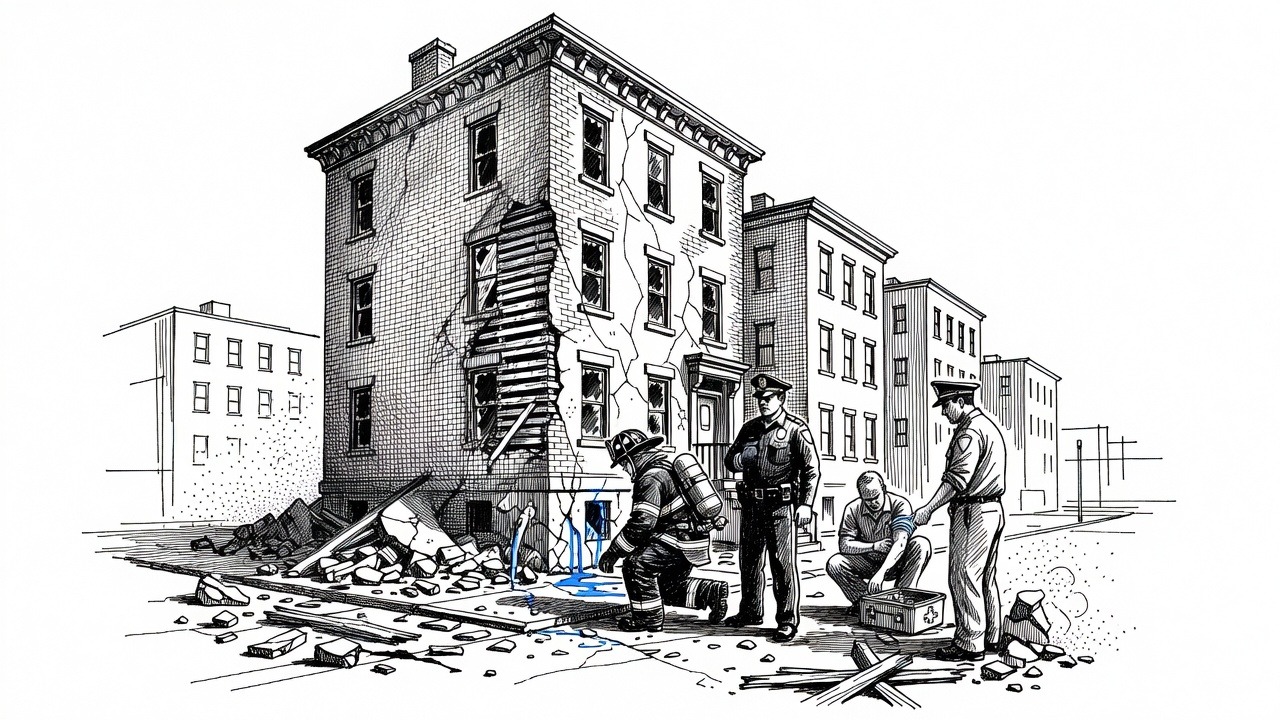
Read the headline closely and you find a small act of false balance. "Russian and Ukrainian strikes cause casualties." The body of the story says something different. In three days, Russian attacks killed more than 50 people in Ukraine. A guided bomb landed near passenger buses in Kramatorsk and killed 30. A missile hit an apartment building in Pryluky and killed 22. On the Russian side, the same period brought two dead in Belgorod, twelve wounded, and some disabled modules at a Yandex data center. Both sides are hitting each other, but the two sides are not suffering the same thing.
Notice who died. A bus stop is where people go when they have no car: the pensioner, the shift worker, the student. An apartment block is where ordinary people live. Modern air war is sold as precision, but its victims are overwhelmingly those who cannot buy their way out of range. In wartime Ukraine, safety is a class-inflected good. Some can relocate west or abroad. Those who stay, who run the clinics, drive the buses and keep the heating on, take the missiles.
That makes air defence the central public-goods question of this war, and it is being rationed by decisions made far from Kramatorsk. Western governments have spent three years haggling over interceptor stocks, delivery timelines and which weapons Ukraine may fire at what. They have been cautious about escalation, and the caution has been paid for in Ukrainian apartment blocks. Defence manufacturers meanwhile have been slow to expand production of the very systems that protect civilians, because capacity costs money and a guaranteed order book is a political choice. When a country asks for the means to shield its people and is told to wait, the waiting has a body count. The left, which spends so much energy insisting that states owe their citizens basic protection, should be loud about this one.
There is a tempting version of the anti-war position that treats the headline's symmetry as wisdom: everyone is bombing everyone, so everyone should stop. But Russia launched this war, and the invaded party cannot be asked to hand over the right to defend itself. Calling for peace while opposing the defensive means that might force one is not neutrality. It leaves the pressure on the victim. The internationalist left once understood this in Spain and Vietnam, and it should understand it in Ukraine.
None of this requires letting Ukraine off the hook. Moscow says it targets military sites; Kyiv says the same, and the Kramatorsk and Pryluky dead make a mockery of that claim for Russia. But the principle that civilians and civilian infrastructure are protected cannot be selective. A drone that takes out a data center, or a strike that kills residents of Belgorod, must meet the same test of distinction and proportionality as anything Russia does. A data center is a hard case: it can serve a military or a state and still carry the banking, shopping and messaging of millions of ordinary people. If we want Russian conduct judged by law, and we should, we forfeit authority by waving through our side's grey areas. Ukraine's strongest asset is moral clarity, and it should not be spent for marginal damage.
The volume matters too. Russia says it intercepted 505 Ukrainian drones in a single night. A war fought this way is increasingly a contest of mass production, and mass production is a contest about who can afford endurance. That is why the arithmetic of a handful of Western air-defence batteries versus hundreds of drones matters more than any single communiqué.
The true measure of this week is not the exchange of strikes but the gap between the two sets of numbers, and the choices in Washington, Berlin and Paris that help explain it.