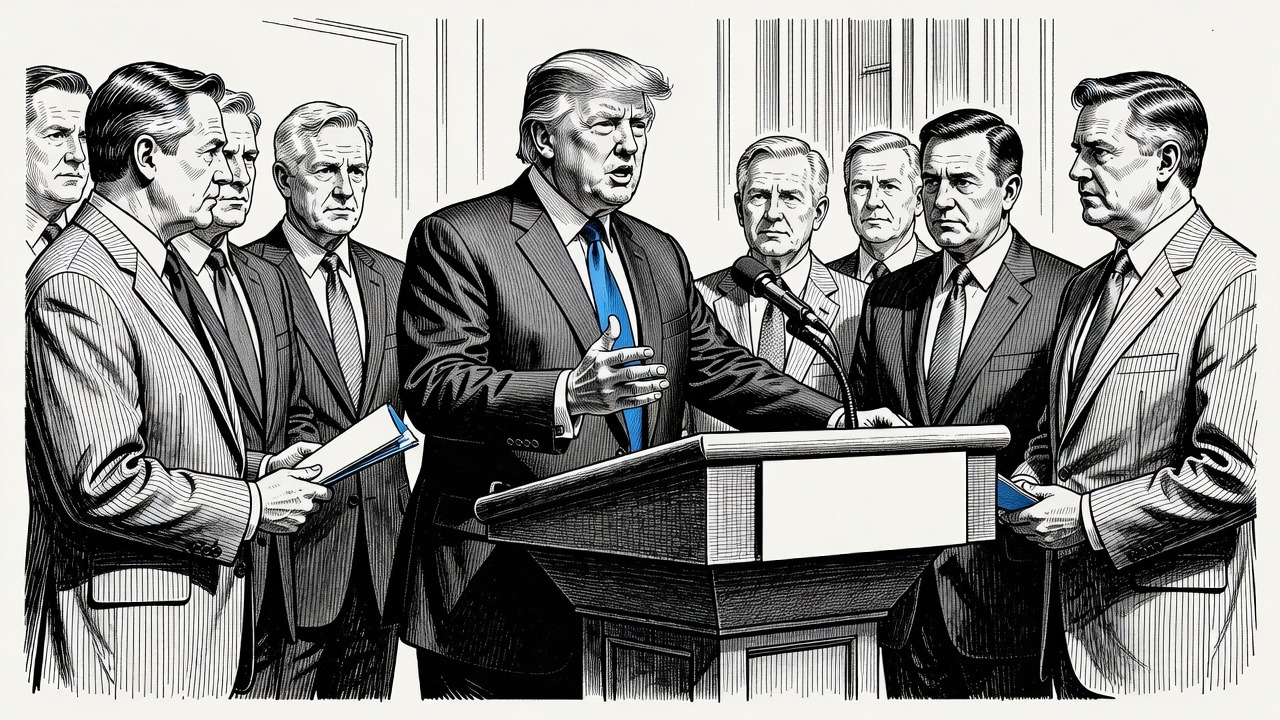
Nearly 70 million children are now said to hold Trump Accounts, and more than 60 million of them are there because the Treasury Department added them. The figure measures administrative reach. It does not measure a decision. Parents still have to verify their identity and accept the terms before they can manage the money. Until they do, the announcement is counting a default.
The idea under the default is better than the way it is being sold. A household that owns a share of productive enterprise really does stand in a different relation to the economy from a household that only receives from it. Compounding rewards waiting, and it ties a child's future to the country's capacity to create value rather than to the next appropriation. Michael and Susan Dell's pledge of $6.25 billion, aimed at children born from 2016 through 2024 in certain income-qualified ZIP codes, and Brad Gerstner's commitment in Indiana, belong to an older pattern: private wealth choosing to widen ownership. A free society should be glad when that happens, and wary of the reflex that treats a voluntary pledge as morally inferior to a federal line item.
Glad is not the same as convinced. Automatic enrollment has a real record in employer retirement plans, and the practical objection to opt-in design is not frivolous. Programs that wait to be chosen are used first by parents who already know what a brokerage account is. Inertia is real, and it falls hardest on families with the least time and the least financial slack. That is an argument for making a sound account easy to keep. It is not an argument for treating silence as participation. A 401(k) default captures wages a worker has already earned inside a job he already accepted. These accounts enroll minors, seed some of them with public money, and make the Treasury custodian before a parent has agreed. One use of a default attaches to a relationship the person chose. The other creates the relationship.
The design choice that should concern anyone who actually wants ownership is already in Treasury's temporary rules. The accounts may receive gifts of individual stocks, generally locked up for five years before sale, and the same regulations warn that those gifts can concentrate a child's portfolio. A program meant to spread ownership would have made a broad market holding the path of least resistance and treated a single-stock position as a choice a parent has to make deliberately. A donation window for individual shares does the opposite. Donors and their advisers will understand that rule more precisely than the households on the receiving end. Concentration risk is the predictable result of favoring the asset a donor already holds.
A second result follows from a complaint that happens to be fair. The $1,000 federal deposit for children born from 2025 through 2028 is not nothing. Left in a diversified market for the length of a childhood, it can become several times the original sum, which matters to a family with no other portfolio. It was never going to rebuild the distribution of American wealth. The charge that the seed is too small to close the gap this launch is being congratulated for addressing is also the door through which a bounded account becomes a standing entitlement. Annual deposits, scaled by income, routed through accounts that already exist for tens of millions of minors, will be an easier vote than building such a system from nothing. The enrollment figure will be produced as evidence that the public wants it. The public, so far, has mostly not been asked.
The useful conservative response is therefore neither applause for the headcount nor a sneer at the concept. It is a fence around the concept. Parental control once an account is claimed. A public contribution that stays capped unless Congress votes, in the open, to raise it. A diversified default, with single-stock gifts treated as the exception they are. Rules plain enough that claiming an account does not require an intermediary. And, if the thing is meant to last, a name dull enough to survive the president it currently advertises. An ownership program that must be renamed or defended whenever power changes hands is not an institution. It is a launch event attached to a custody arrangement.
What happens next is still open. Families may claim the accounts, add their own money, and leave the balance invested through the years when spending it would feel easiest. Or millions of unclaimed accounts may sit as a record of a press conference, while the ones families actually take in hand become a platform for whatever contribution schedule a future majority prefers. Capital ownership is a legitimate conservative aim. Automatic membership in a government program is not a substitute for it. The 70 million does not close that distance.
How it may affect me
If you have a child under 18, an automatic enrollment notice does not by itself give you control of the account. Managing it requires an application, identity verification, and acceptance of the terms, and that process should be started only through official Treasury or IRS channels. Do not send identity documents to unsolicited callers or lookalike sites; a rollout this large will attract impersonators. Children born from 2025 through 2028 may be eligible for a $1,000 federal opening deposit. Older children are not, though some may receive private money, including Dell contributions in certain income-qualified ZIP codes or other donor funds such as the Indiana commitment. Before accepting shares of a single company, read the general five-year holding rule and Treasury's warning on concentration risk, and favor a diversified default unless you understand the specific bet. Confirm contribution limits, tax treatment, fees, and the fate of an unclaimed balance with the program administrator rather than relying on the national enrollment figure.