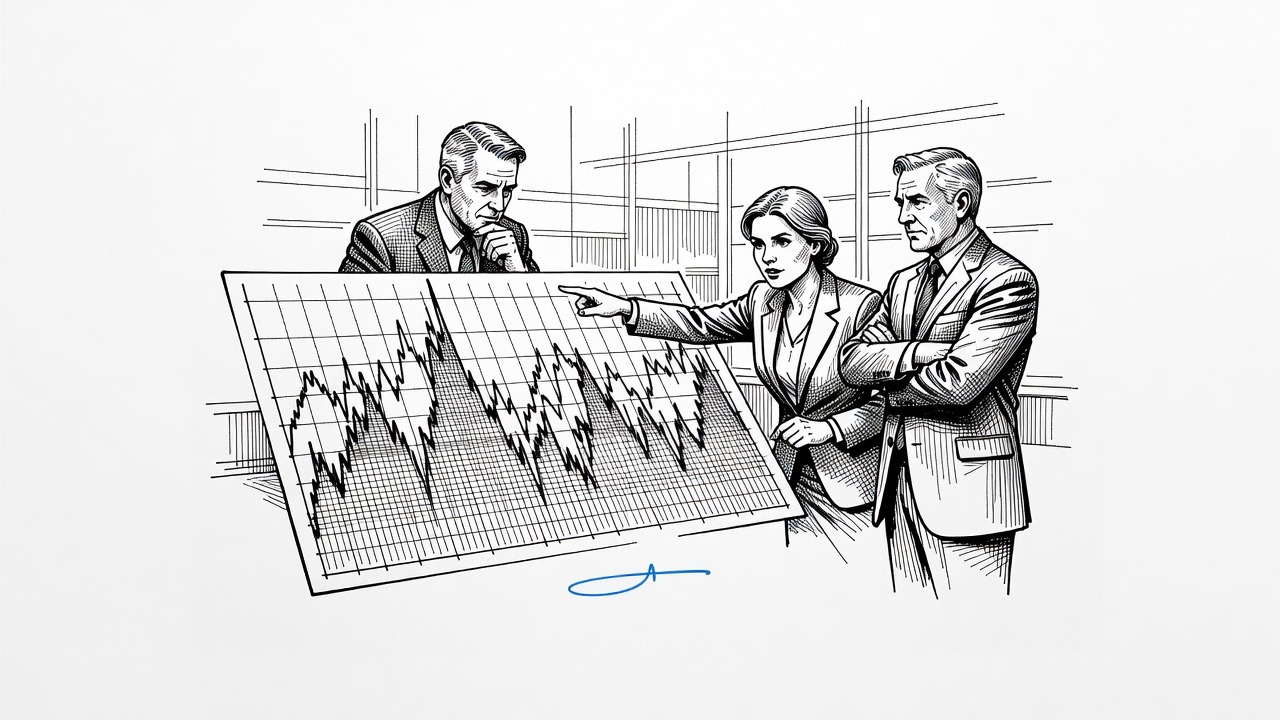
A record high is supposed to be the headline. The more revealing detail is the $44 million put spread, bought on the same day, that pays off only if the S&P 500 falls by more than 18%.
One trade is not a forecast, and I won't pretend otherwise. It could be a hedge by a large holder, a fund managing risk, or a bet that was simply cheap. SpotGamma's Brent Kochuba said as much: with the VIX under 15, March protection had become inexpensive. That is the interesting part. Insurance against a crash is cheapest when everyone feels safest, and the people who know this are the ones with enough capital to act on it. A buyer who can write a $44 million check for downside protection is not like the household whose retirement sits in an index fund and who has never heard of a put spread.
That is the asymmetry. At the top of this market, large investors can hedge. Ordinary savers mostly cannot. They hold the index and hope, and the index is increasingly a concentrated wager. The gains are led largely by AI-linked technology companies, and Shawn Snyder warns that breadth is weakening. A market that looks broad because it is labeled the S&P 500 is, in practice, leaning on a narrow group of firms. Anyone with a 401(k) target-date fund owns that bet whether or not they chose it. Sophisticated money can buy protection against it. Everyone else gets a statement once a quarter.
Snyder describes corporate profits holding up 'despite mixed economic conditions.' That phrase deserves more attention than the index level. A record stock market alongside a mixed economy is not a paradox. It is what an economy looks like when returns flow to owners of capital faster than to people who work for wages. Stock ownership in America is heavily concentrated at the top, so a rally like this is, first and foremost, good news for people who were already comfortable. The wealth effect is real, but it does not reach a renter or a hospital worker in any form they can spend.
The strongest counterargument is that markets are forward-looking, profits are real, and a hedge is evidence of prudence, not pessimism. Fair enough. Hedging is healthy. But look at who ultimately underwrites the system. When markets seize, as in 2008 and 2020, the public steps in through central banks and emergency programs, because a collapse would not stay on Wall Street. Private investors buy private insurance, but the final backstop is public and free. Gains are privately held, and the tail risk is socialized. If a sharp AI-driven correction ever came, nobody should be surprised if those who hedged are made whole by their puts while everyone else is told to wait it out.
There is also a question of what we are building. An economy where a single technology theme carries the market, where investment capital crowds toward one narrative, and where volatility is priced as if nothing could go wrong is fragile. A fragile economy lands hardest on those with the least cushion: workers whose jobs depend on the capital spending cycle, and pension and retirement savers with decades of savings in the same few stocks.
The lesson is not to panic or to time the market. It is to ask who is safe when the music stops. Right now, the people who can afford a $44 million insurance policy are asking that question much more seriously than the people whose savings depend on the answer. We should not need a billionaire's put spread to tell us that a market at 7,800 is more precarious than it looks. We should build the protections, such as stronger retirement security, less reliance on stock-market gains for basic needs, and a financial system where the public isn't the silent counterparty, before the cheap insurance runs out.
How it may affect me
For most households the record high changes little in daily life. Roughly the wealthiest tenth of Americans own most stocks, so the rally mostly enriches people who were already secure. For workers whose retirement depends on a 401(k) or pension tied to broad index funds, the risk is subtler. Their savings are increasingly exposed to a handful of AI-driven companies, while weakening market breadth suggests the strength is narrower than the headline implies. If an 18% or larger decline did occur, people near retirement would have the least time to recover, and they typically have no hedges. Large investors can buy insurance cheaply while volatility is low. Ordinary savers cannot. Over the longer term, if the AI boom falters, the consequences could spread beyond portfolios to jobs tied to investment spending and to pressure on public programs and pension funds. The practical stakes are whether retirement security is built on something sturdier than rising stock prices, and whether the public is again asked to backstop losses that began in private bets.