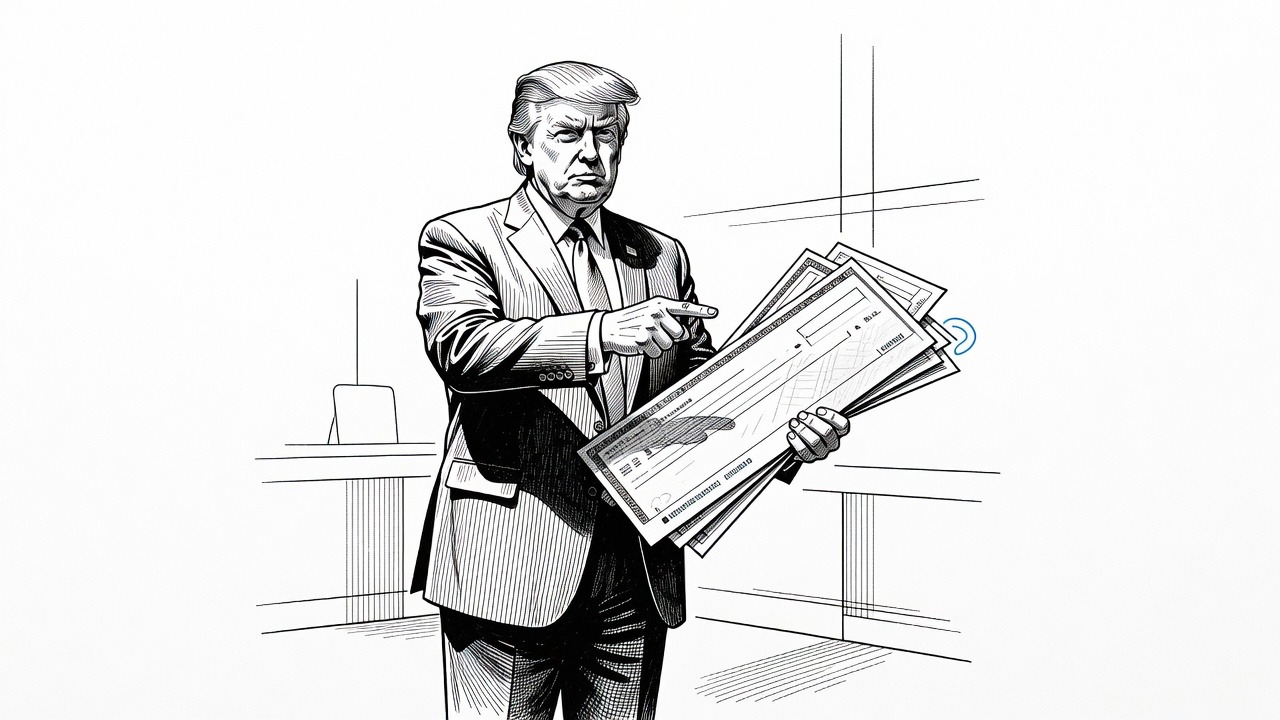
Start with a concession, because it makes the argument sharper. Progressives are not against sending people money. We argued for pandemic checks, for the expanded child tax credit, for the idea that a government able to rescue banks can rescue households. If the objection were that $90 is going to 20 million Medicare enrollees, it would be a bad objection.
The real problem is the form, the timing and the condition.
The form first. The administration says the Part B payments return overcharges. Take that at face value. If seniors were charged more than they should have been, they were owed that money whenever the error was found, and the refund should come with an explanation: who set the charge, why it was too high, and what stops it from happening again. Instead it arrives in early October, about a month before an election, as a gift with a political return address. An overcharge refund is a matter of accounting. A refund timed to the campaign calendar is marketing. Even if the money is legitimately owed, the timing tells voters it comes from a benefactor rather than a right.
Now the scale. Part B premiums run to roughly $200 a month, so $90 is less than half of one month's bill, delivered once. A one-time check does nothing about the price schedule that created the grievance. The $500 refund for about a million exchange enrollees who got no subsidy has the same structure. It is a rebate for people who are still paying full price in a system whose pricing has not changed. Checks are the cheapest way for a government to be seen helping without actually reorganizing who pays for care. A negotiated drug price or a lower premium schedule is a durable benefit that nobody gets to sign. A check can carry a signature and a photo op.
The condition is the most serious part. Trump's promised $5,000 for every adult comes with a clause: if Republicans keep Congress. Whatever one thinks of the policy, that sentence turns the Treasury into a loyalty program. The money is real, over $1 trillion by the estimate in the story, yet it is not pledged to any legislation, any appropriation, or any theory of what ails the country. It is pledged to an outcome. Whether Congress would ever authorize it is, tellingly, uncertain, and that may not matter much to its purpose. A promise only has to work until November 3.
This is also an honest warning for Democrats. If the party's answer is just that the checks are bribes, voters will hear that their rent and prescriptions are not worth discussing. People are not fools for wanting relief. The corrective is to show that the checks are a thin substitute for what government can do: set prices, cap out-of-pocket costs, and make benefits permanent enough that no one has to thank a politician for them. Senator Wyden is right that this is an attempt to influence voters. The stronger charge is that it works only if voters have learned to expect so little that a one-time envelope counts as generosity.
The measure of a social program is whether it lets you plan your life around it. A check you must be grateful for in October cannot do that. A guarantee that does not depend on who wins in November can. One party is selling the first and should be pressed to deliver the second.
How it may affect me
For Medicare and ACA enrollees, the immediate effect is modest but real: roughly $90 for Part B participants and $500 for the unsubsidized exchange enrollees the administration says will be covered. That helps a household for a month, not a year. Premiums, deductibles and the underlying pricing rules are unchanged, so the same costs return as soon as the checks are spent.
The longer-term risk is to expectations and trust. If benefits are routinely timed to elections and tied to partisan outcomes, people may come to see public programs as favors that can be withheld or granted for political reasons, not entitlements they have earned. The $5,000 promise carries a particular risk: if Congress does not authorize it, households that budgeted around it will be disappointed, and public faith in government commitments will erode further.
There is also a fiscal and opportunity cost. A trillion-dollar one-time payment would use up political and budgetary capacity that could otherwise go to lasting reductions in what people pay for care, which would help the same households every year instead of once.