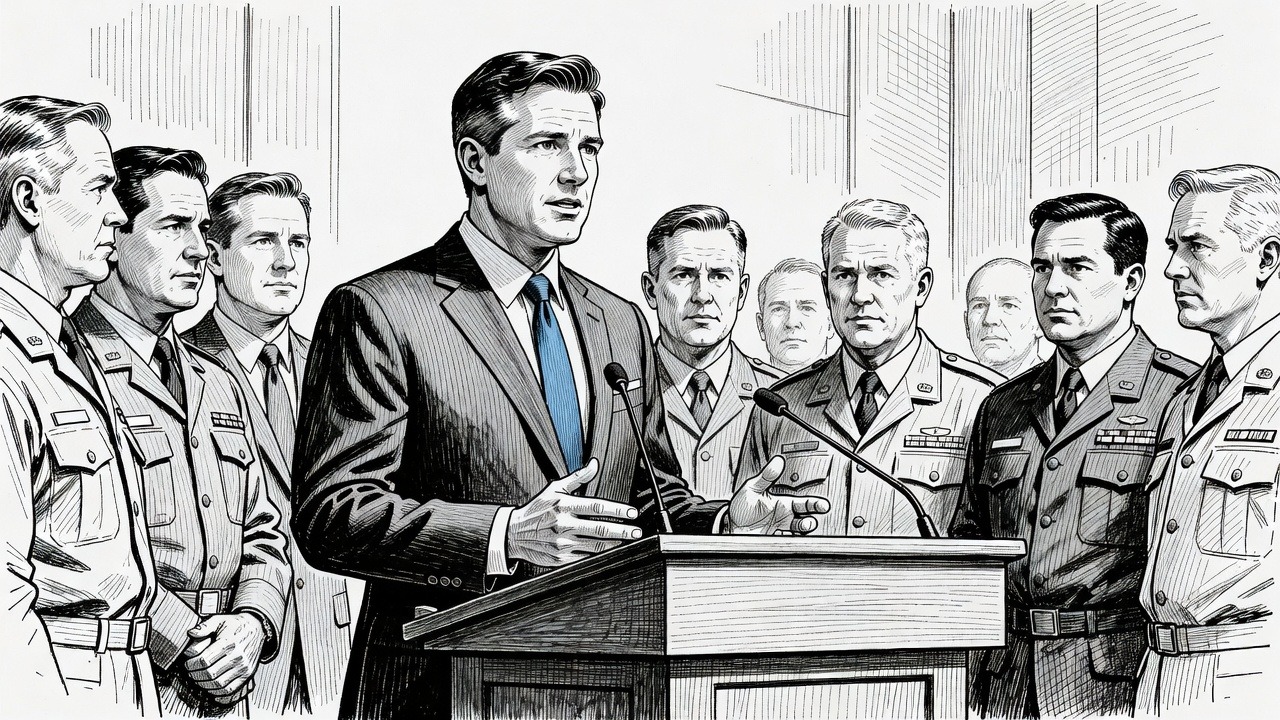
Defense Secretary Pete Hegseth is set to do something Washington rarely does to an institution it claims to revere: cut the top. A 20 percent reduction in general and admiral billets, following a 2025 directive that already required at least a 10 percent cut, is not an attack on the armed forces. It is a bet that a fighting military has been weighed down by its own headquarters.
Recent official counts put the active-duty general and admiral corps between 841 and 851 — a senior leadership class large enough to staff a small government of its own. The services have been told to finish reductions to senior ranks by January, and they have already started the unglamorous work: combining commands, lowering some command levels, and closing certain organizations. That is what flattening a bureaucracy actually looks like. It is slower and less cinematic than a speech, and more serious.
Hegseth’s case is straightforward. He has said that cutting what he considers redundant leadership posts and bureaucratic layers would improve operational effectiveness and innovation. Extra layers do not automatically make the force more lethal. They multiply signatures, dilute accountability, and reward process over initiative. A conservative who believes in a strong national defense should also believe the Pentagon is not exempt from institutional skepticism. Supporting the military does not require defending every flag office that accumulated over years of headquarters growth.
Senator Mark Kelly’s objection — that the plan would remove highly experienced military leaders — deserves a hearing, not a shrug. Experience is not nothing, and a badly aimed cut can strip out commanders the force actually needs. But experience and redundancy are not the same thing. A military can lose billets without losing its best judgment if the services are cutting layers rather than warfighting competence. The test is not whether a Democrat from Arizona dislikes the announcement. The test is whether the January reductions hit bureaucracy or hit capability. Hegseth has defined the target as the former. Implementation will show whether the Pentagon can tell the difference.
How it may affect me
For most Americans this will not change a commute or a household budget overnight. What it may change is how the force they rely on for national defense is organized. If combining commands and closing organizations actually removes redundant layers, decisions that now move through multiple headquarters could travel faster, and more of the military’s attention could sit with units that fight rather than staffs that coordinate. That is a possible gain in effectiveness, not a guaranteed one.
The risk runs the other way. If the 20 percent cut, which the services have been instructed to complete by January, sweeps up posts that still carry real operational responsibility, the force could lose experienced leadership faster than it replaces the function those officers performed. Readers who care about readiness should watch which organizations close and which command levels drop — not just the headline percentage.
There is also a political consequence. Kelly has already framed the plan as a loss of experienced leaders, so the Quantico announcement is unlikely to end the argument. Congressional resistance could slow, reshape, or second-guess the reductions. Ordinary citizens will not see a general’s office disappear. They may eventually see whether a leaner senior ranks corps produces a more accountable military — or whether the bureaucracy simply reappears under a different name.