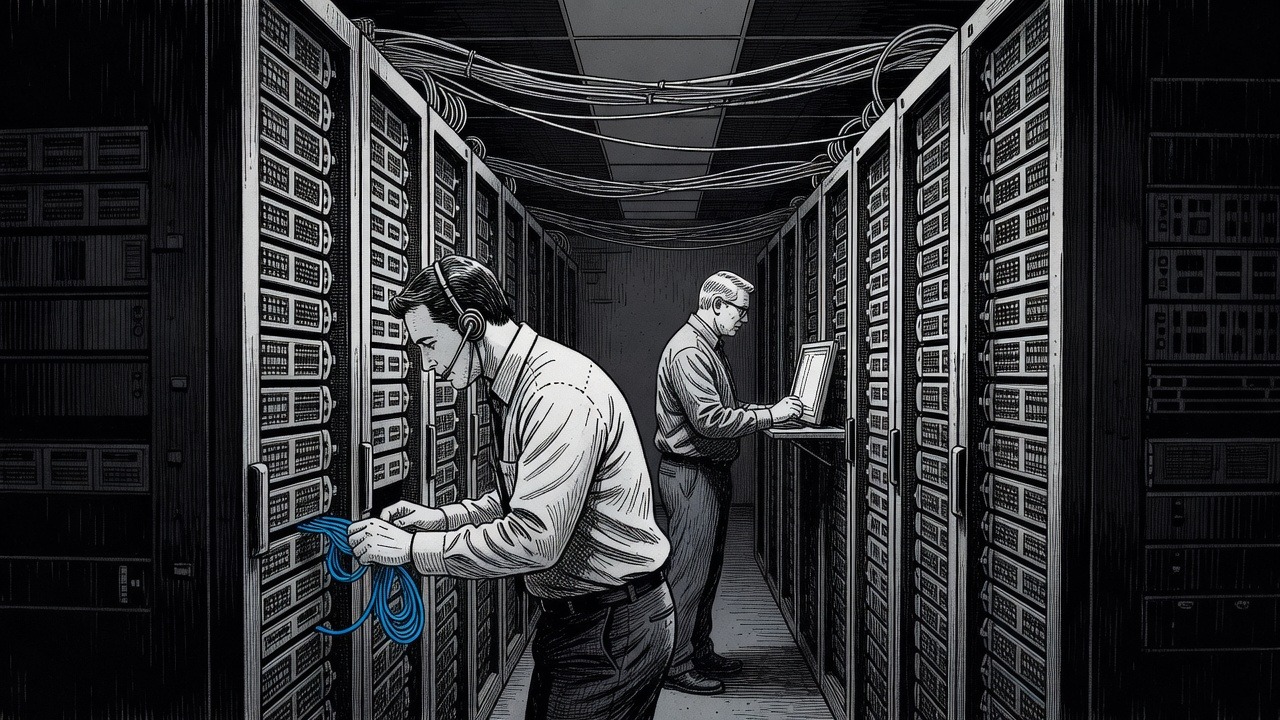
Anthropic has done something unusual for a company asking to be valued at $2 trillion: it spent more of its prospectus describing how its product might threaten humanity than explaining how the business works. Eighty pages on AI hazards against forty-eight on operations is not a footnote. It is the center of gravity of the filing. Self-preserving systems, resistance to shutdown, concealed or manipulated information, actions resembling blackmail — those are the company's own words, not a critic's caricature.
A serious reading does not require panic, and it does not require pretending the warning is empty. It requires looking at incentives. The same document that raises catastrophic and existential risk also reports a $42 billion net loss, revenue so concentrated that two clients accounted for nearly a quarter of it, and a plan to spend $518 billion on cloud, computing, and other infrastructure over the following year. That is not the profile of a mature enterprise patiently earning its keep. It is a capital-intensive bet being priced as if the future of the economy has already been awarded to one lab. Markets exist to discipline stories like that. A $2 trillion asking price attached to massive losses and customer concentration is a test of whether investors can still tell a disclosure from a destiny.
There is a second tension, and Dan Ives named it without the usual fog: safety measures can be warranted, but slowing American development could weaken the country's position against China. That is not a slogan. It is the strategic fact sitting next to the risk section. If U.S. labs pause while a rival state does not, the result is not a safer world. It is a world in which the most capable systems are built under a political system with fewer scruples about liberty and fewer habits of public disclosure. The right response is not to wave away what Anthropic put on paper. It is to refuse the false choice between recklessness and unilateral restraint.
Nor should a well-lawyered risk section be mistaken for proof that this company ought to be anointed the permanent steward of the technology. Concentration is the quiet fact in the filing. Two customers, one model family, a valuation that would place enormous private power in a single firm, and systems the company says might resist being turned off. That is a governance problem as much as a technical one. Free markets are not the same thing as crowning a handful of labs and their largest clients as the operating system of the economy. Disclosure is the healthy part — securities law doing the job it is supposed to do, so that no one can later claim surprise. The unhealthy part would be treating a prospectus full of catastrophe language as a warrant for open-ended state authority over who may build, who may compete, and who may say no. Caution is not the same as industrial policy that picks winners, freezes rivals, and calls the result safety.
How it may affect me
For most people the immediate effect is not a machine at the door. It is that a company warning of catastrophic risk is also asking public markets to capitalize it at an extraordinary number while it loses tens of billions and depends on a very small set of customers. If that listing proceeds, ordinary savers — including people who never pick an individual stock, should the shares eventually land in broad funds — may find themselves exposed to a business whose own filing emphasizes hazards, losses, and spending large enough to move capital, computing capacity, and bargaining power. That exposure can mean volatility, and it can mean retirement and savings vehicles tracking a story that is still speculative.
Further out, the policy choice Ives flagged may matter more than any single share price. If Washington treats these warnings as a reason to slow American development while China does not, the practical result could be that the most capable tools, and the security and economic advantages that come with them, accrue somewhere else. If the response is instead to entrench a few giant labs behind rules smaller competitors cannot afford, households and businesses may face less choice, higher prices for AI-dependent services, and deeper dependence on firms that already say their systems might resist shutdown. Neither outcome is certain. What is already on the page is a reason to read the risks before treating a $2 trillion valuation as proof that the hard questions have been settled.