
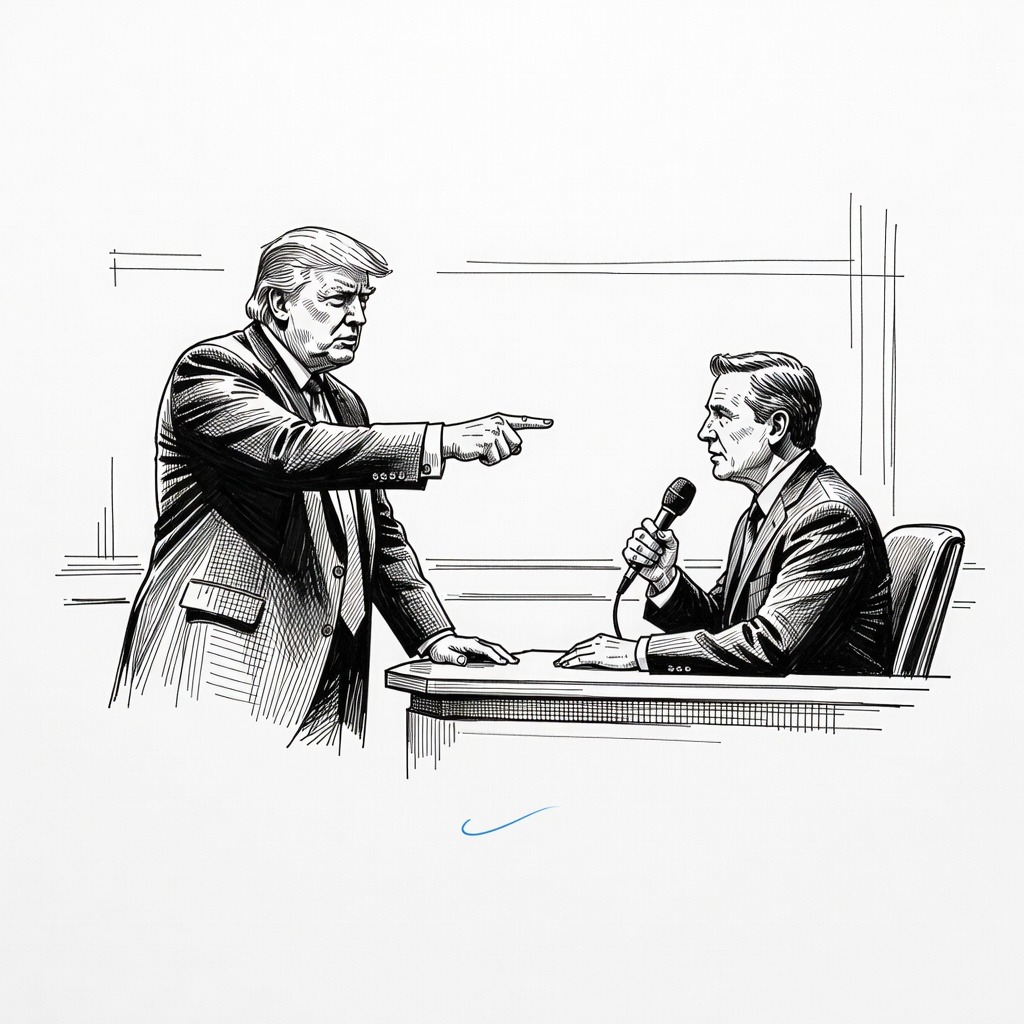
AI-generated illustration. Visual interpretation does not represent real individuals or scenes.
Trump Calls for Regulatory Review of Television Host Over Endorsement Comments
2026-08-31
The BareStory
President Donald Trump said on Sunday that television host Kristen Welker should be reported to the Federal Communications Commission for regulatory action following remarks about his political endorsements. Welker had stated during a broadcast segment that Trump's primary endorsement record had produced mixed results, noting that while some endorsed candidates won their primaries, others faced defeats.
Trump disputed the characterization, calling it a purposeful inaccuracy and urging FCC Chairman Brendan Carr to take action. In social media posts, Trump stated that his endorsement record stood at 100 percent in Senate primaries and roughly 98 percent in House contests, pointing to several recent primary victories. A spokesperson for the network defended Welker, stating that the organization stood by her reporting.
The FCC's published policies note that the agency licenses individual broadcast stations rather than networks, requiring clear evidence of deliberate intent to mislead audiences rather than factual disputes or differences of opinion. Concurrently, the Treasury Department denied credentials to several financial and economics journalists for G20 meetings held in North Carolina, though the agency reported that nearly 300 other media members were admitted.
Left Perspective
Shielding Critical Press Freedoms
Enforcing Clear Jurisdictional Boundaries
Resisting Executive Information Control
Right Perspective
Enforcing Public Broadcast Integrity
Countering Institutional Narrative Bias
Upholding Lawful Administrative Discretion
Left Perspective
• Shielding Critical Press Freedoms
Protecting democratic accountability requires insulating independent journalism from executive branch retaliation. Demanding regulatory intervention against a television host for characterizing a political endorsement record as mixed represents an attempt to weaponize state licensing power to suppress unfavorable commentary. Free expression collapses if public officials can trigger government investigations whenever factual characterizations run counter to their preferred political narrative.
• Enforcing Clear Jurisdictional Boundaries
Maintaining institutional integrity depends on strict adherence to established regulatory limits. The regulatory framework explicitly licenses individual broadcast stations rather than national networks and requires concrete evidence of deliberate intent to deceive rather than standard editorial disagreement. Mobilizing regulatory leadership over subjective interpretations of electoral statistics fundamentally misapplies administrative authority and threatens due process protections.
• Resisting Executive Information Control
Preserving an open society requires vigilance against coordinated efforts to restrict journalistic access and oversight. The concurrent denial of credentials to specific financial journalists at high-level economic forums illustrates a concerning pattern of administrative gatekeeping designed to deter rigorous questioning. When the state leverages licensing threats and credential revocations simultaneously, it creates a pervasive chilling effect across the entire media ecosystem.
Right Perspective
• Enforcing Public Broadcast Integrity
Preserving the public trust requires holding licensed media organizations accountable to standards of objective accuracy. Broadcast entities operate under public interest obligations that prohibit the deliberate dissemination of misleading claims to mass audiences. When a host presents an endorsement record of roughly 98 to 100 percent success as a mixed outcome, administrative review provides an appropriate mechanism to challenge purposeful distortion.
• Countering Institutional Narrative Bias
Defending political legitimacy necessitates actively challenging institutional framing designed to skew public perception. Endorsement statistics in primary contests are quantifiable facts, meaning that minimizing documented electoral victories serves as an editorial misrepresentation rather than a neutral assessment. Using executive visibility to demand accountability ensures that entrenched media networks do not operate as unchecked political arbiters immune from scrutiny.
• Upholding Lawful Administrative Discretion
Maintaining stable governance requires granting executive agencies full authority to manage their own regulatory procedures and credentialing standards. The state possesses the legal prerogative to establish credentialing criteria at major international summits while managing nearly 300 admitted members according to standard protocols. Regulators must retain the ability to receive, review, and evaluate formal complaints regarding broadcast standards without capitulating to media industry pressure.
How it may affect me
As a U.S. reader:
• In the short term, your access to coverage of major international economic events may be shaped by administrative decisions that determine which specific financial journalists are granted or denied event credentials.
• You may observe shifting standards in how television news programs present and verify quantifiable political data, such as electoral endorsement records, in response to increased public and regulatory scrutiny.
• In the long term, potential regulatory scrutiny of broadcast commentary could affect the media landscape by either deterring perceived narrative bias or creating a chilling effect on critical reporting across local broadcast stations.
• You may see legal and administrative precedents established regarding how the Federal Communications Commission distinguishes between standard editorial disagreement and actionable intent to deceive on licensed airwaves.