
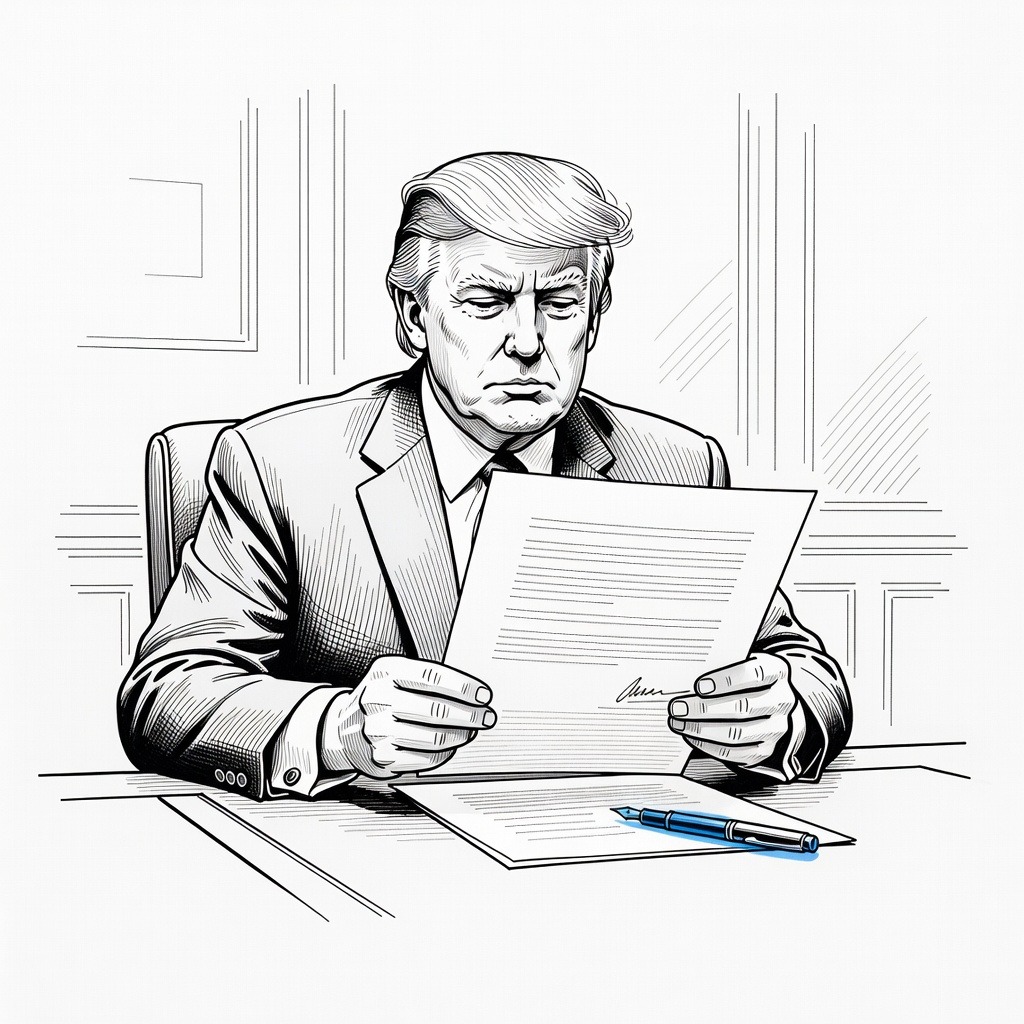
AI-generated illustration. Visual interpretation does not represent real individuals or scenes.
Trump Signs Order to Rename Lake Ontario Amid U.S.-Canada Trade Dispute
2026-08-30
The BareStory
President Donald Trump signed an executive order designating Lake Ontario as "Lake America," directing federal officials to update the nation's geographic records. The presidential action comes amid an escalating trade conflict between the United States and Canada, which saw bilateral negotiations collapse and the U.S. implement 50 percent tariffs on various Canadian imports.
Canadian officials and Indigenous leaders swiftly criticized the measure and called for the order to be rescinded. Canadian Prime Minister Mark Carney condemned the renaming and announced reciprocal tariffs on U.S. goods, while Ontario Premier Doug Ford stated that the lake would retain its traditional name. Seneca Nation President J. Conrad Seneca demanded the decision be reversed, stating that the name Ontario has Indigenous origins and asserting that the executive order violates the 1794 Canandaigua Treaty.
The move also drew varied domestic reactions within the United States. Several state governors opposed the executive order, and Representative Debbie Dingell announced plans to introduce federal legislation to overturn the renaming. Trump defended his administration's broader trade stance, accusing Canada of unfair economic practices, while citing his previous redesignation of the Gulf of Mexico to the Gulf of America.
Left Perspective
Uphold Binding Treaty Commitments
Check Unilateral Executive Overreach
Prevent Self-Defeating Economic Escalation
Right Perspective
Assert Decisive Strategic Leverage
Establish Coherent National Primacy
Deter Foreign Trade Imbalances
Left Perspective
• Uphold Binding Treaty Commitments
Preserving established legal agreements forms the foundation of stable governance and civil liberties. The unilateral renaming of Lake Ontario ignores historical compacts, specifically the 1794 Canandaigua Treaty cited by Seneca Nation President J. Conrad Seneca. Disregarding the Indigenous heritage and legal protections embedded in cross-border geography undermines the rule of law and damages relationships with sovereign tribal nations.
• Check Unilateral Executive Overreach
Democratic accountability requires legislative oversight and balanced federalism rather than expansive executive decrees. The swift domestic pushback from state governors and Representative Debbie Dingell’s proposed legislation highlights the necessity of restraining executive authority in geographic and cultural matters. Bypassing standard deliberative processes to force nationalistic renaming disrupts domestic consensus and risks setting an unstable precedent for federal governance.
• Prevent Self-Defeating Economic Escalation
Sustainable international commerce relies on diplomatic de-escalation and predictable rules rather than performative confrontation. The decision to combine symbolic redesignations with 50 percent tariffs directly triggered reciprocal penalties from Canadian Prime Minister Mark Carney, creating mutually damaging trade barriers. Fracturing alliances with critical trading partners destabilizes supply chains and harms working consumers who bear the burden of retaliatory economic measures.
Right Perspective
• Assert Decisive Strategic Leverage
Maximizing state power and national interests requires using every available administrative mechanism during high-stakes trade disputes. Rebranding the body of water to "Lake America" alongside a 50 percent tariff regime signals an uncompromising stance to force bilateral renegotiations after talks collapsed. By combining economic pressure with symbolic boundary assertions, the administration establishes a firm posture against foreign partners engaging in what it identifies as unfair economic practices.
• Establish Coherent National Primacy
Strengthening civic identity and national sovereignty justifies prioritizing domestic geographic designations over external or international status quos. Building upon the prior administrative redesignation of the Gulf of Mexico, this order treats geographic records as an expression of domestic priority and regional leadership. Asserting American jurisdiction across contiguous waterways reflects a broader mandate to prioritize national self-determination over international deference.
• Deter Foreign Trade Imbalances
Sustained economic stability depends on enforcing strict trade reciprocity rather than absorbing structural deficits. The strong response to Canadian counter-measures reflects a core doctrine that nations must firmly defend their economic boundaries to prevent exploitation. Maintaining a hardline stance ensures long-term industrial resilience by demonstrating that the nation will deploy federal authority aggressively to secure fair economic terms.
How it may affect me
As a U.S. reader:
• In the short term, you may experience higher costs on goods and disrupted supply chains resulting from 50 percent U.S. tariffs on Canadian imports and Canada's reciprocal tariffs.
• You will see federal agencies update national geographic records to the name Lake America, leading to conflicting designations as Canadian authorities and several U.S. state governors retain the name Lake Ontario.
• You may observe legal disputes concerning tribal relations and federal commitments, following claims by Indigenous leadership that the action violates the 1794 Canandaigua Treaty.
• You may see domestic legislative battles in Congress as federal lawmakers introduce bills attempting to overturn the presidential executive order.