
White House and News Network Clash Over Questions on Senator's Viral Comments

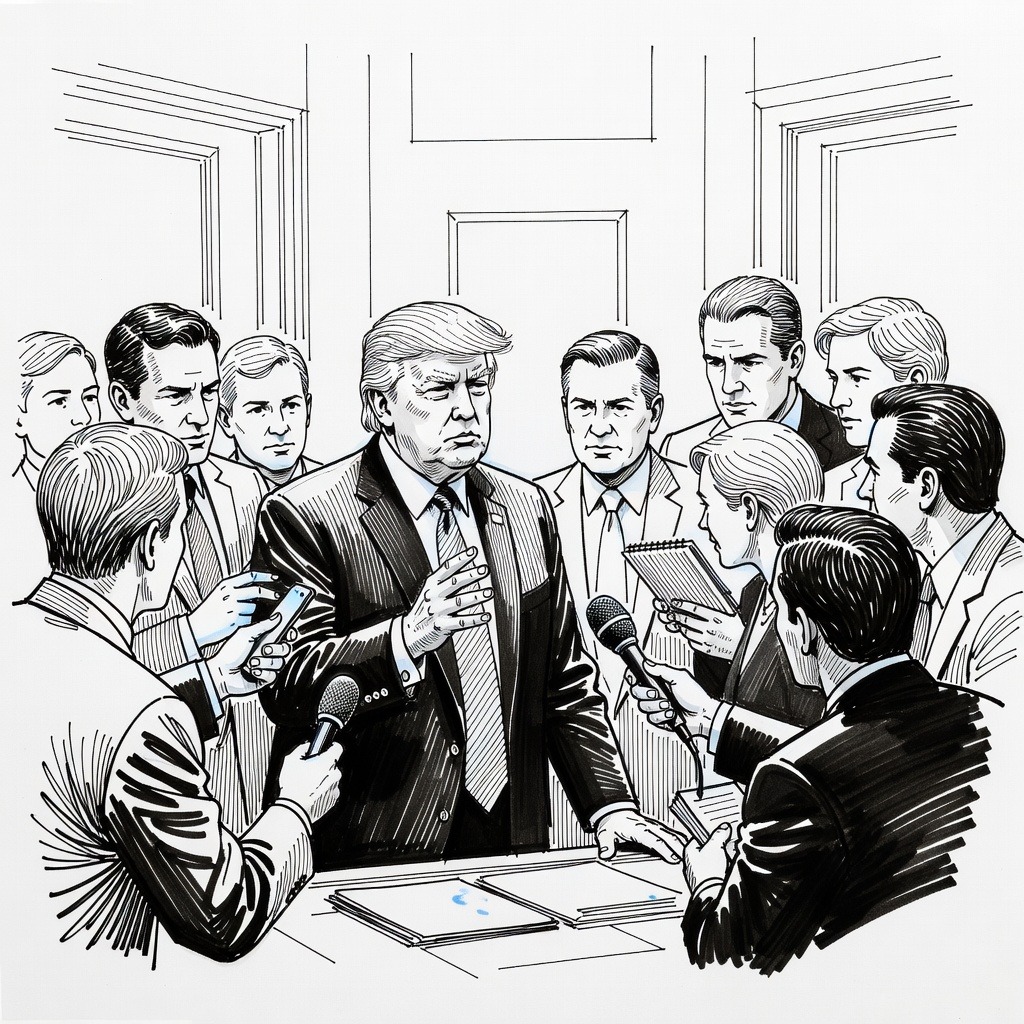
Illustration for: White House and News Network Clash Over Questions on Senator's Viral Comments
AI-generated illustration. Visual interpretation does not represent real individuals or scenes.

THE BARE STORY

A public dispute arose between the White House and a news network on Monday, August 17, 2026, after a correspondent was criticized by President Donald Trump and his rapid response team. During an Oval Office event honoring a teenage lifeguard and a boy rescued from the ocean, correspondent Kristen Holmes asked Trump to respond to viral comments made by Georgia Senator Jon Ossoff.

At a Sunday campaign rally, Ossoff had criticized Trump's travel habits and his executive assistant, Natalie Harp, claiming the president avoids his official duties. During Monday's Oval Office exchange, Trump compared the Democratic senator to the fictional character Pee Wee Herman. According to accounts of the event, the president also repeatedly told Holmes to be quiet and called her disrespectful, while a White House-run social media account called her an embarrassment to her profession and labeled her question callous and vindictive.

The correspondent's network released a statement standing behind Holmes, describing her as a highly respected journalist who was performing her duties. The network asserted that while public officials have the right to challenge reporting, personal attacks on journalists are beneath the office of the president. When asked for further comment, the White House declined to elaborate beyond its social media posts.

The incident occurred amid Ossoff's 2026 Senate reelection campaign in Georgia, where he faces Republican Representative Mike Collins. Public polling shows Ossoff leading in the battleground state, which Trump won by slightly over two percentage points in 2024. Ossoff's campaign has increasingly relied on digital advertising and highly coordinated, viral speeches to communicate with voters.

Same Facts. Different Perspectives.

Two AI models. Two viewpoints. One factual foundation.

• Shielding Civic Honor The primary value is preserving the dignity and focus of official state ceremonies. Injecting partisan campaign rhetoric into an Oval Office event designed to honor a heroic teenage lifeguard and a rescued boy is seen as a profound breach of professional decorum. The president's demand for quiet serves to protect the integrity of the civic honor being bestowed from being overshadowed by media sensationalism.

• Rejecting Media Provocation The value of a fair and objective public square requires calling out media tactics that prioritize conflict over substance. The correspondent's attempt to force a response to viral campaign rally comments about executive assistant Natalie Harp is viewed as a coordinated attempt to bait the executive. Labeling the question "callous and vindictive" is a necessary defense against a press corps that frequently acts as an adversarial political actor rather than an objective observer.

• Defeating Coordinated Narratives The value of democratic sovereignty means that elected leaders must resist media-facilitated campaigns designed to influence key elections. Because Ossoff's 2026 Georgia reelection strategy relies heavily on digital ads and viral speeches to maintain a lead, the news network's inquiry is seen as an attempt to amplify opposition campaign talking points. Refusing to engage with the question neutralizes a biased narrative and protects the integrity of the political contest against Republican Mike Collins.

How it may affect me

As a U.S. reader:

• Georgia voters preparing for the 2026 Senate election may experience a surge in contrasting campaign advertisements and viral messaging from candidates Jon Ossoff and Mike Collins.

• In the short term, the public may encounter highly polarized news coverage regarding whether White House press interactions represent necessary democratic scrutiny or a breach of professional decorum.

• In the long term, continued hostility between the executive branch and news networks could alter the public's access to direct, unscripted presidential responses during official events.

Read the story at

Note: All TheBareNews content is AI-generated. For additional context, reporting, and updates, you are invited to explore the news outlets linked above.