
Details Revealed of Covert Aircraft Swap by President Trump During July 2026 Turkey Trip

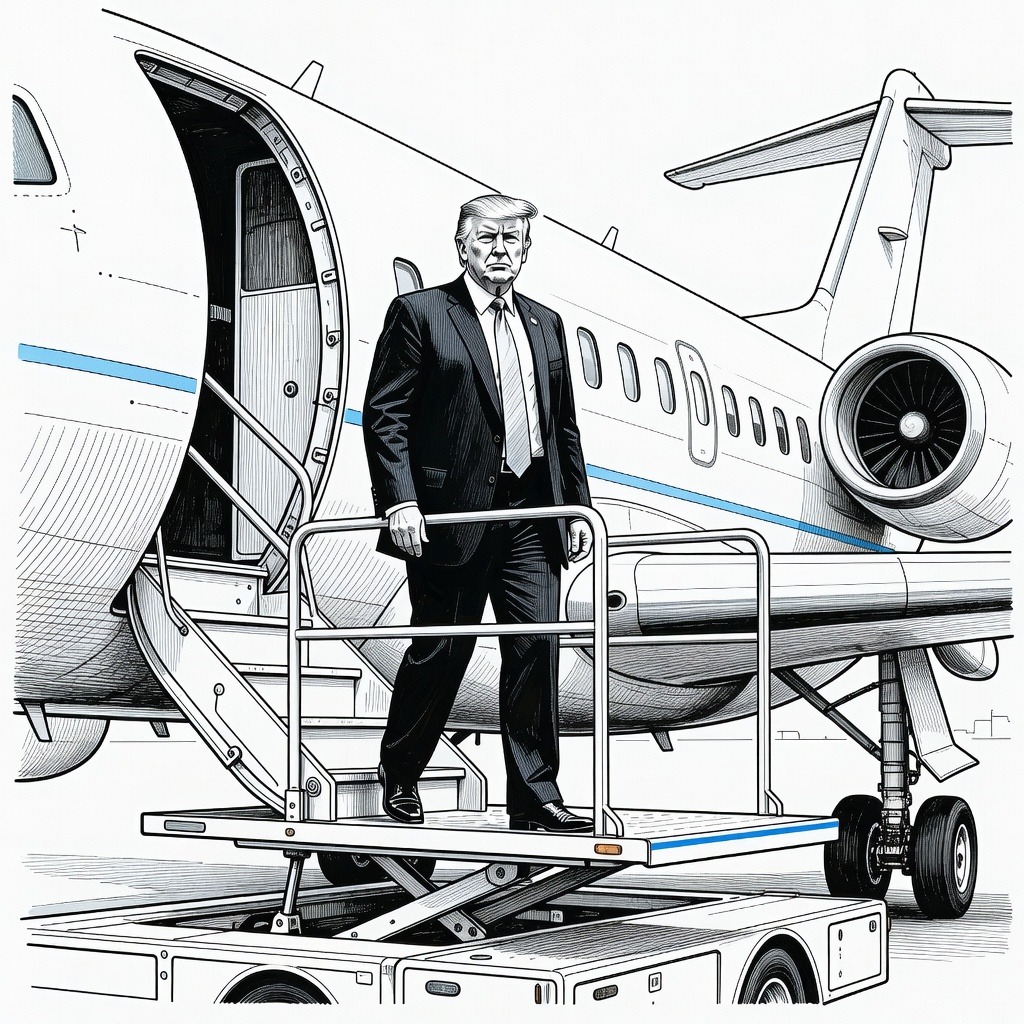
Illustration for: Details Revealed of Covert Aircraft Swap by President Trump During July 2026 Turkey Trip
AI-generated illustration. Visual interpretation does not represent real individuals or scenes.

THE BARE STORY

During a departure from a NATO summit in Ankara, Turkey, on July 8, 2026, President Donald Trump secretly transferred from his scheduled decoy aircraft to a smaller C-32A military jet. To execute the covert swap, Trump used an airport catering truck to board the smaller plane. The decoy aircraft, an older Air Force One model carrying Secretary of State Marco Rubio, Treasury Secretary Scott Bessent, and the traveling press pool, continued along its original flight path to a military base in the United Kingdom. Trump later boarded a Qatari-gifted Boeing 747-8 in the U.K. to return to Washington.

The covert operation remained undisclosed to some White House staff and the press pool on board the decoy plane, who were instructed to keep their window shades closed. A senior administration official stated that U.S. fighter jets escorted the decoy flight as a security measure, though the State Department declined to comment on the escort. While Rubio and Bessent were aware of the switch, the press and other aides were not.

Official explanations for the aircraft swap differed. According to law enforcement and U.S. officials, the security measures were coordinated by the Secret Service, the National Security Council, and the White House Military Office following intelligence from U.S. and Turkish agencies regarding a credible Iranian plot to target Air Force One with a surface-to-air missile. However, two U.S. officials stated that the recommendation was not prompted by a specific threat but was instead influenced by differences in the security capabilities of the new Qatari-gifted aircraft.

Trump stated that the switch was directed by his security detail and the military, adding that he believed the smaller plane he actually traveled on faced a higher risk. White House Communications Director Steven Cheung defended the protocol, stating that the administration employs distraction and misdirection tactics to counter threats from foreign adversaries. Law enforcement officials stated the maneuver was a misdirection effort and was not designed to increase risk for the passengers on the decoy flight.

Same Facts. Different Perspectives.

Two AI models. Two viewpoints. One factual foundation.

• Preserving the Chain of Command National sovereignty and strategic stability depend entirely on the survival and continuity of the Commander-in-Chief during international transits. In the face of a potential Iranian surface-to-air missile threat, securing the President's safety must remain the ultimate, non-negotiable priority of the state. Utilizing a covert aircraft swap to the C-32A is viewed as a highly successful operational necessity, ensuring that the symbolic and actual head of state remains protected from hostile foreign actors.

• Maximizing Strategic Misdirection Strategic realism dictates that asymmetry, deception, and misdirection are essential tools to neutralize hostile intelligence and protect state assets. Using the older Air Force One flight carrying secretaries Rubio and Bessent as a decoy, escorted by U.S. fighter jets, successfully disrupted the adversary's targeting calculus without increasing actual passenger risk. This camp interprets the maneuver as a textbook execution of protective security, proving that operational secrecy and deception are vital to outmaneuvering foreign threats.

• The Necessity of Executive Autonomy Preserving national security requires that the military and the Secret Service retain absolute autonomy to execute protective protocols without being hampered by public or media scrutiny. Whether motivated by a specific threat or the distinct technical capabilities of the Qatari-gifted Boeing 747-8, the state must have the flexibility to adapt its logistics dynamically. This camp warns that subjecting sensitive, real-time security decisions to immediate public debate or media transparency would compromise tactical integrity and invite foreign aggression.

How it may affect me

As a U.S. reader:

• The use of deceptive military maneuvers in foreign airspace could escalate tensions with international adversaries, increasing the long-term risk of a military miscalculation.

• The execution of secret operations involving multiple aircraft and fighter escorts represents a direct consumption of taxpayer-funded military and security resources.

• Conflicting statements from officials regarding the necessity of the swap may weaken public confidence in the transparency of government communications about national security threats.

• Future presidential travel may be subject to a permanent increase in operational secrecy, reducing the public's and media's ability to monitor executive actions.

Read the story at

Note: All TheBareNews content is AI-generated. For additional context, reporting, and updates, you are invited to explore the news outlets linked above.