
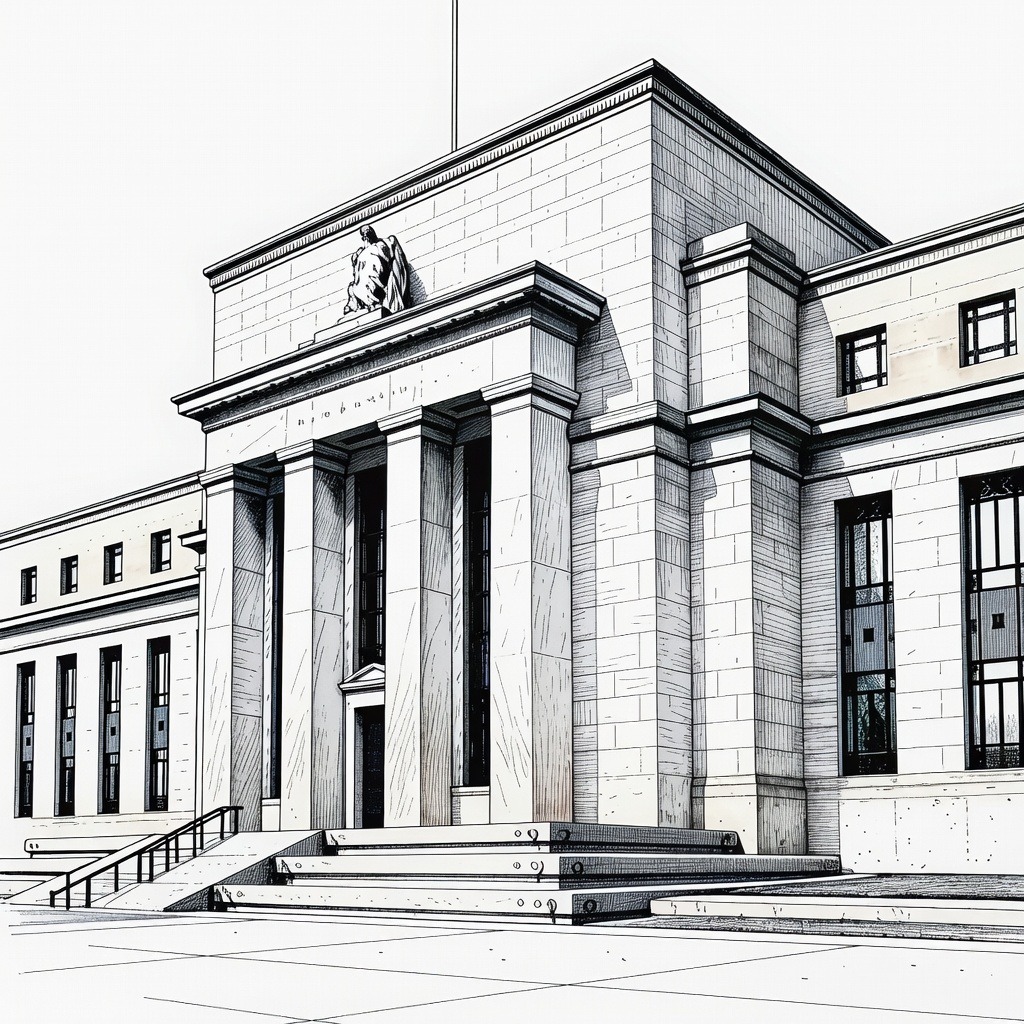
AI-generated illustration. Visual interpretation does not represent real individuals or scenes.
Federal Reserve Holds Interest Rates Steady as Analysts Assess Market Impact and Saver Strategies
2026-07-30
The BareStory
The Federal Reserve's Federal Open Market Committee voted 9–3 on Wednesday, July 29, 2026, to maintain its benchmark interest rate at 3.5% to 3.75%. Led by Chairman Kevin Warsh in his second committee meeting, the decision signals that borrowing costs are expected to remain elevated for the foreseeable future.
During a post-meeting press conference, Warsh declined to detail specific economic conditions that would trigger future rate hikes, stating he prefers to end forward guidance to preserve policy flexibility. He noted that while inflation has exceeded the Fed's 2% target for at least 63 months, June's 0.4% decline in consumer prices was not a primary factor in the decision. Following the announcement, the 30-year Treasury yield climbed to its highest point since 2007, while the 2-year yield declined. Some analysts expressed concern over the central bank's communication; Fed watcher Jon Hilsenrath claimed Warsh did not clearly convey his stance to the bond market, and economist Michael Feroli claimed the chairman's remarks raised doubts about his commitment to reducing inflation.
Meanwhile, financial analysts highlighted opportunities for savers looking to capitalize on the sustained high interest rates. According to senior managing editor Matt Richardson, individuals with larger savings, such as $50,000, can utilize a six-month certificate of deposit (CD) to secure a guaranteed return of approximately $1,000. Richardson calculated that top interest rates between 4.00% and 4.15% would yield returns ranging from $990.20 to $1,026.95 upon maturity, though he cautioned that withdrawing funds early could trigger penalties that eliminate any earned interest.
Left Perspective
Squeezing Working-Class Borrowers' Budgets
Locking Out Low-Income Savers
Shielding Policymakers from Public Accountability
Right Perspective
Anchoring Systemic Price Stability
Reclaiming Strategic Policy Nimbleness
Rewarding Capital Formation and Discipline
Left Perspective
• Squeezing Working-Class Borrowers' Budgets
The decision to maintain elevated borrowing rates at 3.5% to 3.75% functions as an extraction mechanism that disproportionately burdens ordinary consumers over wealthy asset holders. While the affluent can leverage high interest rates to extract guaranteed yields, working-class families face prolonged, expensive debt burdens on credit cards, mortgages, and auto loans. Sustaining these high rates despite a 0.4% decline in June's consumer prices prioritizes institutional control over immediate financial relief for everyday citizens.
• Locking Out Low-Income Savers
Financial strategies capitalizing on these sustained interest rates highlight systemic inequalities, as achieving meaningful returns requires a substantial capital threshold of $50,000. For households struggling with high living costs, locking up such significant liquidity in a six-month CD is an unattainable luxury, particularly when early withdrawal penalties risk erasing all earned interest in an emergency. This dynamic turns public monetary policy into an exclusive wealth-generation engine for the highly liquid, while leaving cash-poor consumers with declining purchasing power.
• Shielding Policymakers from Public Accountability
Chairman Kevin Warsh’s decision to end forward guidance and obscure the specific economic conditions that would trigger future rate hikes undermines democratic transparency. By refusing to clarify his policy stance to the public and bond markets, the Fed insulates itself from scrutiny while inflation remains above the 2% target for 63 months. This lack of clear communication creates market uncertainty that ultimately harms regular consumers, who are left unable to plan their financial futures against an unpredictable and uncommunicative central banking authority.
Right Perspective
• Anchoring Systemic Price Stability
Maintaining the benchmark interest rate at 3.5% to 3.75% is a necessary measure of fiscal discipline to anchor long-term price stability after 63 months of inflation exceeding the 2% target. From this perspective, a single month's 0.4% decline in consumer prices is insufficient evidence of a structural correction, requiring the central bank to resist premature rate cuts that could reignite inflationary pressures. Prioritizing systemic stability over short-term market gratification prevents the compounding devaluing of currency, protecting the foundational integrity of the broader economy.
• Reclaiming Strategic Policy Nimbleness
Eliminating rigid forward guidance is a vital structural pivot that restores the Federal Reserve's operational flexibility in an unpredictable economic landscape. While market commentators and bond analysts criticize the lack of explicit forward communication, committing to pre-announced pathways limits the central bank's capacity to react swiftly to real-time macroeconomic shifts. By maintaining a highly adaptable posture, the Fed can respond dynamically to emerging threats without being cornered by market expectations or speculative bond-market reactions.
• Rewarding Capital Formation and Discipline
Elevated yields, exemplified by the 30-year Treasury rate hitting its highest mark since 2007 and short-term CD rates reaching 4.15%, serve as crucial mechanisms to incentivize domestic saving and capital accumulation. By offering guaranteed, risk-free returns—such as over $1,000 on a $50,000 deposit—monetary policy rewards fiscal prudence and encourages non-speculative wealth preservation. This environment stabilizes the banking sector by securing longer-term deposits, channeling capital back into productive, stable financial instruments that underpin overall economic health.
How it may affect me
As a U.S. reader:
• You will face prolonged and expensive borrowing costs for credit cards, mortgages, and auto loans as the benchmark interest rate remains elevated between 3.5% and 3.75%.
• If you have substantial cash reserves, such as 50,000 dollars, you can secure short-term guaranteed returns of approximately 1,000 dollars through six-month certificates of deposit, though early withdrawals will trigger penalties.
• If you are a lower-income or cash-poor consumer, you may be locked out of these high-yield savings opportunities and face declining purchasing power because you cannot afford to lock up large sums of money.
• You may find it more difficult to plan your financial future due to increased market uncertainty caused by the Federal Reserve ending forward guidance on future interest rate changes.
• In the long term, you may experience more stable consumer prices as the sustained high rates are intended to anchor price stability and prevent currency devaluation.