
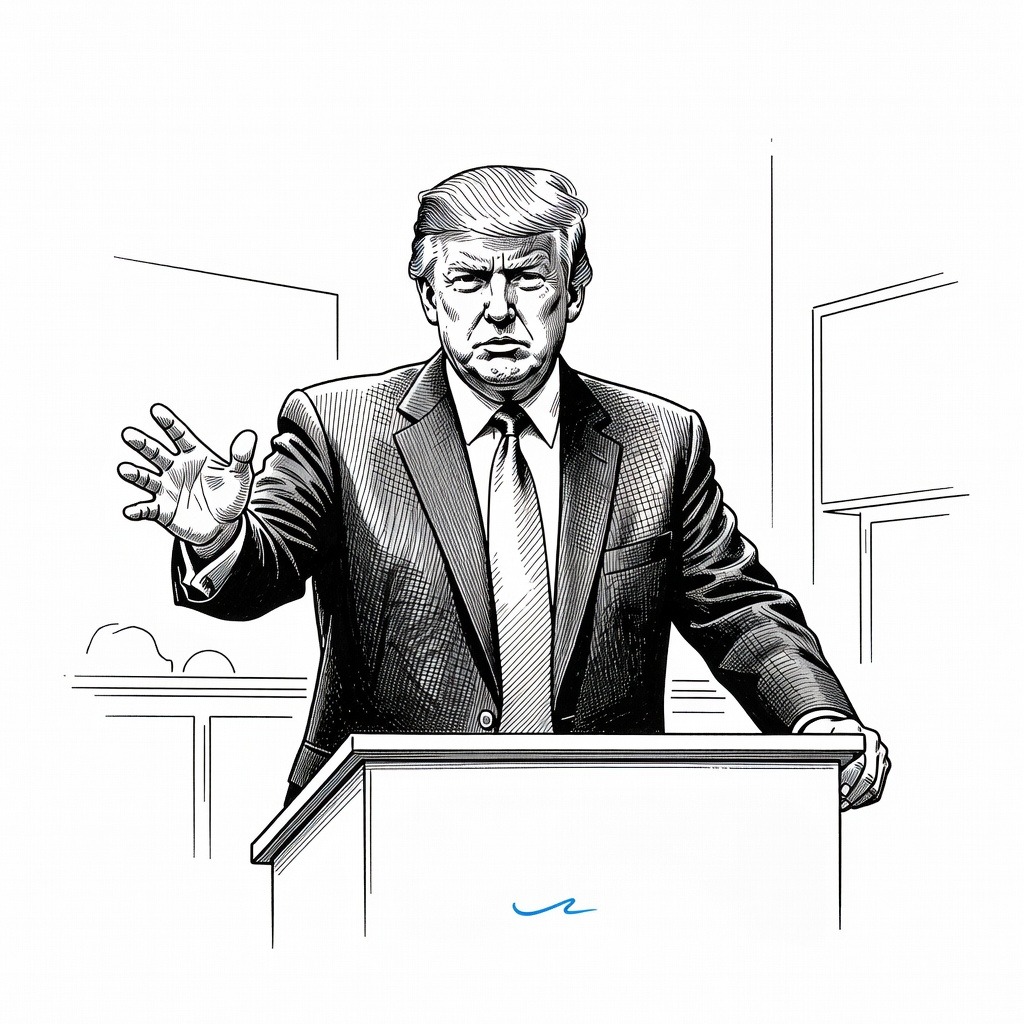
Illustration for: Trump Threatens Tariffs as Canadian Wildfire Smoke Prompts U.S. Air Quality Alerts
AI-generated illustration. Visual interpretation does not represent real individuals or scenes.

Trump Threatens Tariffs as Canadian Wildfire Smoke Prompts U.S. Air Quality Alerts

2026-07-18

The BareStory

Smoke from active Canadian wildfires has drifted across the eastern United States, covering a dozen states and reducing air quality to dangerous levels in major cities, including Chicago, New York, and Washington, D.C. According to government agencies, millions of Americans have been advised to remain indoors due to health risks from fine particulate matter, which health experts warn can lead to asthma, heart attacks, and other long-term illnesses.

President Donald Trump announced on Friday that the United States will add the estimated financial damages of the air pollution to Canada's existing tariffs, accusing the Canadian government of willful negligence regarding forest and brush maintenance. Trump stated on Truth Social that the pollution has cost the U.S. billions of dollars and said he planned to speak with Canadian Prime Minister Mark Carney. Ohio Senator Bernie Moreno also pledged to propose sanctions and visa restrictions against Canadian officials, while some Michigan legislators called for direct U.S. intervention in cross-border fuel reduction.

In response, Canadian officials pointed to the country's long-term partnership with the U.S. in combatting wildfires, a cooperation that was also acknowledged by U.S. Ambassador to Canada Pete Hoekstra. Prime Minister Carney stated earlier in the week that the fires have intensified rapidly, particularly in Northwestern Ontario, forcing thousands of residents to evacuate.

U.S. Environmental Protection Agency Administrator Lee Zeldin stated that the wildfires are causing significant harm across the U.S. and noted that the agency is urging Canadian leadership to quickly extinguish the blazes. While U.S. officials blamed Canadian forest management practices, scientists and environmental advocates stated that the active wildfire season, which includes nearly 900 fires in Canada and over 150 in the U.S., is driven by a North American heat wave and climate change.

Left Perspective

  • Shield Public Health First: Protecting human lives and vulnerable populations from environmental degradation must be the primary metric of successful governance. When millions of Americans in major cities like Chicago and New York face hazardous fine particulate matter, the state's urgent duty is to mitigate this immediate health crisis. Framing a shared ecological disaster as a hostile act ignores the scientific reality of climate change and fails to protect citizens from systemic environmental risks.
  • Unify Through Global Cooperation: Resolving transboundary crises requires deep diplomatic partnership and collective action rather than unilateral economic retaliation. Pointing to the long-term joint wildfire combat efforts recognized by Ambassador Pete Hoekstra shows that bilateral resource sharing is the only practical way to manage large-scale disasters. Punishing a partner state during an active emergency—where thousands of Canadians are also fleeing evacuations—destroys the trust needed to solve shared global challenges.
  • Target the Root Driver: Addressing the systemic threat of climate change is the only viable path to long-term regional stability and safety. Scientists and environmental advocates point out that the 900 active fires in Canada and 150 in the U.S. are fueled by a broader North American heat wave, not simple administrative failure. Shifting the blame to local forest management practices is a dangerous diversion that delays the necessary transition away from fossil fuels and guarantees more severe future crises.

Right Perspective

  • Enforce State-Level Accountability: National sovereignty dictates that governments must be held financially and legally responsible for the external harms their internal failures cause to neighboring states. When Canadian negligence in forest and brush maintenance allows toxic smoke to cross borders and inflict billions of dollars in economic damages on the U.S., leveraging tariffs is a legitimate tool of statecraft. Using economic leverage, as proposed by President Trump, ensures that foreign governments internalize the costs of their policy failures.
  • Deter Foreign Administrative Neglect: Projecting strength and imposing tangible consequences is the most effective way to compel foreign leaders to prioritize basic management duties. Proposing sanctions, visa restrictions, and direct fuel-reduction interventions—as championed by Senator Bernie Moreno and Michigan legislators—signals that passive governance will no longer be tolerated at America's expense. Without strong economic and political pressure, neighboring countries have little incentive to invest in the costly infrastructure needed to prevent cross-border disasters.
  • Defend Domestic Economic Interests: Protecting American commerce and taxpayers from subsidizing foreign negligence is a fundamental duty of the state. The Environmental Protection Agency's recognition of significant domestic harm justifies taking a hardline stance to force Canadian Prime Minister Mark Carney's administration to act swiftly. Relying on vague international treaties or climate theories does nothing to recoup the tangible billions lost in productivity, healthcare costs, and economic disruption caused by the drifting pollution.

How it may affect me

As a U.S. reader:

• In the short term, you may face immediate health risks from dangerous fine particulate matter drifting across a dozen states, requiring you to stay indoors to avoid potential asthma, heart attacks, and other illnesses.

• If you live in major cities like Chicago, New York, or Washington, D.C., you will experience reduced air quality and potential disruptions to your daily activities and local productivity due to the drifting Canadian wildfire smoke.

• In the long term, you could see increased costs for goods and services if the U.S. government adds wildfire damages to existing Canadian tariffs, potentially leading to broader economic friction between the two trading partners.

• You may experience changes in cross-border travel or policy if proposed sanctions, visa restrictions against Canadian officials, or direct U.S. fuel-reduction interventions are enacted by lawmakers.

Read the story at