
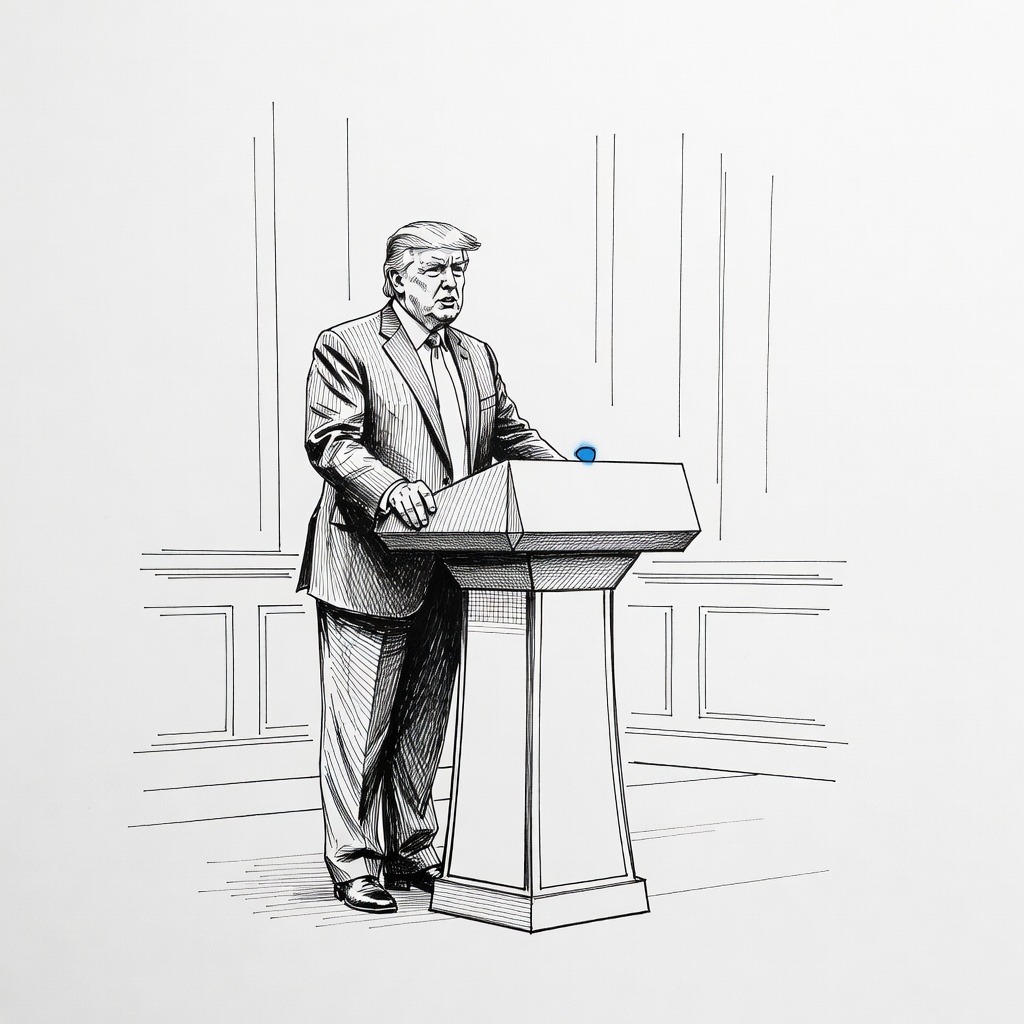
Illustration for: China rejects Trump's election interference allegations following White House address
AI-generated illustration. Visual interpretation does not represent real individuals or scenes.

China rejects Trump's election interference allegations following White House address

2026-07-17

The BareStory

During a White House address on Thursday night, President Donald Trump raised concerns over election security and accused foreign nations, including China, of interfering in the U.S. election process. Trump alleged that China conducted a major compromise of election data by acquiring 220 million U.S. voter files starting during the 2020 election cycle, and he claimed the intelligence community had hidden Chinese meddling. Following the speech, the White House released declassified documents concerning China's acquisition of American voter data, electronic voting systems, and state voter rolls.

China’s Foreign Ministry spokesperson Lin Jian rejected the allegations on Friday, calling them entirely fabricated, groundless accusations designed to vilify China. Lin stated that Beijing has never interfered in U.S. elections and has no interest in doing so, urging Washington to refrain from making China an issue in its elections. When asked if the dispute would affect Chinese President Xi Jinping's scheduled visit to the United States in September, Lin did not answer directly but urged the U.S. to take actions that support bilateral relations.

During his 25-minute address, Trump also warned of election involvement from Russia, Iran, and North Korea, and he cautioned domestic election officials that the 2026 midterm elections would face close scrutiny. He used the speech to advocate for the SAVE America Act, a stalled Senate bill that would mandate photo identification and proof of citizenship for federal elections while restricting mail voting.

The president's address drew criticism from political opponents. Democratic Senator Mark Warner accused broadcasters of presenting disputed election claims as news without sufficient journalistic pushback. Fact-checking reports subsequently challenged Trump's assertions, citing past federal bulletins which stated that obtaining voter-registration data did not affect voting or election results.

Left Perspective

  • Dismantling Democratic Norms: Protecting democratic legitimacy and civil rights requires defending the integrity of the electoral process from unverified claims. Opponents see the administration's allegations and the promotion of the stalled SAVE America Act as a partisan effort to restrict voting access through strict identification laws and mail-in voting limits. By framing standard voter registration data access as a "major compromise," the administration risks undermining public trust in domestic democratic systems without proof of actual vote manipulation.
  • Weaponizing Intelligence for Politics: Safeguarding the independence of federal agencies and maintaining media accountability is vital for a healthy democracy. The administration’s claims that the intelligence community hid foreign meddling, paired with the public release of declassified documents, are viewed as an attempt to politicize national security agencies. The lack of immediate journalistic pushback during the broadcast, as highlighted by critics, allows unverified assertions to bypass the rigorous scrutiny necessary to prevent public disinformation.
  • Deflecting Domestic Policy Failures: Prioritizing diplomatic de-escalation and international cooperation is crucial for global stability and resolving complex transnational issues. Escalating tensions with China over voter data—which past federal bulletins note has no impact on actual election results—is interpreted as a strategic distraction from domestic policy challenges. Accusing Beijing of interference right before a scheduled high-level diplomatic visit risks alienating a key global partner and scuttling productive bilateral engagement on trade and security.

Right Perspective

  • Securing the Sovereign Border: Securing the nation's critical infrastructure and electoral systems from foreign adversaries is the fundamental duty of the federal government. The acquisition of 220 million U.S. voter files by a hostile foreign power represents a severe national security vulnerability that demands immediate public exposure and policy action. Promoting the SAVE America Act is a logical and necessary defense to fortify the system by requiring proof of citizenship and photo identification to ensure only legal citizens participate.
  • Exposing Hostile Foreign Influence: Maintaining national sovereignty requires confronting foreign adversaries who seek to destabilize domestic institutions. Rejecting China's denials of interference is essential, as revisionist powers routinely use deniability to mask cyber espionage and data harvesting campaigns. By declassifying intelligence documents regarding China’s access to electronic voting systems and voter rolls, the administration establishes a posture of strategic deterrence, signaling that hostile actions in the cyber domain will no longer be tolerated or kept hidden.
  • Enforcing Accountability and Transparency: Preserving long-term systemic stability requires challenging institutional complacency within the bureaucracy. Accusing elements of the intelligence community of downplaying foreign meddling is a necessary critique to force accountability and ensure agencies prioritize national defense over political comfort. Unless the vulnerability of state voter rolls is aggressively addressed before the 2026 midterms, the nation faces the ongoing risk of covert foreign manipulation and weakened public confidence in its sovereign institutions.

How it may affect me

As a U.S. reader:

• You may experience changes in how you vote in future federal elections, such as the 2026 midterms, if proposed measures like the SAVE America Act are passed to mandate photo identification, require proof of citizenship, and restrict mail-in voting.

• Your confidence in the security of your personal information may be affected by the declassification of documents showing that foreign entities acquired 220 million domestic voter files, state voter rolls, and electronic voting system data, though federal bulletins note this data acquisition has not altered election results.

• You may observe increased political polarization and debate surrounding the credibility of national intelligence agencies and media broadcasters, driven by conflicting claims over whether foreign election meddling was intentionally hidden or if security threats are being politicized.

• You could see a shift in international relations and trade stability with China, potentially affecting the outcomes of the scheduled high-level diplomatic visit by Chinese President Xi Jinping in September.

Read the story at