
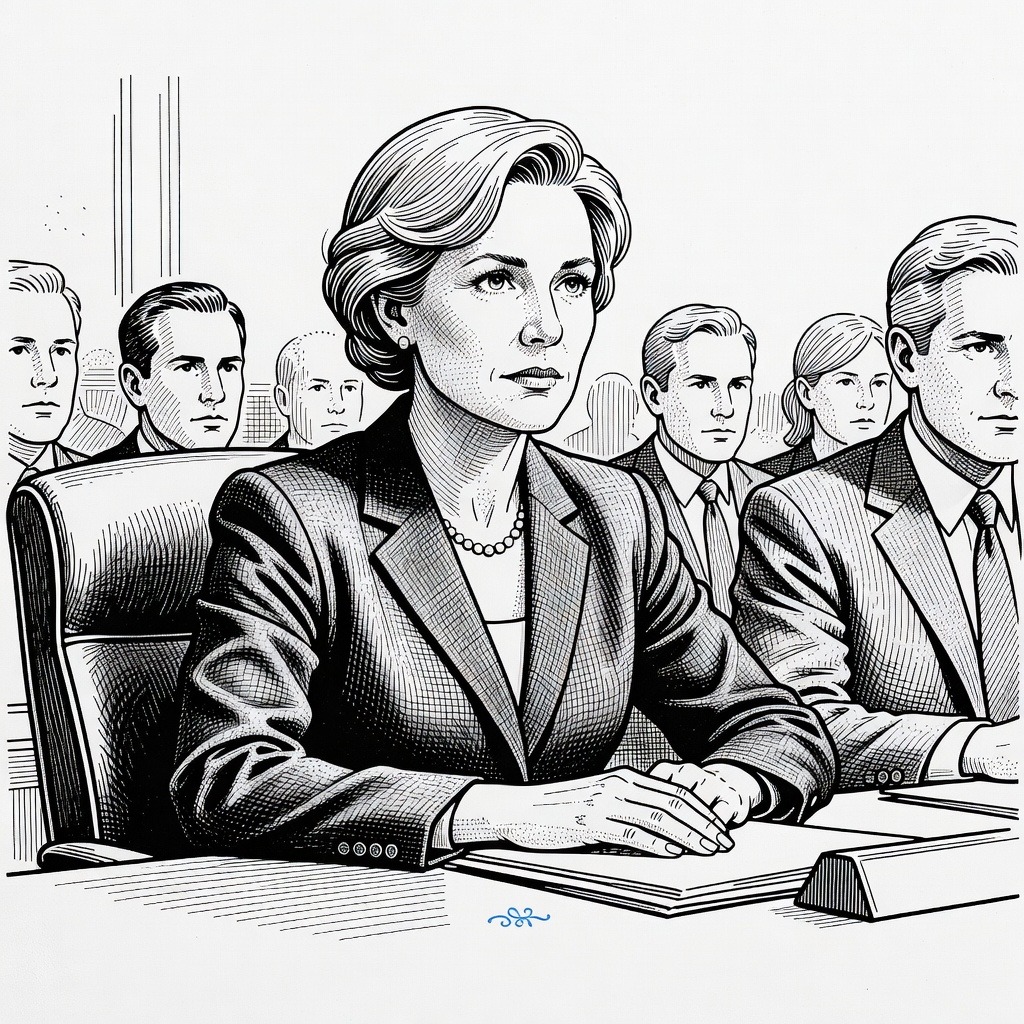
Illustration for: Former Goldman Sachs Counsel Testifies in House Inquiry on Jeffrey Epstein
AI-generated illustration. Visual interpretation does not represent real individuals or scenes.

Former Goldman Sachs Counsel Testifies in House Inquiry on Jeffrey Epstein

2026-07-16

The BareStory

Kathryn Ruemmler, the former chief legal officer for Goldman Sachs and White House counsel under former President Barack Obama, participated in a closed-door, voluntary interview with the House Oversight Committee on Wednesday. The transcribed session is part of a broader congressional investigation into Jeffrey Epstein's network, his influence among prominent figures, and the federal government's handling of his cases.

During the hearing, Ruemmler stated in her prepared remarks that she never witnessed any evidence of criminal conduct or abuse by Epstein, asserting she would have reported such behavior immediately. She described Epstein as a "masterful liar" who used her to legitimize his social standing, and she expressed regret for her association with him. Ruemmler acknowledged receiving luxury gifts from Epstein but compared them to routine business outings. She stated that she did not represent him as an attorney, cut off communication following his 2019 arraignment, and declined to join his legal defense team. Following the six-hour session, a spokesperson for Ruemmler stated that she testified openly and truthfully.

Democratic members of the committee publicly challenged Ruemmler's credibility during the proceedings. Representative Robert Garcia accused her of lying about the nature of her relationship, pointing to emails released by the Justice Department that contained jokes about massages and "Epstein's girls." Garcia also noted that Ruemmler was one of the last people Epstein contacted before his death. Representative Christian Menefee called her claims of not having a friendship with Epstein false, while Republican Committee Chair James Comer stated that Ruemmler remained associated with Epstein until the end and worked to rehabilitate his image.

Ruemmler first met Epstein in 2014 while working as a defense lawyer at Latham & Watkins. Congressional and Justice Department documents show she offered Epstein advice on responding to media scrutiny in 2019. The public scrutiny surrounding their communication led to Ruemmler's decision to step down from her role as Goldman Sachs' chief legal officer, though she remains with the firm in an advisory capacity during the search for her successor.

Left Perspective

  • Expose Elite Shielding Mechanisms: Social progress and institutional accountability demand that high-ranking officials face rigorous scrutiny when tied to systemic abusers. The fact that a former White House counsel and top corporate lawyer maintained ties with a convicted offender highlights how elite networks protect themselves under the guise of professional distance. This camp views Ruemmler’s defense as a classic exercise in reputational damage control rather than genuine transparency.
  • Deconstruct Professional Complicity Narratives: True justice requires challenging the normalization of luxury gifts and casual interactions with known exploiters. Labeling high-end gifts as "routine business outings" and joking about "Epstein's girls" in emails exposes a deep-seated culture of indifference toward the vulnerable. From this viewpoint, minimizing these actions as standard professional networking shields powerful actors from the ethical consequences of their associations.
  • Dismantle Access-Peddling Networks: The primary systemic risk is the preservation of backchannel influence that allows wealthy predators to rehabilitate their public standing. When prominent legal minds offer media advice to individuals facing serious criminal scrutiny, they actively assist in structural evasion. Without aggressive congressional intervention and public exposure, these private networks of influence will continue to operate above the public interest.

Right Perspective

  • Uphold Due Process Standards: Preserving the integrity of established legal institutions requires a strict adherence to objective evidence over political grandstanding. Ruemmler’s voluntary participation in a six-hour, closed-door congressional interview demonstrates respect for oversight and the rule of law. For this camp, her clear testimony that she witnessed no criminal conduct must be treated as factual unless concrete, contradictory evidence is produced under oath.
  • Defend Legitimate Legal Boundaries: Maintaining a functioning justice system depends on protecting the boundaries of professional legal counsel and advice. This perspective emphasizes that providing preliminary advice, declining to join a formal defense team, and cutting ties after an arraignment demonstrate appropriate professional boundaries. Conflating standard legal consulting with personal complicity threatens the constitutional right to counsel and the proper functioning of the legal profession.
  • Prevent Partisan Character Assassination: The chief danger of these high-profile inquiries is the degradation of civic trust through political theater and premature public condemnation. When lawmakers use selective email leaks and personal associations to destroy a professional career, it undermines institutional stability and deters qualified individuals from public service. Preserving social order requires that accountability is pursued through structured legal channels rather than performative legislative hearings.

How it may affect me

As a U.S. reader:

• This inquiry may increase your awareness of how high-level corporate and government officials interact with individuals under criminal investigation, potentially shaping your trust in public and private institutions.

• You may observe changes in the leadership of major financial institutions, as seen with the chief legal officer of Goldman Sachs stepping down to an advisory role due to public scrutiny.

• The ongoing investigation could influence your confidence in congressional oversight, depending on whether you view the public questioning of elite figures as necessary accountability or as partisan political theater.

• In the long term, this congressional scrutiny could lead to stricter ethical standards and boundaries regarding professional networking, luxury gifts, and legal consulting within the legal and financial sectors.

Read the story at