
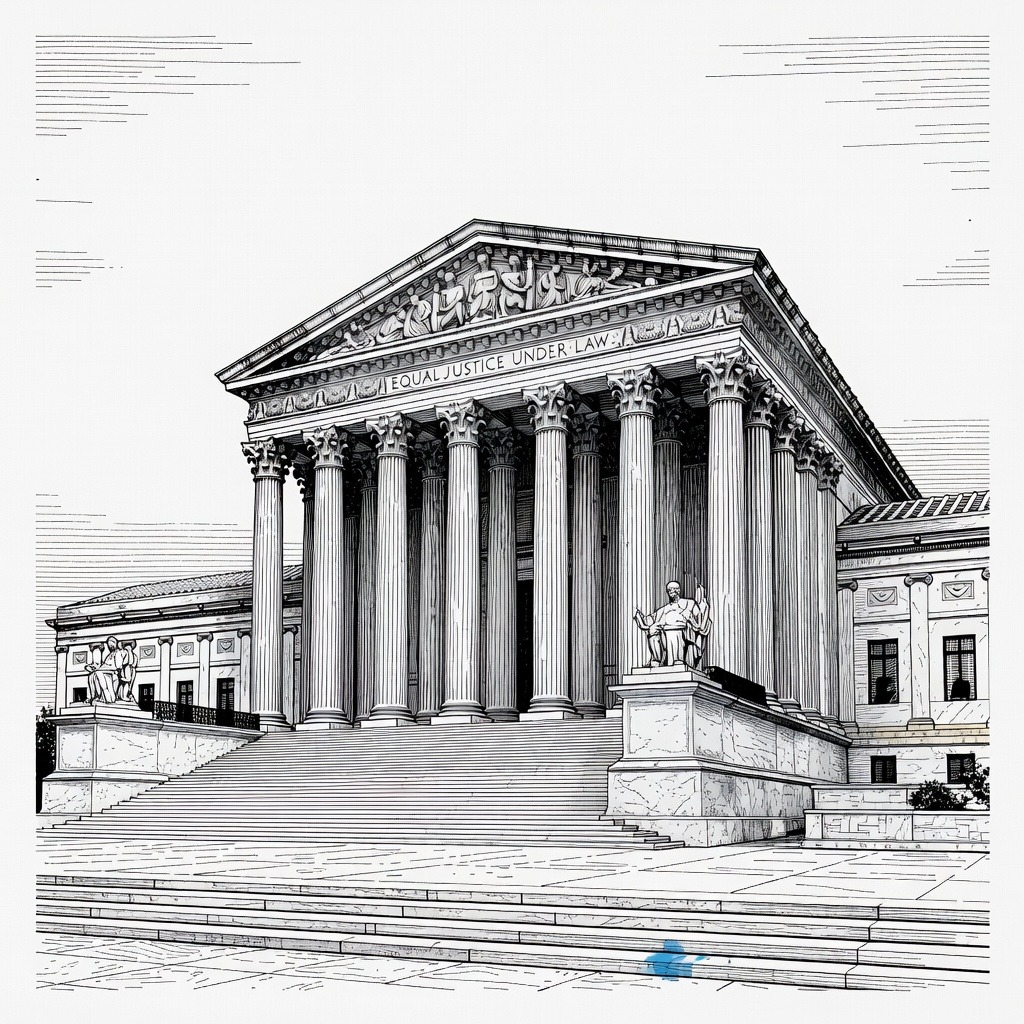
Illustration for: Supreme Court Justices Request Budget Increase From Congress Citing Rising Security Threats
AI-generated illustration. Visual interpretation does not represent real individuals or scenes.

Supreme Court Justices Request Budget Increase From Congress Citing Rising Security Threats

2026-07-14

The BareStory

On July 14, 2026, Supreme Court Justices Amy Coney Barrett and Elena Kagan testified before a House Appropriations subcommittee to request $228.4 million for the upcoming fiscal year. This request represents a nearly 10% increase from the $207.8 million appropriated in 2026. The justices stated the additional funding is necessary to enhance security measures for the judiciary and to improve cybersecurity protections.

The requested budget includes $14.6 million to expand Supreme Court Police security details, adding six agents per justice and extending coverage to travel outside the Washington, D.C., area. The court is also seeking $6.5 million for an external visitor screening facility and $2.3 million for cybersecurity. Barrett testified that the advancement of artificial intelligence has made cyberattacks increasingly viable, making additional funding essential to hire security experts and bolster protections.

During the hearing, the justices highlighted a significant rise in threats against federal judges. Kagan cited projections indicating a 38% annual increase in threats to the Supreme Court and its justices. According to data from the U.S. Marshals Service, there have been 512 investigations into threats against federal judges since the beginning of 2026, compared to 807 investigations in all of 2025.

Barrett shared personal experiences regarding the safety risks, stating that she was sent home with a bulletproof vest following the May 2022 leak of the draft abortion rights opinion and recently experienced a "swatting" incident at her residence. She also noted that several judges have received threatening anonymous deliveries. Subcommittee Chairman Representative David Joyce and Representative Steny Hoyer both expressed support for the security funding, emphasizing that judicial officers must be able to perform their duties without fearing for their safety.

Left Perspective

  • Protect Civic Liberty Priorities: The protection of judicial officers is vital, but expanding policing power must be balanced against civil liberties and transparency. An 10% budget increase to $228.4 million, including expanding Supreme Court Police security details, risks creating an insular, militarized judicial class shielded from the public they serve. True institutional resilience comes from public trust and ethical accountability, rather than just erecting physical barriers and hiring more security agents.
  • De-escalate the Societal Friction: The rise in threats, including 512 investigations of federal judges in early 2026 and a projected 38% annual increase in threats to the Supreme Court, is a symptom of deep systemic and political polarization. While security measures like a $6.5 million external visitor screening facility address immediate symptoms, they do not resolve the underlying public frustration with the court's direction. Security funding should be treated as a temporary shield rather than a permanent substitute for addressing the democratic deficit surrounding lifetime appointments.
  • Divert Capital to Public Welfare: Investing heavily in specialized judicial protections, such as adding six personal security agents per justice for travel outside Washington, D.C., raises questions of equity in public spending. Resource allocation should prioritize systemic judicial reforms, court accessibility, and community-level safety programs over localized executive-style protection. Relying on increased funding to solve trust-based crises risks further alienating the judiciary from the everyday citizens who lack access to similar taxpayer-funded security.

Right Perspective

  • Deter Threats Through Strength: Protecting the physical integrity of the judiciary is a non-negotiable requirement for maintaining the rule of law and preserving constitutional order. Citing a projected 38% annual increase in threats to the Supreme Court, the request for $228.4 million represents a necessary, proactive investment to deter extremist violence. The state must project absolute stability, ensuring that judges can make decisions based strictly on the Constitution without fear of physical retaliation.
  • Neutralize Evolving Digital Warfare: Advanced technological developments, particularly artificial intelligence, have transformed the threat landscape from physical intimidation to sophisticated systemic sabotage. The requested $2.3 million for cybersecurity is essential to hire security experts and defend the court's digital infrastructure against increasingly viable cyberattacks. Securing the judiciary's data and internal communications is just as vital to institutional continuity as physical checkpoints.
  • Shield the State from Anarchy: Direct intimidation tactics, such as the "swatting" incident experienced by Justice Barrett and the necessity of wearing a bulletproof vest after the May 2022 draft opinion leak, represent direct attacks on the separation of powers. If justices are forced to operate under constant threat of violence, the independence of the entire legal system is compromised. Expanding Supreme Court Police security details and adding six agents per justice ensures that the arbiters of the law can perform their duties free from coercion and external duress.

How it may affect me

As a U.S. reader:

• You may see more of your federal tax dollars allocated toward the judicial branch, as the Supreme Court is requesting a nearly 10 percent budget increase to $228.4 million for fiscal year 2027.

• Your physical access to the Supreme Court building may be altered or face stricter controls due to a proposed $6.5 million external visitor screening facility designed to enhance security.

• In the short term, you may see a debate over whether taxpayer funds are better spent on localized, high-level executive security details for traveling justices or redirected toward community-level safety, court accessibility, and systemic judicial reforms.

• In the long term, you will see increased efforts to secure the judiciary's digital infrastructure against AI-driven cyberattacks, which aims to protect the integrity of the nation's legal data and court communications.

Read the story at