
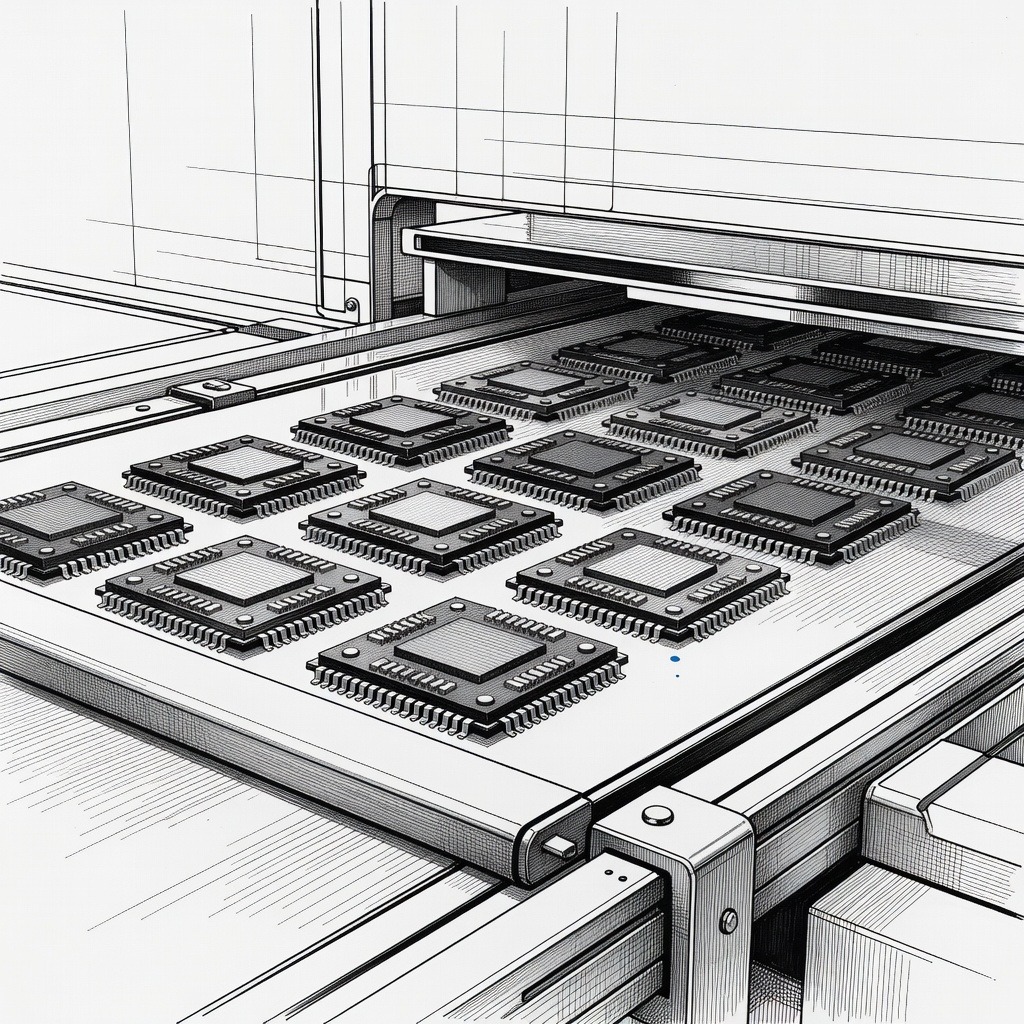
• Anchor Domestic Economic Safeguards The fundamental priority of economic progress is ensuring that massive capital accumulations translate into equitable domestic development and secure, high-paying local jobs. While the $26.5 billion Nasdaq offering represents a massive influx of wealth, the decision to concentrate the vast majority of the expansion—specifically the $390 billion fabrication cluster in Yongin—within South Korea limits the direct economic benefit to American workers. The relatively modest $4 billion investment in the Indiana packaging plant highlights a systemic imbalance where Western capital is harvested to build long-term industrial infrastructure abroad, leaving the domestic workforce with a fraction of the manufacturing gains.
• Dismantle Corporate Monopsony Risks Market stability relies on preventing hyper-concentration of supply chains that serve only a select handful of elite corporate giants. SK Hynix’s stated strategy of doubling its capacity to satisfy dominant tech conglomerates like Apple and Nvidia threatens to consolidate the artificial intelligence ecosystem into an exclusive, high-barrier cartel. When critical high-bandwidth memory chips are funneled primarily to established tech monopolies, smaller innovators and public research institutions are priced out, stifling democratic technological progress and exacerbating wealth inequality within the broader digital economy.
• Shield Against Volatile Speculation Protecting everyday retail investors from the predatory nature of speculative market cycles is essential for long-term economic security. Despite the celebratory 14 percent first-day trading jump to $170 per share, the memory-chip industry remains historically bound to aggressive boom-and-bust cycles. Framing artificial intelligence demand as a permanent paradigm shift is a high-stakes gamble that ignores historical market corrections, potentially exposing public pension funds and individual retirement accounts to catastrophic losses when the current infrastructure bubble eventually contracts.
How it may affect me
As a U.S. reader:
• You gain direct access to invest in a major global producer of high-bandwidth memory chips through the Nasdaq under the ticker symbols SKHYV and SKHY.
• You may experience a long-term economic risk if you invest your retirement accounts or public pension funds in this stock, as the memory-chip industry is historically volatile and prone to boom-and-bust cycles.
• You will see limited local job creation from this massive offering, as the majority of the planned expansion will occur in South Korea rather than the United States, despite a modest $4 billion packaging plant planned for Indiana.
• You may see pricing pressure or reduced innovation from smaller domestic tech companies if critical high-bandwidth memory chips are monopolized by major tech firms like Apple and Nvidia.