
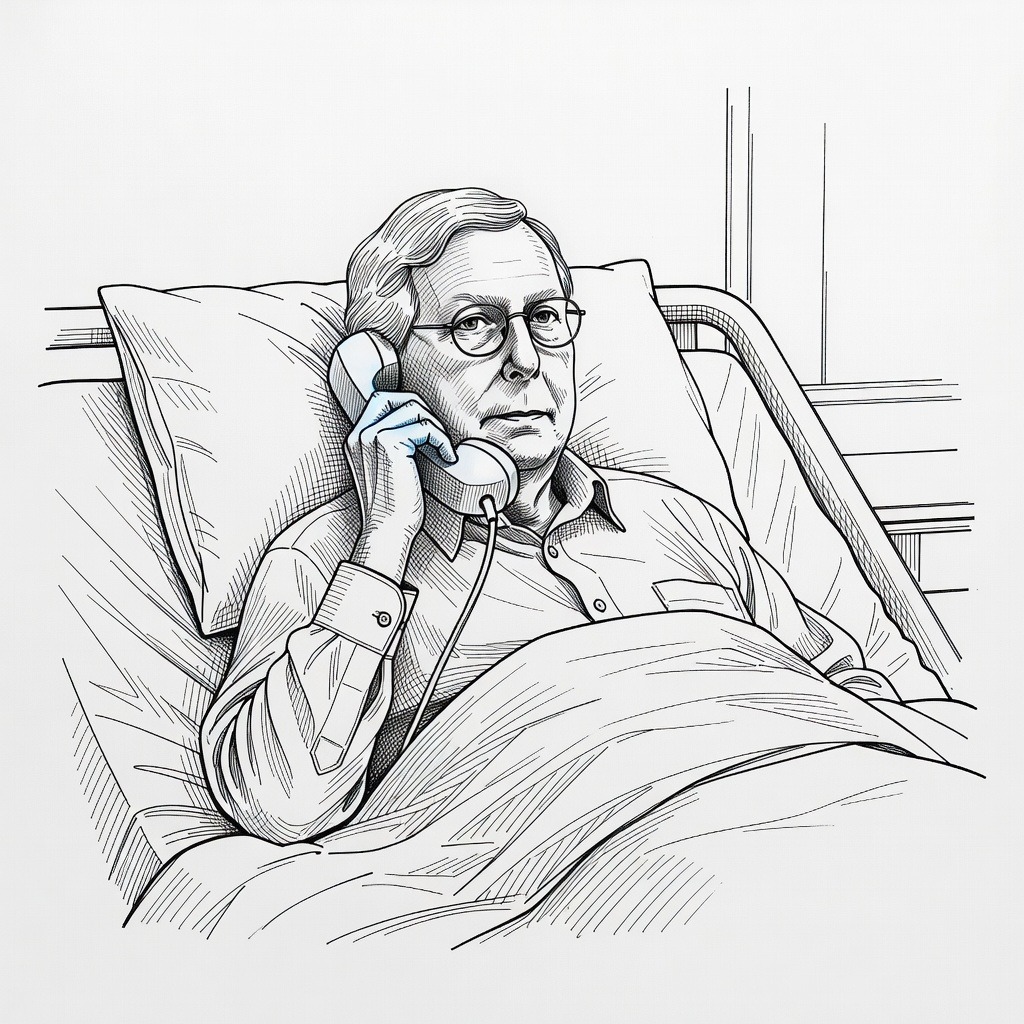
Illustration for: Hospitalized Senator Mitch McConnell Holds Phone Calls With GOP Leaders
AI-generated illustration. Visual interpretation does not represent real individuals or scenes.

Hospitalized Senator Mitch McConnell Holds Phone Calls With GOP Leaders

2026-07-08

The BareStory

Kentucky Senator Mitch McConnell remains in the hospital following his admission on June 14, 2026. While his office has released few details regarding his specific diagnosis or condition, spokespeople for Senate Republican leaders confirmed that the 84-year-old lawmaker held phone conversations with colleagues this week.

According to spokespeople, Senate Majority Leader John Thune spoke with McConnell on Monday in a lengthy conversation that covered national security. Senate Republican Whip John Barrasso spoke with McConnell for approximately 20 minutes on Tuesday. Barrasso's spokeswoman, Kate Noyes, stated that McConnell was fully engaged and eager to return to the Senate, noting that their discussion covered defense spending, legislative agendas, a recent Supreme Court ruling, and Senate races. Political commentator Scott Jennings also reported speaking with McConnell on Tuesday.

The phone calls follow weeks of limited public information and growing speculation regarding the senator's health. In a statement, McConnell's office said the senator continues to improve, appreciates the support he has received, and is working closely with his staff on Kentucky and Senate matters while the chamber is out of session. The Senate is scheduled to reconvene on July 13, 2026.

Public emergency dispatch audio from the day of McConnell's admission revealed that emergency medical personnel were sent to his Washington residence to treat an unnamed, unconscious individual in cardiac arrest. McConnell's office has declined to comment on the dispatch recordings, and the identity of the person has not been officially confirmed. Activist Laura Loomer claimed that a source told her McConnell was brain dead, a claim contrasted by the reports from GOP leaders of their recent phone conversations with him.

Left Perspective

  • Demanding Democratic Transparency: The public's right to know the physical and mental capacity of its representatives is paramount to democratic accountability. Withholding specific medical details regarding an 84-year-old senator's hospitalization—especially following emergency dispatch reports of an unconscious individual in cardiac arrest—erodes civic trust. When public servants conceal vital health information, it compromises the electorate’s ability to ensure they are being represented by capable leaders.
  • Challenging Controlled Narratives: Orchestrated reports of brief phone conversations cannot substitute for verifiable, objective updates on a lawmaker's health. Relying solely on statements from political allies and partisan commentators to verify fitness creates an insular system designed to protect institutional power rather than serve the public interest. This selective flow of information serves to suppress legitimate concerns and bypasses the independent scrutiny required in a healthy democracy.
  • Guarding Against Governance Vacuums: Operating critical state functions through proxy communications risks paralyzing the legislative process and disenfranchising constituents. If a key lawmaker is incapacitated, hiding behind a shield of secrecy prevents the necessary constitutional transitions of power from occurring smoothly. The long-term danger is a compromised legislative chamber where decisions are managed by staff and party elites rather than an active, accountable elected official.

Right Perspective

  • Preserving Institutional Continuity: Maintaining stability and preventing disruption within the legislative hierarchy is vital for national governance. Demonstrating that a senior leader is actively engaged in critical policy matters—such as national security, defense spending, and legislative agendas—reassures allies, deters adversaries, and ensures the steady operation of the state. Preserving the continuity of leadership takes precedence over satisfying public curiosity during a medical recovery.
  • Defending Constitutional Privacy: Every individual, regardless of their public office, retains a fundamental right to personal privacy, especially concerning medical emergencies. Disclosing graphic details of a health crisis invites sensationalism and weakens the dignity of the office. Refusing to address unverified dispatch audio or speculative online rumors protects the integrity of the institution from bad-faith actors seeking to exploit personal vulnerability for political disruption.
  • Thwarting Destructive Speculation: Allowing external narratives to dictate the terms of public service risks handing control to bad-faith actors and partisan agitators. Responding to sensational claims, such as rumors of severe cognitive impairment, only legitimizes conspiracy theories and fosters unnecessary chaos. By relying on trusted colleagues to convey message of engagement, the leadership maintains order and ensures the senator can focus on recovery without political interference.

How it may affect me

As a U.S. reader:

• You may experience uncertainty regarding how your interests are being represented in Congress due to the limited public information and conflicting reports about Senator McConnell's actual physical and mental capacity to govern.

• The ongoing legislative process on key national issues, including national security, defense spending, and upcoming Senate agendas, could either proceed steadily or face sudden disruptions depending on whether McConnell can actively participate when the Senate reconvenes on July 13, 2026.

• In the long term, the lack of transparency surrounding a key leader's health could either weaken civic trust and stall constitutional transitions of power, or conversely, protect the stability and dignity of legislative institutions from political disruption and sensationalism.

Read the story at