
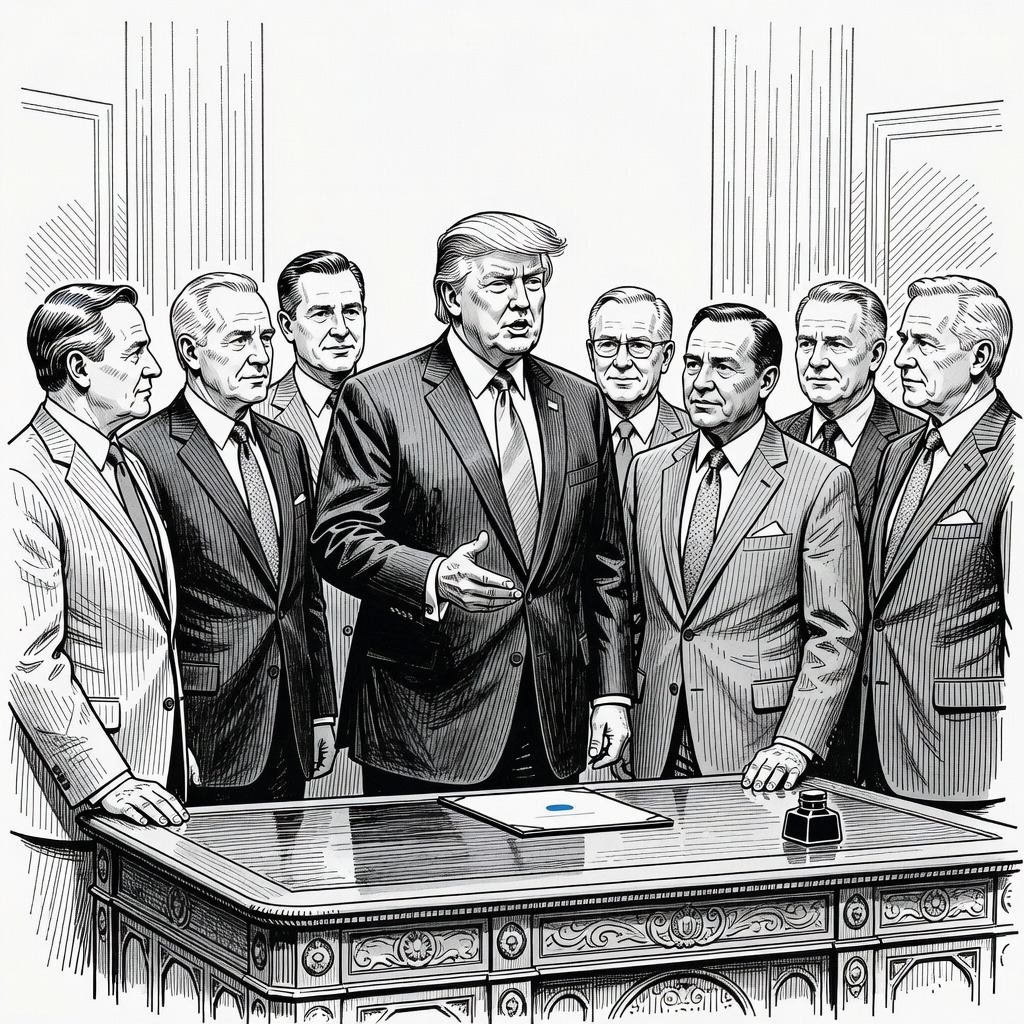
Illustration for: Trump Launches Tax-Advantaged Investment Accounts for Children With Wall Street Ceremony
AI-generated illustration. Visual interpretation does not represent real individuals or scenes.

Trump Launches Tax-Advantaged Investment Accounts for Children With Wall Street Ceremony

2026-07-06

The BareStory

President Donald Trump officially launched the "Trump Accounts" initiative on Monday, hosting a joint New York Stock Exchange and Nasdaq opening bell ceremony in the Oval Office. The new program, which officially began on July 4, establishes tax-deferred investment accounts for American children under the age of 18. Under the program, the U.S. Treasury Department will provide a one-time $1,000 pilot contribution for infants born between 2025 and 2028.

During the event, Trump actively promoted Dell Technologies and encouraged the public to purchase Dell computers, noting that he actively trades the company's shares. According to Trump's 2025 annual financial disclosure released last week, he made 24 trades of Dell Technologies stock between January and November, valued between $300,000 and $1 million. Following Trump's remarks at the White House, Dell stock rose by more than 7%.

Several high-profile executives and corporations have pledged financial backing to support the accounts. Dell CEO Michael Dell and his wife, Susan, pledged over $6 billion to seed the accounts with $250 each for children aged 10 or under born before January 1, 2025, specifically targeting ZIP codes with median incomes of $150,000 or less. Additionally, SpaceX President Gwynne Shotwell announced she and her husband would donate SpaceX stock to approximately 2 million accounts, with a particular focus on children in central Texas.

A number of major financial and technology corporations, including Goldman Sachs, Morgan Stanley, JPMorgan Chase, Intel, Robinhood, and Micron, have committed to matching the government's $1,000 contribution for their employees' children. Micron also announced a one-time $250 million seed deposit for children's accounts in its operating communities. Attendees at the White House ceremony included Treasury Secretary Scott Bessent, SEC Chair Paul Atkins, Senator Ted Cruz, and investor Brad Gerstner, who helped spearhead the program.

Left Perspective

  • Expose Corporate Influence Peddling: Social equity and public trust demand a strict separation between public office and private financial gain. The President's active promotion of Dell Technologies from the Oval Office, immediately following disclosures of his own personal stock trades in the company valued up to $1 million, represents an unacceptable conflict of interest. When a presidential endorsement triggers a 7% spike in a company's stock price, it demonstrates how public policy can be co-opted to enrich private portfolios rather than serve the collective public good.
  • Address Systemic Wealth Inequities: True financial security for vulnerable families cannot be achieved by tying childhood welfare to the volatile fluctuations of the stock market. While targeted private pledges like the $6 billion from Michael and Susan Dell for lower-income ZIP codes offer localized relief, they rely on the whims of billionaire philanthropy rather than systematic, guaranteed public support. Relying on corporate giants like Goldman Sachs and JPMorgan Chase to match contributions primarily for their own employees' children risks widening the inequality gap, as children of lower-wage workers in non-participating industries are left behind.
  • Resist Financialization of Childhood: Public policy should prioritize direct investments in fundamental social infrastructure, such as education and healthcare, rather than channeling public funds into Wall Street. Diverting federal resources into tax-deferred investment accounts managed by major financial institutions serves as a subsidy for the financial sector under the guise of child welfare. The long-term risk of this strategy is the normalization of market dependency, exposing the future financial stability of American children to market downturns and the high fees of private investment platforms.

Right Perspective

  • Ignite Generational Wealth Creation: Long-term economic prosperity is achieved by integrating citizens into the capitalist engine at the earliest age possible. By establishing tax-deferred investment accounts with a $1,000 federal pilot contribution, this initiative instills a culture of ownership and financial literacy in the next generation. Leveraging the compounding power of the stock market turns every American child into a stakeholder in the nation's economic growth, shifting the welfare paradigm from government dependency to wealth accumulation.
  • Mobilize Private Capital Efficiencies: Public-private partnerships are far more effective at scaling social solutions than bloated, tax-funded government bureaucracies. The commitments of multi-billion-dollar donations from philanthropic leaders like the Dells and SpaceX's Gwynne Shotwell demonstrate how targeted corporate citizenship can amplify federal initiatives without burdening taxpayers. Encouraging major employers like Intel, Micron, and Morgan Stanley to match contributions for their workforce rewards productivity and aligns corporate success directly with the financial well-being of working families.
  • Champion Market-Driven National Prosperity: Economic vitality thrives when leadership actively champions domestic industries and encourages public investment in high-performing American enterprises. Highlighting successful companies like Dell Technologies during a major policy rollout reinforces confidence in the technological sector and stimulates market activity, as evidenced by the subsequent 7% rise in Dell's stock. By aligning the interests of the government, private corporations, and individual families, this framework fosters a robust, self-sustaining economic ecosystem built on market growth rather than regulatory stagnation.

How it may affect me

As a U.S. reader:

• If you have an infant born between 2025 and 2028, your child will receive a one-time $1,000 pilot contribution from the U.S. Treasury to seed a new tax-deferred investment account.

• If you have a child aged 10 or under born before January 1, 2025, and reside in a ZIP code with a median income of $150,000 or less, your child is eligible for a $250 contribution funded by a private pledge from Michael and Susan Dell.

• If you are employed by participating corporations such as Goldman Sachs, Morgan Stanley, JPMorgan Chase, Intel, Robinhood, or Micron, your employer will match the government's $1,000 contribution for your children.

• If your children receive these accounts, their long-term financial security will be tied to stock market performance, exposing their future savings to market fluctuations, potential downturns, and private investment platform fees.

• If you invest in the stock market, you may see immediate fluctuations in specific company shares, such as Dell Technologies, following presidential endorsements and associated policy rollouts.

Read the story at