
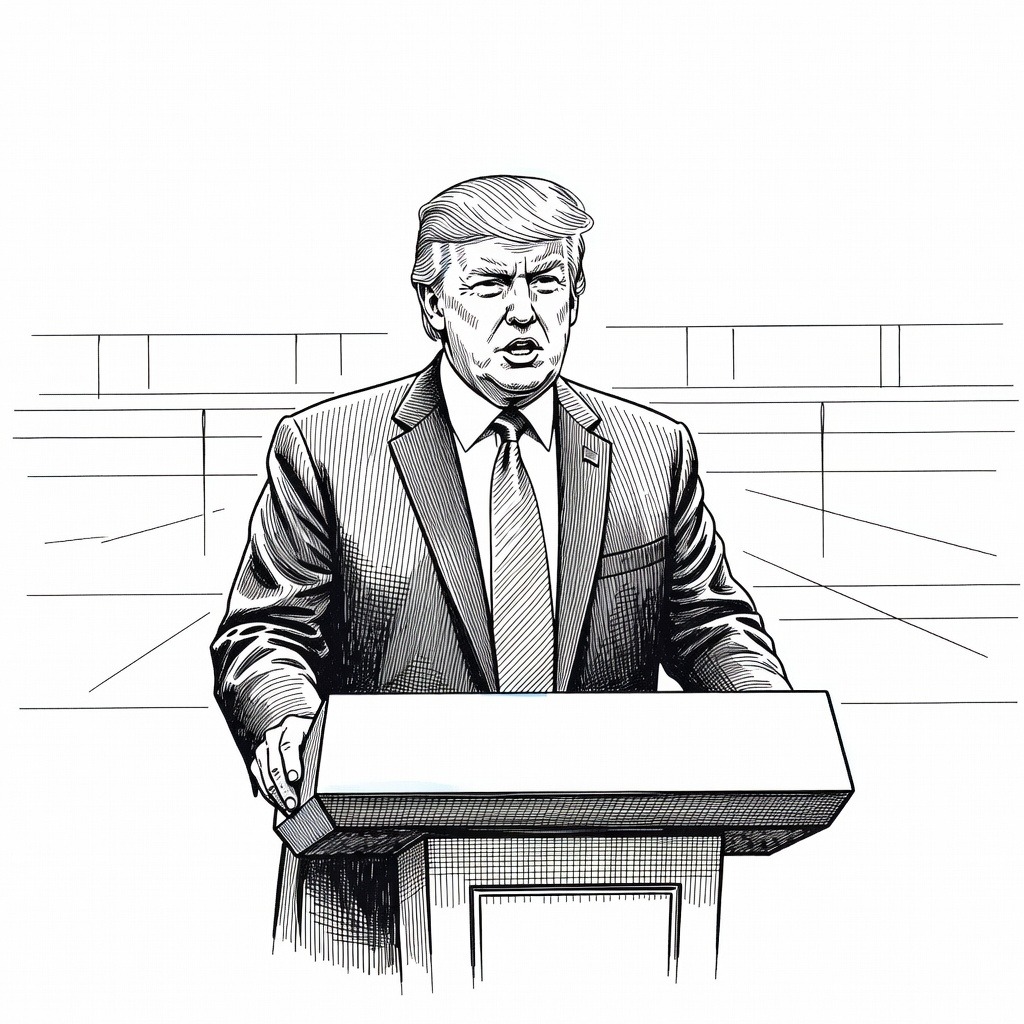
Illustration for: Severe Weather Delays July 4th Celebrations as Trump Delivers 250th Anniversary Speech
AI-generated illustration. Visual interpretation does not represent real individuals or scenes.

Severe Weather Delays July 4th Celebrations as Trump Delivers 250th Anniversary Speech

2026-07-05

The BareStory

On July 4, 2026, severe weather in Washington, D.C., led to the temporary evacuation of the National Mall, delaying President Donald Trump's scheduled speech commemorating the 250th anniversary of American independence. Organizers, alongside the U.S. Secret Service, the National Park Service, and other public safety agencies, instructed attendees to seek shelter due to extreme heat and forecasted thunderstorms. A severe thunderstorm watch was active during the evening, following a daytime high temperature of 102 degrees, which surpassed the city's previous July Fourth record set in 1919.

The adverse weather conditions delayed the official program by about two hours and forced several performance cancellations. Despite these disruptions, President Trump vowed to proceed with his address, which was rescheduled to approximately 11 p.m. and followed by a large fireworks display. Prior to the event, organizers had also temporarily closed the nearby Great American State Fair due to heat-related medical issues among visitors.

In his delayed address, President Trump combined historical tribute with political messaging, declaring the anniversary the beginning of a "golden age of America." The president paid tribute to several military veterans, farmers, police officers, and astronauts. He also utilized the platform to promote the SAVE America Act, a legislative proposal requiring proof of citizenship and identification for voters, and condemned communism, comparing it to a disease that must be removed from the country.

The celebrations occurred amid a broader political context for the administration, which has faced public pushback regarding foreign and domestic policies, as well as local criticism over the condition and closure of the Lincoln Memorial Reflecting Pool. During his address, President Trump also highlighted what he characterized as significant military achievements under his administration, claiming to have dismantled the militaries of Venezuela and Iran, including the sinking of the Iranian navy.

Left Perspective

  • Expose Democratic Backsliding: Demanding proof of citizenship and identification under the proposed SAVE America Act is viewed as an attempt to restrict the franchise and suppress vulnerable voter populations. Using a historic national celebration to promote this restrictive legislation demonstrates a willingness to politicize neutral civic milestones. Progressive values dictate that true democratic strength comes from expanding access to the ballot, not erecting administrative barriers under the guise of security.
  • Prioritize Public Well-being: Extreme record-breaking heat of 102 degrees and severe thunderstorms highlight the immediate threat of ecological degradation and the urgent need for robust public infrastructure. The closure of the Great American State Fair due to heat-related illnesses, combined with the poor condition of local landmarks like the Lincoln Memorial Reflecting Pool, reveals a failure of state stewardship over shared civic spaces. A government's primary duty is to protect its citizens and public commons from systemic neglect and environmental hazards, rather than prioritizing costly spectacles.
  • De-escalate Aggressive Rhetoric: Condemning ideological opponents by comparing political philosophies to a disease and boasting about the destruction of foreign militaries, such as those of Iran and Venezuela, fosters dangerous polarization and undermines diplomatic norms. This aggressive posture risks dragging the nation into avoidable conflicts while alienating international allies. True national security is achieved through collaborative global partnerships and adherence to international law, not through unilateral bellicosity and divisive internal rhetoric.

Right Perspective

  • Securing Democratic Integrity: Requiring proof of citizenship and identification through the SAVE America Act is the most fundamental way to protect the integrity of the ballot and preserve public trust in elections. Securing the nation's democratic processes is a core sovereign duty that must be championed at every opportunity, especially during historic milestones like the 250th anniversary. Without strict verification measures, the rule of law is undermined, and the value of citizenship is diluted.
  • Demonstrate Institutional Resilience: Proceeding with the 250th anniversary address and fireworks despite a two-hour delay, extreme heat, and severe weather reflects national resolve and strength. Honoring foundational figures like military veterans, police officers, farmers, and astronauts during a self-proclaimed "golden age" reinforces the continuity of the American tradition. Overcoming these immediate environmental challenges serves as a powerful metaphor for national endurance and commitment to patriotic duty.
  • Deter Adversaries Through Strength: Highlighting decisive actions that dismantled foreign threats, including the Iranian navy and Venezuelan military, projects vital strategic deterrence on the world stage. Peaceful stability is only guaranteed when adversaries understand that the nation possesses both the capability and the political will to use decisive force. Assertive rhetoric and a strong military posture are essential to preventing aggression and maintaining global order.

How it may affect me

As a U.S. reader:

• You may experience immediate health and safety disruptions or event delays when attending major national outdoor public events due to extreme heat and severe weather.

• You may face new administrative requirements to vote in future elections if the proposed SAVE America Act, which requires proof of citizenship and identification, is passed into law.

• You could experience shifting diplomatic relations or heightened international tensions resulting from assertive U.S. foreign policy rhetoric and reported military actions against foreign adversaries like Iran and Venezuela.

Read the story at