
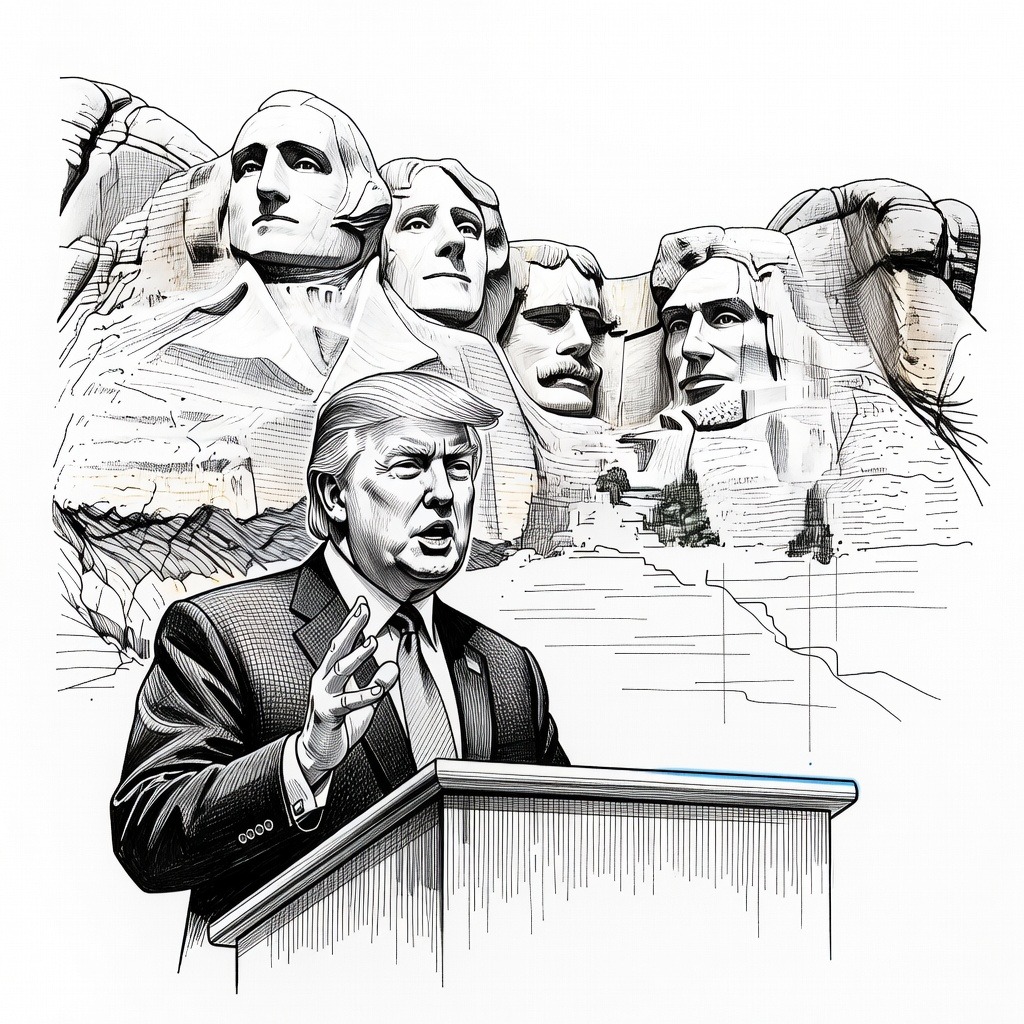
Illustration for: President Trump Marks July Fourth Eve with Mount Rushmore Speech Warning of 'Communist' Threat
AI-generated illustration. Visual interpretation does not represent real individuals or scenes.

President Trump Marks July Fourth Eve with Mount Rushmore Speech Warning of 'Communist' Threat

2026-07-04

The BareStory

President Donald Trump marked the eve of the United States' 250th anniversary on Friday, July 3, 2026, with a patriotic speech delivered at the Mount Rushmore monument in Keystone, South Dakota. The event featured a fireworks display over the Black Hills and a flyover by the new Air Force One. In his address, Trump declared the United States to be the most exceptional, successful, and freest nation in human history, and urged the country to rededicate itself to the ideals of the four presidents carved into the monument.

During the speech, Trump warned of a resurgence of what he termed a "communist menace" and a growing communist movement, which he characterized as the greatest threat the nation faces. According to Trump, this movement seeks to target American history, undermine the nation's character, and alienate citizens from their heritage. He asserted that individuals cannot be both loyal to America and support communist ideals, stating that communism is the enemy of free people.

To counter these perceived threats and secure Republican victories in upcoming midterm elections, Trump called for the abolition of the filibuster and the passage of the SAVE America Act. He stated that this proposed legislation would require individuals to provide proof of U.S. citizenship to register to vote and present a valid photo identification to cast a ballot. Following the South Dakota event, Trump was scheduled to deliver another address on Saturday on the National Mall in Washington, D.C.

Left Perspective

  • Dismantling Democratic Safeguards: The foundational value of civil liberties is directly threatened by calls to abolish the filibuster to push through restrictive voting laws. Using a patriotic milestone to advocate for the removal of legislative checks and balances exposes a desire to consolidate power rather than protect democratic norms. This strategic pivot reveals that the underlying goal is not preserving freedom, but rather reshaping the legislative process to secure partisan victories.
  • Weaponizing Historical Divisiveness: Social progress requires an honest reckoning with history, making the labeling of critics and reformers as a "communist menace" a dangerous attempt to stifle legitimate dissent. By framing efforts to reexamine American history as an existential threat to the nation's character, this rhetoric seeks to alienate marginalized groups and halt progress toward social equity. The strategy relies on creating ideological enemies to distract from pressing systemic issues and unify a conservative base.
  • Constructing Barriers to Voting: The push for the SAVE America Act, requiring proof of citizenship and photo identification, serves as a mechanism to disenfranchise vulnerable and marginalized populations. Under the guise of election integrity, these measures construct systemic barriers that disproportionately impact low-income and minority voters who may lack easy access to such documentation. The long-term risk of this policy is a weakened democracy where political power is restricted to a privileged demographic.

Right Perspective

  • Defending National Sovereignty: Preserving national identity and the rule of law requires a steadfast defense of American heritage against ideologies that seek to undermine the nation's foundational character. Celebrating America's exceptionalism at Mount Rushmore reinforces the continuity of the republic and honors the legacy of its most pivotal leaders. Safeguarding these historical symbols is essential for maintaining social order, national unity, and a shared civic duty.
  • Securing Electoral Integrity: Ensuring the sanctity of the vote is a core prerequisite for a functioning republic, making the SAVE America Act a vital tool for systemic stability. Requiring proof of citizenship and valid photo identification protects the principle of "one citizen, one vote" and restores public trust in democratic institutions. This policy is not about exclusion, but about establishing clear, common-sense rules that verify eligibility and prevent illegal participation in the democratic process.
  • Abolishing Legislative Obstructionism: Eliminating the filibuster to pass critical election security measures is a necessary strategic action to overcome partisan gridlock and protect the nation's sovereignty. When key legislative priorities like the SAVE America Act are blocked, bold procedural reforms are justified to ensure the government can defend its borders and institutions. The risk of inaction is a compromised electoral system that leaves the nation vulnerable to internal erosion and administrative chaos.

How it may affect me

As a U.S. reader:

• You may face new, stricter federal voting requirements in future elections if the SAVE America Act is passed, which would require you to provide proof of citizenship to register and a valid photo ID to cast a ballot.

• Depending on your access to official documents, the proposed voting laws could either make it more difficult for you to participate in elections or increase your confidence in the security and integrity of the voting process.

• You could see a major shift in how federal laws are passed if the legislative filibuster is abolished, potentially allowing the majority party in Congress to pass significant policy changes more quickly and with fewer bipartisan compromise requirements.

• You may experience heightened political polarization and ideological division in your community as national leaders debate whether efforts to reexamine American history represent a threat to national heritage or a necessary step toward social progress.

Read the story at