
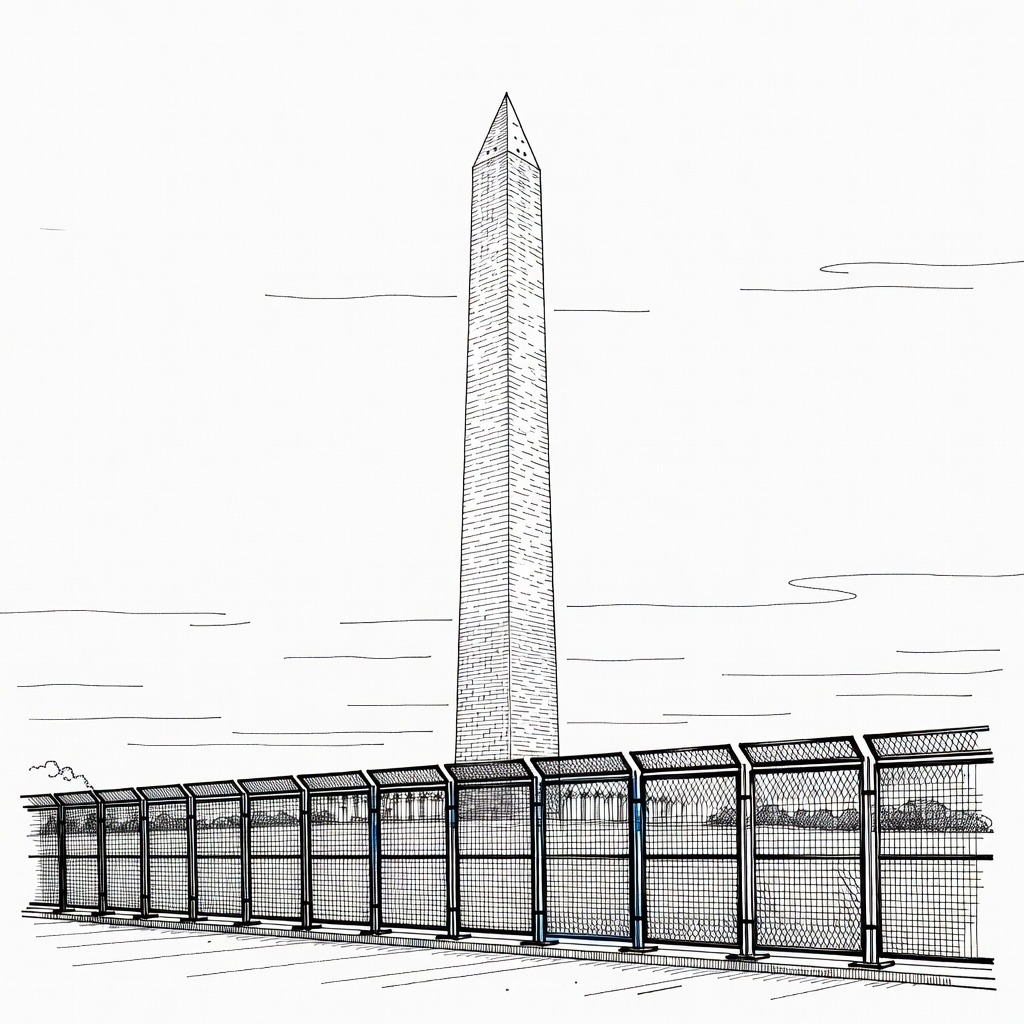
AI-generated illustration. Visual interpretation does not represent real individuals or scenes.
Federal Judge Permits Protest Flags at National Mall Amid Heightened July Fourth Security
2026-07-03
The BareStory
A federal judge has ruled that a progressive activist group, Accountability Now USA, may fly protest flags near the National Mall. U.S. District Judge Randolph Moss ruled on Monday that a flag displaying the numbers "8647" is protected political speech and does not constitute a threat or incitement to violence. Judge Moss also ruled that two other flags, which accuse President Donald Trump of sexually assaulting a minor, are not legally obscene. The ruling came after the group filed a lawsuit alleging the National Park Service violated its First Amendment rights by threatening to revoke its permit.
The Department of the Interior criticized the decision, with a spokesperson stating that flags threatening the Office of the President should not be allowed under any administration. The administration interpreted the number "86"—a restaurant industry term for removing or refusing service—combined with "47" as a political threat against Trump, the 47th president. Federal authorities are also investigating a recent incident where "8647" was etched into the grass near the Washington Monument.
The legal dispute occurs amid heightened security preparations in Washington, D.C., for the "America 250" July Fourth celebrations, where President Trump is scheduled to speak on Saturday. The main holiday events have been designated as a national special security event, placing the U.S. Secret Service in charge of security operations.
Security measures for the holiday include the deployment of nearly 5,000 National Guard troops, miles of fencing, and U.S. Coast Guard patrols on local waterways. The U.S. Marshals Service has also sworn in hundreds of officers from 44 local law enforcement agencies to assist. Security officials stated that planning has been underway for several months and that there are currently no specific, credible threats for the weekend.
Left Perspective
Shielding Dissent From State Censorship
Challenging Institutional Power Dynamically
Defending the Commons Against Encroachment
Right Perspective
Preserving Dignity of Executive Office
Securing Order Amid Heightened Threat
Preventing the Weaponization of Liberty
Left Perspective
• Shielding Dissent From State Censorship
Civil liberties must be guarded most fiercely when the state attempts to silence criticism of its highest leaders. The judicial ruling correctly identifies that political speech—even when highly provocative, uncomfortable, or critical of a sitting president—deserves absolute First Amendment protection. Utilizing restaurant slang like "86" to advocate for a president's removal or defeat is a standard form of democratic expression, not a credible threat of violence.
• Challenging Institutional Power Dynamically
Progressive activism relies on pushing boundaries to expose systemic issues and hold powerful figures accountable. Allowing flags that highlight serious allegations against a political leader ensures that the public square remains a venue for truth-telling rather than sanitized state messaging. The National Park Service's attempt to revoke the permit represents an overreach of executive authority designed to shield the administration from public embarrassment under the guise of security.
• Defending the Commons Against Encroachment
The National Mall belongs to the public, not to the administration in power, and it must never become a zone free of dissent. The long-term danger of allowing the government to ban controversial symbols on public land is the inevitable slide toward state-approved speech during national celebrations. Protecting the right to protest during major national events ensures that patriotism is not co-opted as a tool for forced conformity.
Right Perspective
• Preserving Dignity of Executive Office
The office of the presidency represents the sovereignty of the nation, and its symbols must be protected from degradation and targeted hostility. Allowing highly inflammatory flags that accuse a sitting president of heinous crimes or imply physical removal ("86ing") damages the civic fabric and erodes public trust in democratic institutions. The Department of the Interior’s objection correctly highlights that a baseline of respect for the head of state must be maintained regardless of which party occupies the White House.
• Securing Order Amid Heightened Threat
Ensuring public safety during a designated national special security event must take precedence over provocative partisan displays. With thousands of National Guard troops, miles of fencing, and Secret Service operations deployed for "America 250," introducing highly charged, hostile rhetoric into a dense crowd creates an unnecessary flashpoint for conflict. When physical vandalism like etching "8647" into the grass near the Washington Monument has already occurred, such messaging transitions from speech to active provocation.
• Preventing the Weaponization of Liberty
Allowing extreme, unsubstantiated allegations to be displayed under the banner of free speech risks normalizing defamation as a legitimate political tool. The long-term danger of this ruling is the degradation of the public square into a venue for hostile conspiracy theories, making it increasingly difficult to host unifying national events. When the legal system refuses to draw a line at obscenity and implied threats, it inadvertently incentivizes further polarization and potential civic unrest.
How it may affect me
As a U.S. reader:
• Visitors attending the America 250 July Fourth celebrations on the National Mall will encounter heightened security measures, including miles of fencing, checkpoints, and a visible security presence of nearly 5,000 National Guard troops, U.S. Coast Guard patrols, and sworn-in local law enforcement officers.
• Members of the public visiting the National Mall during the holiday weekend will be permitted to view and display highly provocative political protest flags, including those featuring the number 8647 and others leveling serious allegations against the president, following a federal court ruling protecting them as free speech.
• In the short term, attendees at the national holiday events may experience a more tense or polarized environment, as some view the permitted protest flags as vital democratic expression while others see them as active provocations that degrade the civic dignity of the presidency.
• In the long term, the court decision reinforces the legal right of the public to use controversial symbols and slang to criticize sitting presidents on federal land, preventing the government from banning uncomfortable political dissent during major national celebrations.