
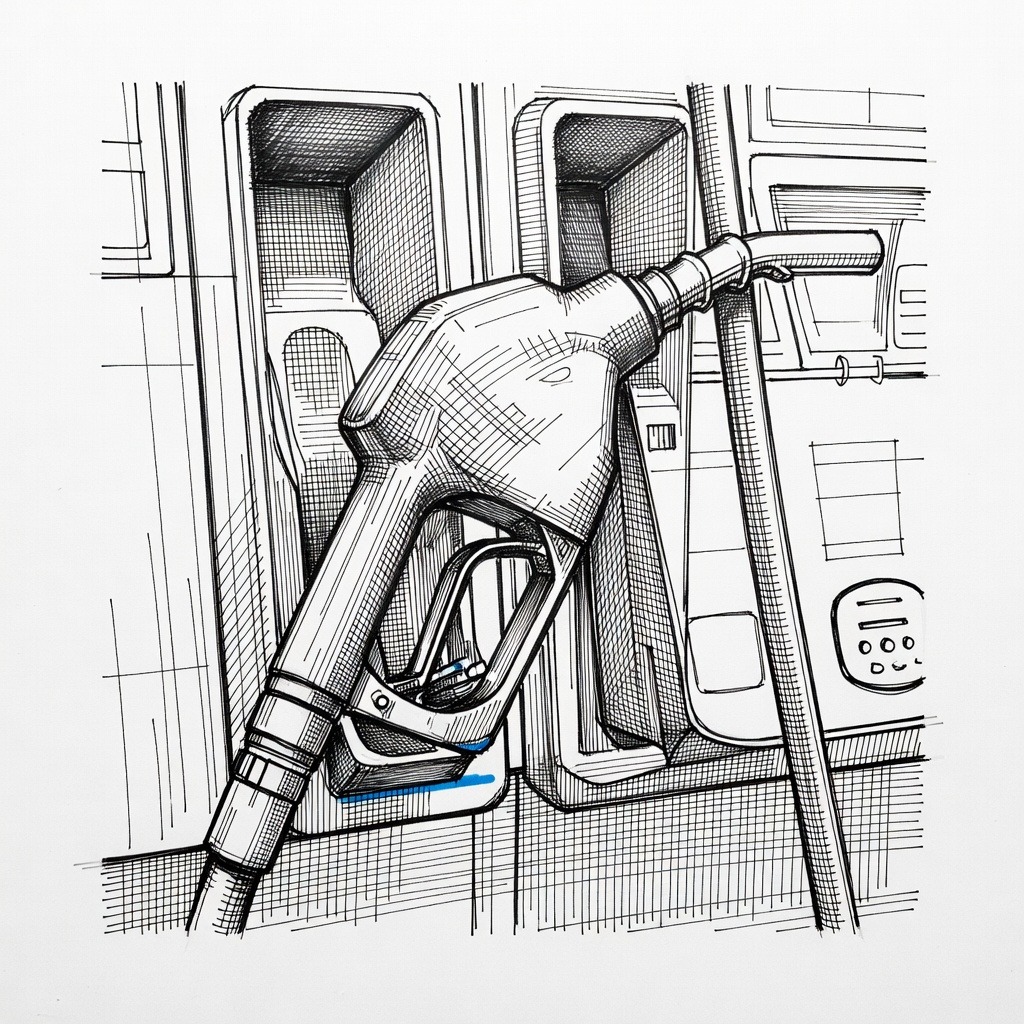
AI-generated illustration. Visual interpretation does not represent real individuals or scenes.
President Trump Calls for Justice Department Probe into Gas Prices
2026-06-24
The BareStory
President Donald Trump has called for the Department of Justice to investigate major oil companies over alleged price gouging at the gas pump. The directive, announced via social media, coincides with ongoing peace negotiations between the United States and Iran.
Trump claimed that while the cost of crude oil has fallen, companies are not lowering consumer gasoline prices at a matching rate. He demanded faster price reductions but did not specify which corporations would face scrutiny. According to AAA, national gas averages recently dropped below $4 per gallon.
The elevated fuel costs follow a disruption in the Strait of Hormuz, which was closed by Iran earlier in the year amid military conflicts involving the U.S. and Israel. Oil prices have begun to decline as delegations from Washington and Tehran participate in the current diplomatic talks.
The status of the waterway remains a central issue in the negotiations. Trump stated that Iranian officials told American negotiators that no tolls or charges are being imposed on vessels traversing the strait, warning that the talks would immediately end if that information proves false.
Left Perspective
Shield Against Corporate Extraction
Exposing the Geopolitical Smokescreen
Gamble of Performative Accountability
Right Perspective
Defending Natural Market Mechanics
Anchoring Stability in Deterrence
Chilling Domestic Energy Capital
Left Perspective
• Shield Against Corporate Extraction
Prioritizing working-class prosperity requires aggressive intervention when corporate monopolies exploit captive markets. The observed lag between falling crude costs and stagnant retail gasoline prices validates long-held suspicions of asymmetric pricing—a mechanism where companies instantly hike rates during a crisis but artificially delay reductions. Directing the Department of Justice to investigate these entities is viewed as a necessary deployment of federal power to stop unwarranted wealth extraction from the public.
• Exposing the Geopolitical Smokescreen
Protecting domestic consumers demands separating legitimate supply shocks from opportunistic profit-taking. While the initial closure of the Strait of Hormuz constrained supply, the active peace negotiations with Tehran and the corresponding drop in global crude prices eliminate the fundamental justification for high costs at the pump. From this perspective, oil companies are weaponizing the lingering uncertainty of Middle East conflicts as a smokescreen to maintain inflated, anti-consumer profit margins.
• Gamble of Performative Accountability
The primary hazard lies in the potential for this executive directive to serve as temporary political theater rather than an engine for structural reform. If the Justice Department fails to execute a systemic crackdown on monopolistic pricing behaviors, the underlying mechanisms of corporate extraction will remain perfectly intact. Without establishing permanent regulatory guardrails, these conglomerates are guaranteed to repeat this exploitative cycle during the next international disruption.
Right Perspective
• Defending Natural Market Mechanics
Systemic economic stability relies on allowing complex supply chains to function without heavy-handed executive interference. The discrepancy between dropping crude costs and retail gasoline remaining near $4 per gallon is understood as a standard logistical lag—dictated by refining costs and long-term distribution contracts—rather than malicious gouging. Weaponizing the Department of Justice to force rapid retail price reductions is viewed as a populist distortion of free-market principles that punishes private enterprise for natural economic friction.
• Anchoring Stability in Deterrence
True market efficiency is downstream of robust national security and the uninterrupted flow of global trade. The root cause of the initial fuel price spike was an artificial supply shock created by Iran closing the Strait of Hormuz, not domestic corporate policy. Leveraging the explicit threat of terminating peace negotiations to ensure the waterway remains toll-free is praised as an essential application of strategic realism, directly addressing the true systemic risk to global energy markets.
• Chilling Domestic Energy Capital
The overarching risk is that politically motivated federal probes will disincentivize domestic energy production and paralyze vital capital investment. Threatening unspecified major oil companies with legal scrutiny over natural market lags introduces severe regulatory uncertainty, which inherently freezes supply-side expansion. Over the long term, this hostility toward private capital risks eroding domestic production capacity, ironically leaving American consumers far more vulnerable to future foreign supply shocks.
How it may affect me
As a U.S. reader:
• In the short term, you may experience faster reductions in retail gasoline prices if the Department of Justice investigation forces energy companies to align pump prices with falling crude oil costs.
• Your daily fuel costs remain tied to international developments, as the success or failure of ongoing diplomatic talks with Iran regarding the Strait of Hormuz will directly influence global oil supply and pricing.
• In the long term, if this probe leads to the establishment of permanent regulatory guardrails, you could be shielded from sudden, artificial retail price hikes during future geopolitical crises.
• Conversely, the threat of federal legal scrutiny could discourage energy companies from investing in domestic infrastructure, which over the long term may reduce local production and leave you more vulnerable to foreign supply shocks.