
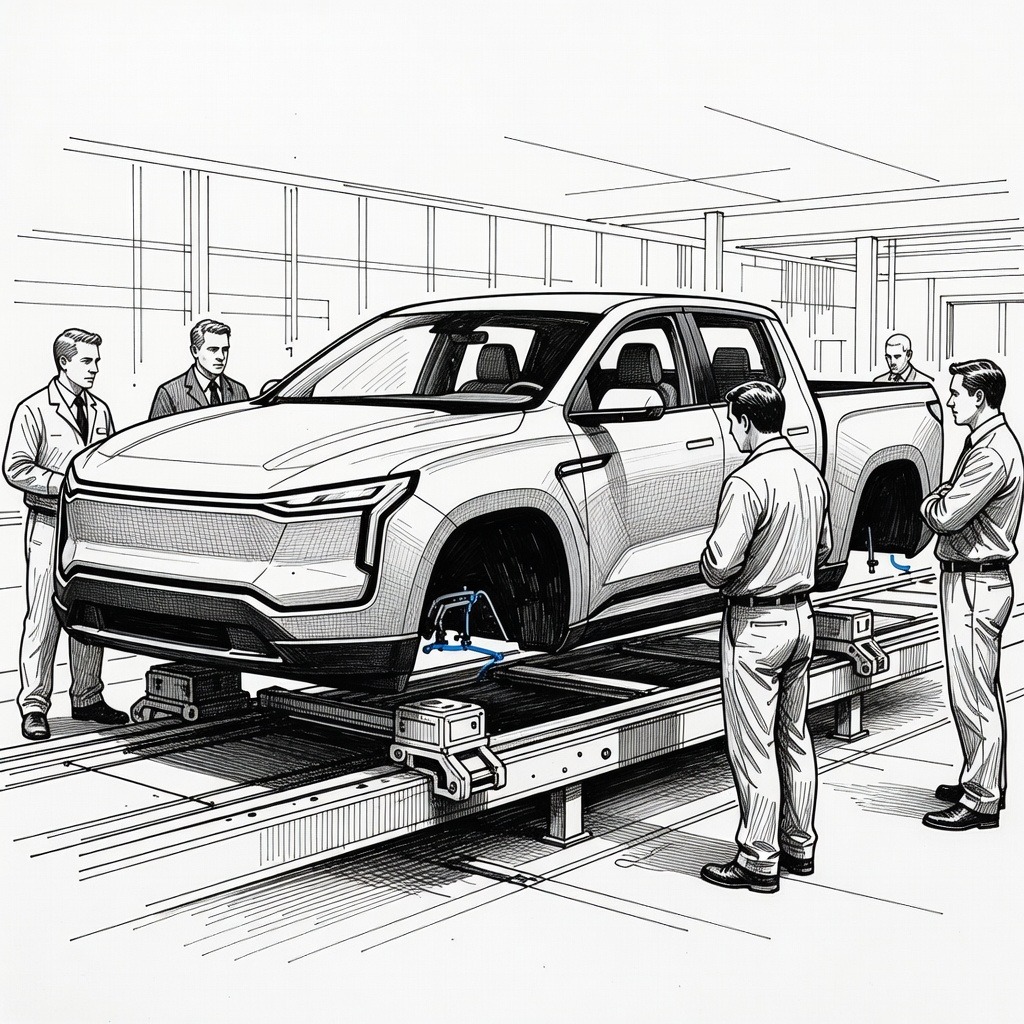
• Democratize Green Tech Access Prioritizing social equity requires making environmental sustainability affordable for the working and middle classes. Slate Auto’s $24,950 entry price challenges an auto industry that has historically restricted electric vehicles to affluent early adopters. By utilizing a modular design with an unpainted composite exterior and crank windows, the company rejects luxury bloat in favor of practical utility. This no-frills approach successfully lowers the barrier to entry, ensuring the socioeconomic benefits of clean transit can reach a much broader demographic.
• Shift Risk to Consumers The transition from $50 refundable reservations to $300 nonrefundable down payments functions as a corporate transfer of financial liability. Despite being backed by massive private capital from investors like Amazon founder Jeff Bezos, Slate is leaning on retail buyers to subsidize its operational cash flow. Asking consumers to forfeit nonrefundable capital for a vehicle that has not yet passed required federal safety and range certifications represents an extractive funding model. This structure protects institutional investors while forcing ordinary buyers to shoulder the ultimate risk of startup failure.
• Expose Vulnerabilities in Scaling The mandate to rapidly reach an 80,000-vehicle break-even threshold threatens to prioritize aggressive investor timelines over workforce stability and product reliability. Currently assembling only three cars a day through heavy manual labor in Warsaw, Indiana, the startup faces a massive, precarious leap to implement standard mass production by August. Pushing a workforce to scale at this unprecedented speed raises alarms about potential corner-cutting on the factory floor. Rushing hand-assembled prototypes into mass production ahead of federal validation risks exploiting manufacturing labor and compromising consumer safety.
How it may affect me
As a U.S. reader:
• You now have a more affordable entry point into the electric vehicle market, as the $24,950 starting price omits traditional features like exterior paint and power windows to make clean transit accessible to a broader demographic.
• In the short term, securing a vehicle requires you to assume financial risk by making a $300 nonrefundable down payment for a truck that has not yet passed mandatory federal safety and range certifications.
• You will have the option to upgrade the base rear-wheel-drive pickup into a five-passenger sport utility vehicle for an additional $5,000, requiring a choice between stripped-down utility and expanded passenger capacity.
• Long-term delivery schedules and initial vehicle reliability could be impacted if the company encounters federal regulatory delays or struggles to safely scale its Warsaw, Indiana, plant from hand-assembling three cars a day to automated mass production by August.