
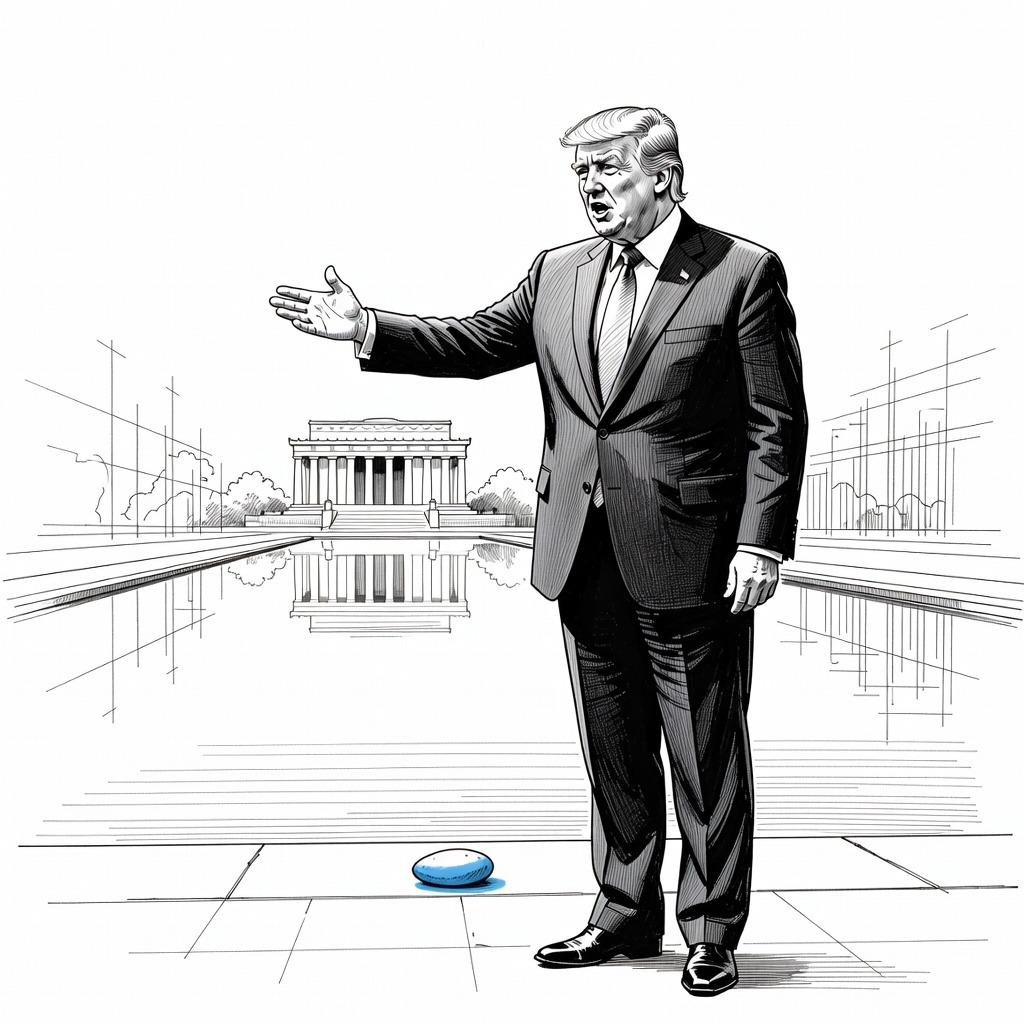
AI-generated illustration. Visual interpretation does not represent real individuals or scenes.
Administration Announces Reflecting Pool Repairs Amid Broader D.C. Construction Disputes
2026-06-24
The BareStory
President Donald Trump announced that the Lincoln Memorial Reflecting Pool will be partially drained around the Fourth of July to undergo permanent repairs. The repairs follow a recent $16 million taxpayer-funded renovation, initiated by a presidential directive, to install a new filtration system and paint the pool blue ahead of the 250th anniversary of U.S. independence. Following the initial renovation, the pool experienced peeling paint and algae growth.
Trump attributed the pool's damage to vandalism, claiming individuals used sharp instruments to intentionally cut and lift sections of the pool bottom. The administration and the Interior Department reported multiple arrests and federal citations related to the site, though the exact figures provided by officials have varied between five and six arrests. Neither the president nor investigating agencies have released evidence of intentional damage, and an Interior Department spokesperson previously cited dormant supply lines as the cause of the algae.
The Reflecting Pool work is part of a wider series of Washington, D.C., construction initiatives launched during Trump's second term. The administration also initiated the demolition of the White House East Wing by Clark Construction to build a 90,000-square-foot ballroom, which officials argued would improve security for major gatherings. However, a lower court temporarily halted the ballroom's construction pending congressional approval after a historic preservation group filed a lawsuit.
Additional administration projects include a planned 250-foot arch near Arlington National Cemetery and rebuilding efforts at Lafayette Park. Another initiative faced legal intervention when a federal judge reversed a decision by the board of the John F. Kennedy Center for the Performing Arts to temporarily close the facility and rename it the Trump-Kennedy Center. Following the court's ruling, the board established a private endowment in the president's name.
Left Perspective
Expose Administrative Fiscal Waste
Enforce Strict Democratic Checks
Shield Shared Cultural Heritage
Right Perspective
Enforce Strict Civic Order
Prioritize Executive Security Upgrades
Project Sovereign National Grandeur
Left Perspective
• Expose Administrative Fiscal Waste
Government accountability requires strict scrutiny over taxpayer expenditures and public infrastructure projects. The $16 million Reflecting Pool renovation is viewed as a definitive failure of executive competence, evidenced by the immediate emergence of peeling paint and algae. By highlighting the Interior Department’s own admission regarding dormant supply lines, this perspective rejects the administration’s unsubstantiated vandalism claims, framing the July 4th repairs as an attempt to mask mismanagement and deflect responsibility.
• Enforce Strict Democratic Checks
Protecting the republic from executive overreach necessitates rigid adherence to legislative oversight and the separation of powers. The demolition of the East Wing to construct a 90,000-square-foot ballroom without congressional approval is interpreted as a blatant circumvention of constitutional checks and balances. The lower court’s intervention is celebrated as a vital institutional defense mechanism, halting an unchecked expansion of presidential power that was packaged as a necessary security enhancement.
• Shield Shared Cultural Heritage
Public monuments and cultural institutions must remain insulated from personal branding and partisan co-optation. The attempted renaming of the Kennedy Center, alongside the planned 250-foot arch near Arlington National Cemetery, is seen as a dangerous erosion of shared national legacy. This camp fears that bypassing historic preservation groups to establish executive monuments and private endowments permanently damages the civic integrity and democratic neutrality of the nation's capital.
Right Perspective
• Enforce Strict Civic Order
Preserving the dignity of national monuments requires uncompromising adherence to the rule of law and the aggressive prosecution of vandalism. The arrests and federal citations surrounding the Reflecting Pool damage are viewed as a necessary defense of public spaces against intentional degradation. By ordering permanent repairs ahead of the 250th anniversary, the executive branch is fulfilling its duty to protect the nation's historical anchors, viewing conflicting bureaucratic narratives about algae as secondary to maintaining social order.
• Prioritize Executive Security Upgrades
Institutional continuity and operational safety must supersede the aesthetic preferences of preservationist groups. The 90,000-square-foot East Wing ballroom is understood as a vital, pragmatic modernization effort designed to secure major gatherings at the seat of government. The historic preservation lawsuit and subsequent court injunction halting construction are viewed as dangerous bureaucratic obstructionism, prioritizing red tape over the legitimate physical security requirements of the presidency.
• Project Sovereign National Grandeur
Celebrating American independence demands ambitious infrastructure initiatives that visually reinforce national strength and historical pride. Rebuilding Lafayette Park, proposing the Arlington arch, and establishing presidential endowments are interpreted as essential steps to honor the nation's heritage on the global stage. There is a deep concern that continuous legal interventions by lower courts undermine the executive branch's inherent authority to properly commemorate the country's legacy and project sovereignty.
How it may affect me
As a U.S. reader:
• In the short term, tourists and residents visiting Washington, D.C., around the Fourth of July will experience restricted access and active construction at the Lincoln Memorial Reflecting Pool due to partial draining and repair work.
• Taxpayers will bear the financial burden for these ongoing executive infrastructure projects, which currently include the initial 16 million dollar pool renovation and the costs of the newly ordered permanent repairs.
• Visitors to national monuments may encounter heightened security measures and stricter law enforcement, as authorities are actively issuing federal citations and making arrests to deter alleged vandalism at public sites.
• In the long term, Americans may navigate permanent structural and aesthetic alterations to the nation's historic landmarks, such as a blue Reflecting Pool, reconstructed areas of Lafayette Park, and a newly proposed 250-foot arch near Arlington National Cemetery.
• Public infrastructure and security modernization efforts at major federal facilities may face ongoing delays, as continued lawsuits between historic preservation groups and the administration result in court injunctions and demands for congressional approval.