
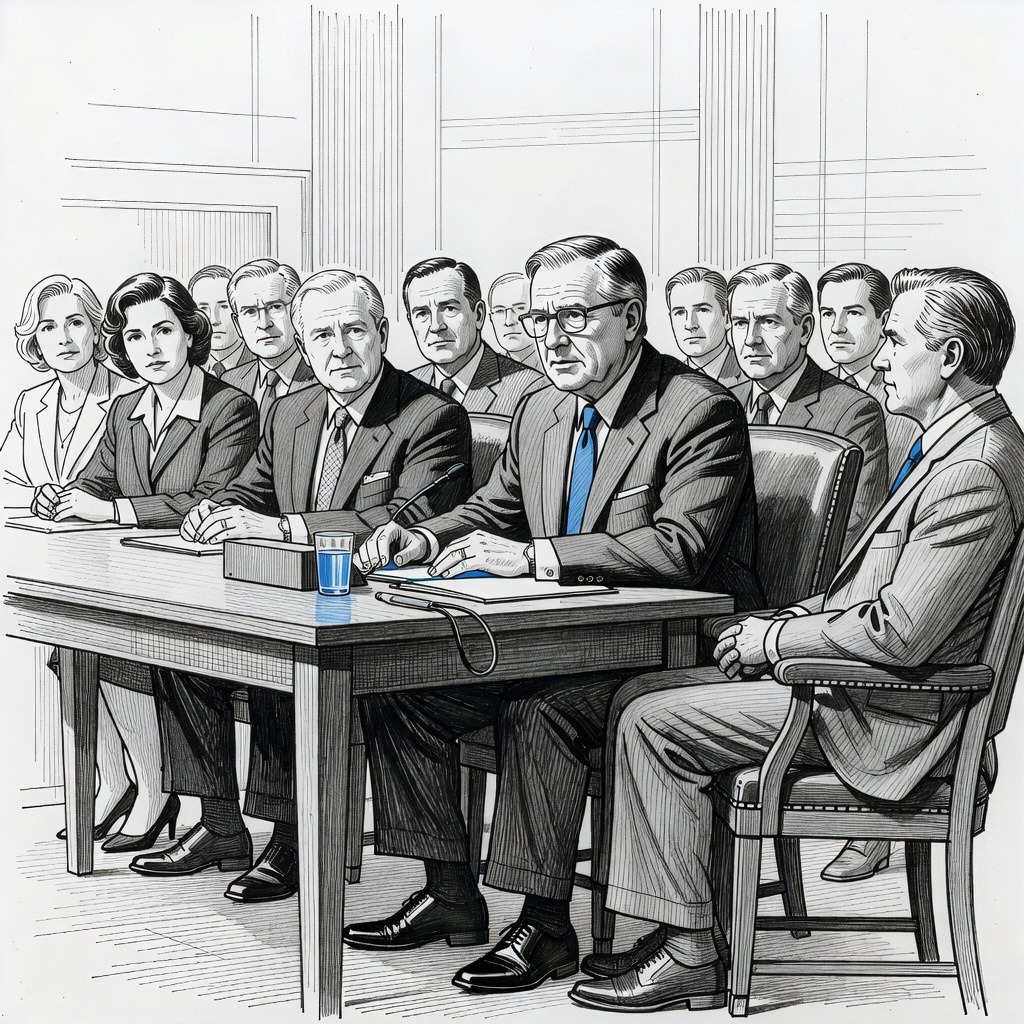
Former Federal Reserve Chairman Alan Greenspan Dies at 100

Illustration for: Former Federal Reserve Chairman Alan Greenspan Dies at 100
AI-generated illustration. Visual interpretation does not represent real individuals or scenes.

THE BARE STORY

Alan Greenspan, who served as chairman of the United States Federal Reserve for nearly two decades, died Monday at the age of 100. His wife, Andrea Mitchell, announced his passing in a statement, noting that he died at home from complications of Parkinson’s disease.

Appointed to five consecutive terms, Greenspan led the central bank from 1987 until his retirement in 2006. He steered U.S. monetary policy through several major events, notably expanding bank reserves to provide emergency liquidity following the 1987 stock market crash. During the economic boom of the 1990s, he shifted the central bank toward data-dependent interest rate targeting and publicly cautioned financial markets about "irrational exuberance."

While recognized for facilitating a historically long economic expansion, Greenspan also faced scrutiny for his regulatory philosophy. Critics have claimed that his preference for low interest rates and limited regulation helped fuel a housing bubble that worsened the 2008 global financial crisis. Later that year, Greenspan acknowledged to a congressional committee that he made an error in assuming financial organizations could adequately protect their own shareholders.

Before his lengthy career in economics, Greenspan studied music at Juilliard and played in a swing band. As he transitioned into finance and government advisory roles, he developed a free-market ideology heavily influenced by his close, decades-long friendship with novelist Ayn Rand, who remained a central figure in his intellectual circle until her death in 1982.

Same Facts. Different Perspectives.

Two AI models. Two viewpoints. One factual foundation.

• Engine of Historic Expansion Broad national prosperity is best achieved by incentivizing capital deployment and minimizing bureaucratic friction. By steering the central bank toward data-dependent interest rate targeting, Greenspan laid the pragmatic monetary foundation for the massive economic boom of the 1990s. This historically long expansion validates his free-market ideology, demonstrating that allowing private enterprise to operate with minimal regulatory burden is the most effective engine for widespread wealth creation.

• Shield Against Systemic Panic Preserving systemic stability during sudden black-swan events requires decisive intervention to maintain capital liquidity and prevent market paralysis. Greenspan demonstrated this essential market realism by rapidly expanding bank reserves to provide emergency liquidity immediately following the 1987 stock market crash. By prioritizing capital mobility during an acute shock, he successfully insulated the broader economy from cascading institutional failures that would have decimated private savings.

• Calculated Risks of Capitalism Fostering a dynamic, growth-oriented economy inherently involves navigating volatile asset cycles and periods of "irrational exuberance." While critics directly blame his low-interest-rate preference for the 2008 housing bubble, this regulatory philosophy successfully funded decades of unprecedented innovation and commercial expansion. His 2008 congressional acknowledgment regarding the limits of shareholder self-protection reflects a technocrat’s intellectual adaptability, rather than a failure of the foundational free-market principles that defined his five terms.

How it may affect me

As a U.S. reader:

• Since Alan Greenspan retired from his role at the Federal Reserve in 2006, his passing is a historical event that is not expected to have any significant practical impact on current economic policy or the daily lives of the general public.

Read the story at

Note: All TheBareNews content is AI-generated. For additional context, reporting, and updates, you are invited to explore the news outlets linked above.