
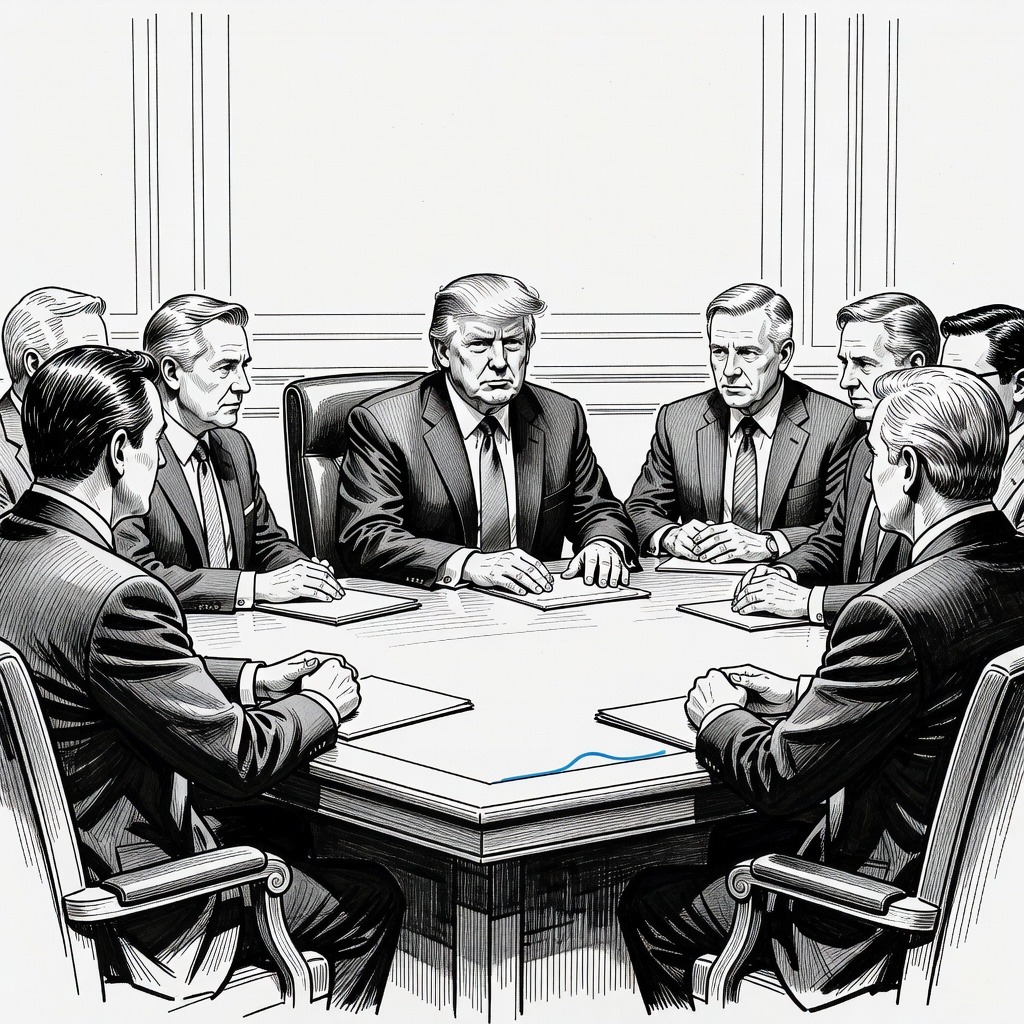
AI-generated illustration. Visual interpretation does not represent real individuals or scenes.
Kennedy Center Weighs Operational Options Following Court Order on Closure and Name Removal
2026-06-21
The BareStory
Lawyers representing the Kennedy Center informed a federal judge on Friday that the venue's board is evaluating future operational plans, including full, partial, or phased closures. The board is scheduled to vote on these recommendations in mid-July. This follows a May court order by U.S. District Judge Christopher Cooper that blocked a previously planned two-year closure of the performing arts center.
To comply with another of Judge Cooper's mandates, officials confirmed that workers removed President Donald Trump’s name from the building’s facade, digital platforms, and official communications on June 13. The removal took place after a federal appeals court denied a request to pause the directive. In his ruling, Judge Cooper determined that the board lacked the authority to unilaterally rename the center, stating that the power belongs exclusively to Congress.
The operational filings are part of an ongoing lawsuit initiated by Representative Joyce Beatty. In a new court submission on Friday, Beatty’s attorneys accused the board, which is chaired by President Trump, of attempting to bypass the court order and shut down the center through inaction. Representatives for the Kennedy Center countered that the judge's order did not explicitly require the board to reschedule canceled programming or strictly prohibit closures necessary for renovations.
The legal dispute follows leadership changes made to the center's management in early 2025. After appointing new trustees and being elected chairman, President Trump and the board voted to add his name to the venue and institute the two-year closure, actions the federal court subsequently halted.
Left Perspective
Halt Unilateral Executive Co-optation
Expose Bad-Faith Institutional Sabotage
Shield Civic Cultural Heritage
Right Perspective
Defend Legitimate Administrative Discretion
Check Intrusive Judicial Overreach
Protect Lawful Executive Prerogative
Left Perspective
• Halt Unilateral Executive Co-optation
Prioritizing strict government accountability, this framework views the June 13 removal of President Trump’s name from the center's facade and digital platforms as a vital restoration of democratic checks and balances. By anchoring to Judge Christopher Cooper’s ruling that renaming authority belongs exclusively to Congress, this perspective interprets the judicial intervention as a necessary firewall against a newly appointed board attempting to bypass legislative consent for personal or political branding.
• Expose Bad-Faith Institutional Sabotage
Rooted in the obligation to protect public goods from systemic manipulation, this logic interprets the board's current evaluation of full or phased closures as a hostile legal workaround. Representative Joyce Beatty’s lawsuit perfectly captures this camp's suspicion, arguing that the board's upcoming mid-July votes are a calculated attempt to achieve the halted two-year closure through manufactured inaction, intentionally depriving the public of a taxpayer-funded civic asset.
• Shield Civic Cultural Heritage
The primary long-term priority is defending vulnerable public institutions from rapid ideological capture or operational dismantling. The aggressive early 2025 leadership changes—where a newly configured board immediately moved to shutter the center and rebrand it—are viewed as a dangerous blueprint for institutional weaponization that, if left unchecked by federal courts, could fundamentally erase the independence of national cultural landmarks.
Right Perspective
• Defend Legitimate Administrative Discretion
Grounded in a commitment to institutional continuity and structural order, this perspective views the board’s mid-July vote on operational closures as the lawful execution of its managerial duties. Because representatives accurately note that the court order did not explicitly prohibit closures necessary for renovations, the newly elected leadership under President Trump is seen as properly exercising its legal mandate to manage logistics and facility upgrades without legislative micromanagement.
• Check Intrusive Judicial Overreach
Prioritizing the strict separation of powers and effective governance, this framework interprets Judge Cooper’s May mandate and the subsequent appeals court denial as an improper expansion of judicial authority into daily operations. The forced June 13 removal of the chairman's name and the blocking of a planned two-year strategic closure are viewed as disruptive legal interventions that paralyze a legally appointed governing body's ability to implement strategic changes.
• Protect Lawful Executive Prerogative
The underlying long-term fear centers on the erosion of executive-appointed authority by sustained, adversarial litigation. If lawsuits like Representative Beatty’s can successfully use federal courts to freeze the operational decisions of legally appointed trustees from early 2025, it threatens the fundamental stability of administrative law, signaling that future appointed boards will be functionally powerless to enact organizational reforms.
How it may affect me
As a U.S. reader:
• Short-term access to the Kennedy Center remains uncertain, as the board will vote in mid-July on potential full, partial, or phased closures and is not currently required by the court to reschedule canceled programming.
• Visitors and online users will notice immediate outward changes to the institution, as President Trump's name has been completely removed from the building's physical facade, digital platforms, and official communications to comply with a judicial mandate.
• Depending on whether the board enacts future operational closures, the public may temporarily lose access to a taxpayer-funded civic asset, though these closures are argued to be necessary for long-term facility renovations and logistical upgrades.
• Over the long term, the outcome of this lawsuit will affect how publicly funded national cultural landmarks are governed by setting a legal precedent for whether appointed executive boards can unilaterally suspend operations, enact structural reforms, or rebrand venues without congressional approval.