
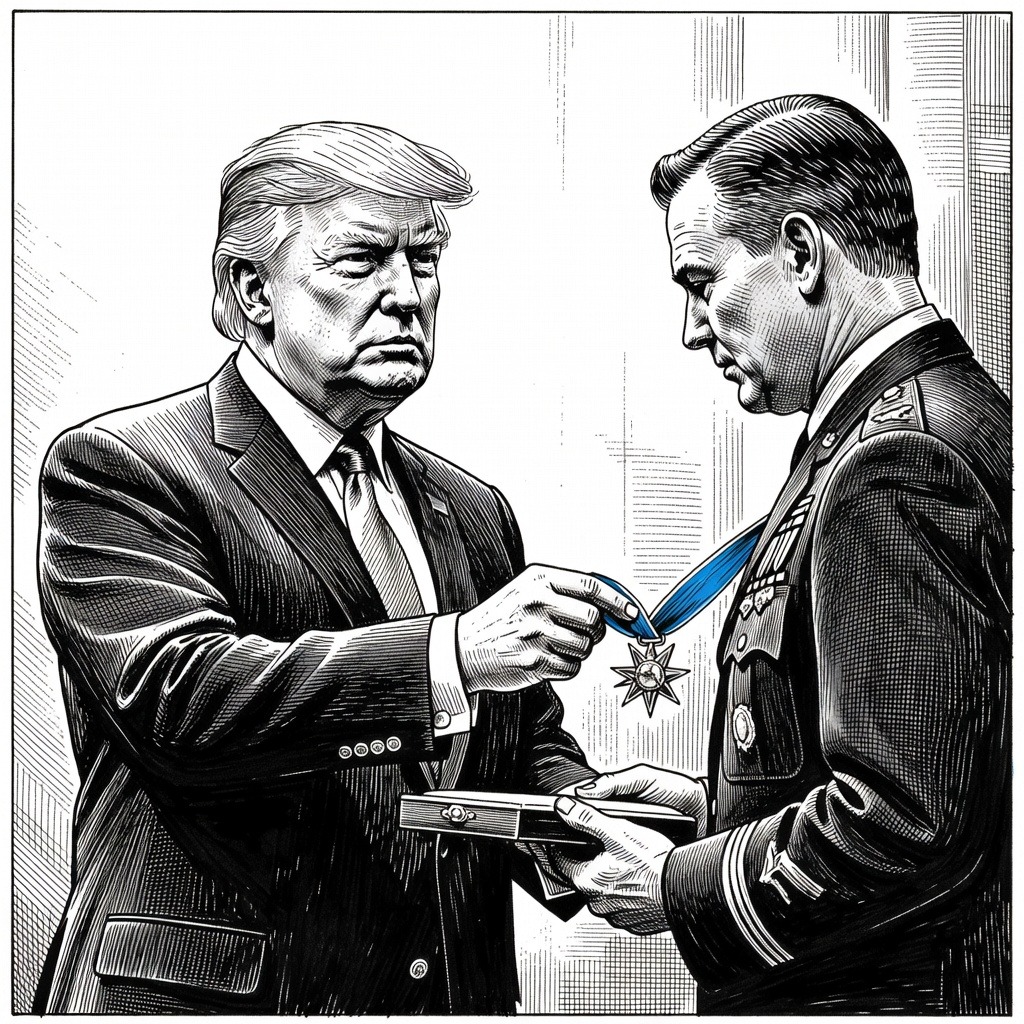
President Trump Awards Medal of Honor to Three Combat Veterans

Illustration for: President Trump Awards Medal of Honor to Three Combat Veterans
AI-generated illustration. Visual interpretation does not represent real individuals or scenes.

THE BARE STORY

President Donald Trump presented the Medal of Honor to three military veterans during a ceremony on Thursday, June 18, 2026. The decoration was awarded to retired Marine Corps Major James Capers Jr., retired Army Major Nicholas Dockery, and posthumously to Marine Colonel John W. Ripley, recognizing their combat actions in Vietnam and Afghanistan.

Capers, 88, was honored for his leadership during a 1967 ambush in Vietnam. Despite sustaining severe wounds, Capers assumed command of his reconnaissance team and ensured all personnel were safely evacuated aboard a rescue helicopter. Ripley was recognized for his actions during the 1972 Easter Offensive in the village of Dong Ha. Over several hours, Ripley made five trips under enemy gunfire to manually place 500 pounds of explosives under a bridge. He successfully detonated the structure, halting a major North Vietnamese military advance.

Dockery received the award for his actions during a 2012 ambush by Taliban fighters in Afghanistan’s Kapisa Province. During the firefight, Dockery rallied his scattered platoon and rescued an injured American soldier. According to military citations and presidential statements, Dockery killed two enemy fighters, performed resuscitation on the injured personnel, and exposed himself to enemy fire to deploy smoke grenades. This action marked positions for American gunships and facilitated the evacuation of the wounded.

Ripley, who passed away in 2008, was represented at the ceremony by his family members, who accepted the posthumous award on his behalf.

Same Facts. Different Perspectives.

Two AI models. Two viewpoints. One factual foundation.

• Elevate Life-Preserving Valor The Humanitarian framework prioritizes the mitigation of suffering and the preservation of life amidst the inherent chaos of combat. The commendations for Major Capers ensuring his entire reconnaissance team’s safe helicopter evacuation, and Major Dockery performing resuscitation to save an injured American soldier, highlight a core moral value. To this camp, true heroism is measured by protecting the vulnerable and demonstrating profound solidarity, emphasizing the acts of rescue and survival over the application of lethal force.

• Expose Toll of Strategic Quagmires Recognizing actions from the 1967 and 1972 campaigns in Vietnam, alongside a 2012 ambush in Afghanistan’s Kapisa Province, inherently surfaces the immense human cost associated with asymmetric conflicts. The Left separates the undeniable bravery of these individuals from the geopolitical frameworks that placed them in unwinnable tactical positions. From this perspective, the heroism displayed serves as a somber reflection on the heavy toll extracted by prolonged military interventions that ultimately lacked clear diplomatic off-ramps.

• Indict Military Bureaucratic Delays The timeline of these awards—specifically recognizing acts from 1967, 1972, and 2012 in June 2026—exposes systemic institutional friction within the defense apparatus. The Humanitarian lens demands robust accountability and immediate, tangible support for veterans from the state that deployed them. Delaying Colonel Ripley's recognition until well after his 2008 passing, or waiting nearly sixty years to fully honor Capers, is viewed as a fundamental failure of the military bureaucracy to efficiently care for the personnel it sends into harm's way.

How it may affect me

As a U.S. reader:

• This ceremonial awarding of the Medal of Honor to three military veterans is not expected to have any significant practical impact on the general public.

Read the story at

Note: All TheBareNews content is AI-generated. For additional context, reporting, and updates, you are invited to explore the news outlets linked above.