
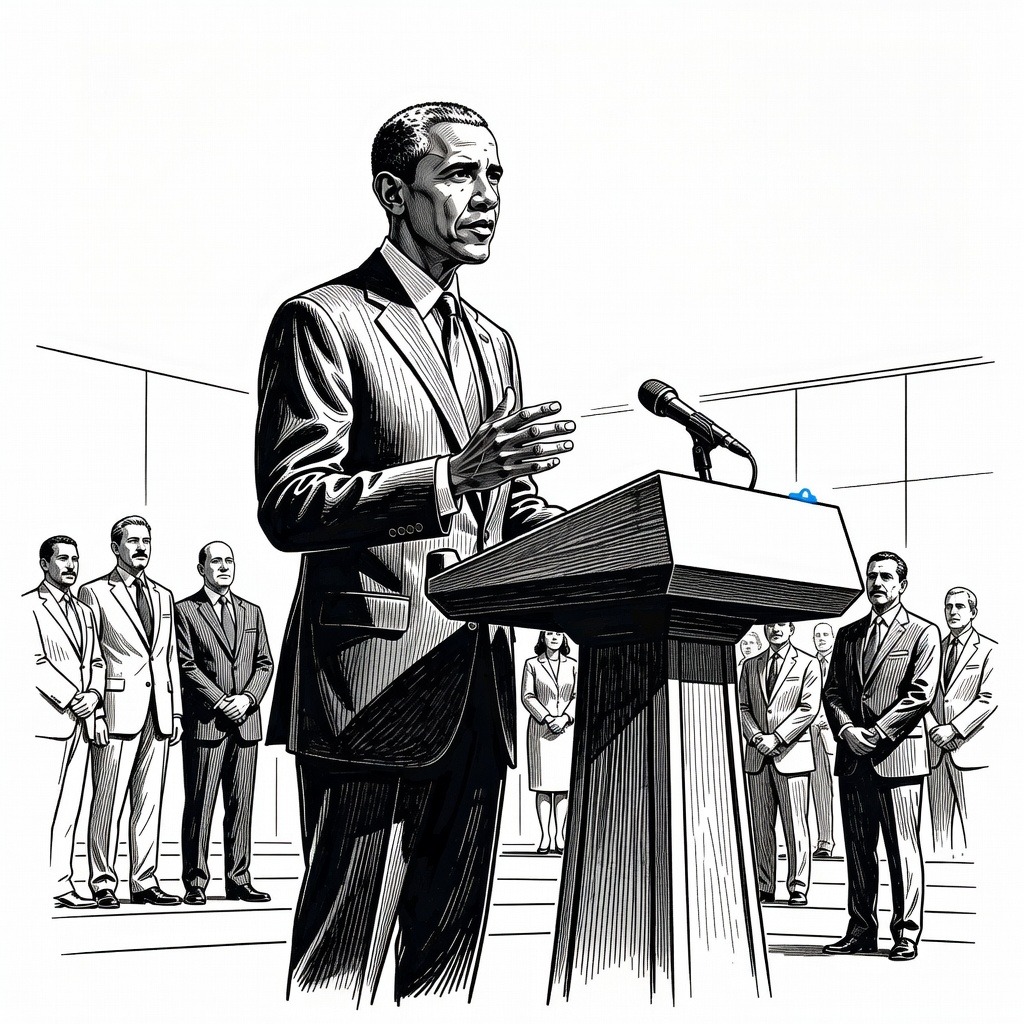
AI-generated illustration. Visual interpretation does not represent real individuals or scenes.
Obama Presidential Center Opens in Chicago with Star-Studded Dedication
2026-06-18
The BareStory
The Obama Presidential Center is set to officially open this week on a 19-acre campus on Chicago's South Side. An invite-only dedication ceremony is scheduled for Thursday, followed by public access to the museum on Friday. The launch event features an address from former President Barack Obama and musical performances by artists including Bruce Springsteen and Stevie Wonder.
Managed by the non-profit Obama Foundation, the facility has been in development for nearly a decade. The campus includes a tall museum building, a branch of the Chicago Public Library, and various public recreational spaces. Organizers noted the facility is not a traditional presidential library and will not house Obama's official presidential documents, which remain with the National Archives.
Organizers invited all living former U.S. presidents to the Thursday ceremony, with the exception of Donald Trump. Obama Foundation CEO Valerie Jarrett stated that Trump was not invited to the dedication but is welcome to tour the facility at a later date. While Jarrett described the center as officially non-partisan, several political strategists and donors characterized the opening as a major networking and fundraising gathering for the Democratic Party ahead of upcoming elections.
During a private reception ahead of the opening, Obama stated that ordinary citizens are disadvantaged by institutions focused on wealth and fame, claiming such organizations have fallen victim to greed. Locally, the project's construction previously faced legal challenges from activists who expressed concerns that the center would lead to gentrification and displace low-income residents. Conversely, corporate donors backing the project have argued the facility will spark economic growth on the South Side.
Left Perspective
Pivot to Civic Utility
Shield Against Urban Displacement
Audit of Corporate Alignment
Right Perspective
Fracture of Institutional Continuity
Erosion of Civic Decorum
Engine for Partisan Mobilization
Left Perspective
• Pivot to Civic Utility
The progressive framework prioritizes active community benefit over static historical preservation. By choosing not to house official documents under the traditional National Archives structure, the Obama Foundation reallocates spatial and financial resources toward a public library branch and recreational areas. This deliberate shift dismantles the conventional, top-down monument model, transforming the campus into a functional tool designed for local social progress and public engagement.
• Shield Against Urban Displacement
Protecting marginalized populations from systemic extraction remains a non-negotiable priority for this camp. The decade-long development faced direct legal challenges from local activists who identified the 19-acre mega-project as a dangerous catalyst for gentrification. From this perspective, the promise of corporate-backed economic growth is viewed with deep suspicion because such development historically prices out and displaces the vulnerable, low-income legacy residents of Chicago's South Side.
• Audit of Corporate Alignment
Reformers demand strict consistency between anti-corporatist rhetoric and political reality. During a private reception, Obama condemned institutions driven by wealth and greed for disadvantaging ordinary citizens, reflecting core progressive critiques of capital. However, this camp scrutinizes the systemic friction of delivering this populist message at an invite-only dedication heavily backed by corporate donors, featuring celebrity performances, and operating as a premier networking hub for Democratic elites.
Right Perspective
• Fracture of Institutional Continuity
The traditionalist lens highly values established civic systems and the standardized rule of law. By opting out of the traditional presidential library model and leaving official documents with the National Archives, the center effectively breaks a decades-old framework of historical transparency. This privatization of a presidential legacy under an independent non-profit foundation is viewed as an intentional circumvention of formal federal oversight, directly undermining institutional continuity.
• Erosion of Civic Decorum
Preserving social order requires upholding the dignity of national offices above temporary personal or partisan disputes. Organizers explicitly excluded Donald Trump from an otherwise universal invitation to all living former U.S. presidents. Traditionalists interpret this deliberate snub not as a moral victory, but as a degradation of systemic norms, sacrificing the institutional solidarity of the presidential fraternity for immediate political theater.
• Engine for Partisan Mobilization
The Right remains highly vigilant against the institutional capture of ostensibly neutral civic organizations. While the Obama Foundation legally designates the center as a non-partisan entity, political strategists openly recognize the opening as a massive networking and fundraising operation ahead of upcoming elections. Traditionalists see this as a manipulation of the non-profit structure, utilizing tax-advantaged philanthropy as a covert apparatus to consolidate Democratic power and influence.
How it may affect me
As a U.S. reader:
• In the short term, local residents and visitors will gain access to new public amenities on Chicago's South Side, including a museum, a public library branch, and recreational spaces, rather than a traditional historical archive.
• Over the long term, local residents may experience significant economic shifts in their neighborhoods, which could manifest as regional economic growth or as gentrification that displaces vulnerable, low-income populations.
• Citizens and researchers looking to access official presidential documents from the Obama administration will need to utilize the federal National Archives instead of visiting this facility, as the center operates independently of federal oversight.
• In the near term, voters may be indirectly impacted by increased political mobilization and campaign financing, as the center's opening events are acting as a major networking and fundraising hub for the Democratic Party ahead of upcoming elections.