
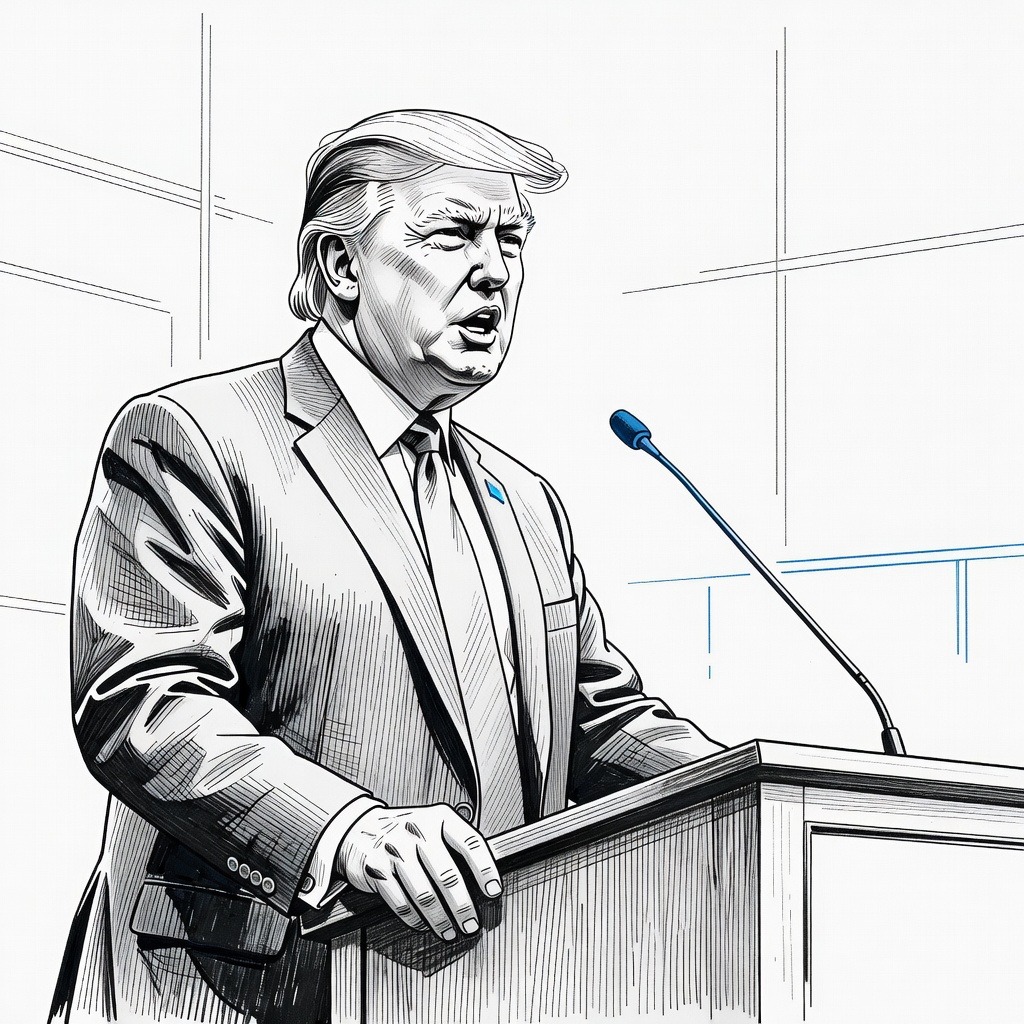
AI-generated illustration. Visual interpretation does not represent real individuals or scenes.
Senate Postpones Confirmation Hearing for DNI Nominee Jay Clayton
2026-06-17
The BareStory
The Senate Intelligence Committee postponed Wednesday's confirmation hearing for Jay Clayton, the nominee for director of national intelligence. The delay occurred after President Donald Trump directed Clayton not to attend the proceedings. Trump announced that the confirmation process will remain halted until the Senate approves Jamie McDonald to replace Clayton in his current role as the United States Attorney for the Southern District of New York.
The president stated that Bill Pulte will continue serving as the acting director of national intelligence in the interim. Following the president's directive, Senate Intelligence Chairman Tom Cotton postponed the hearing but expressed intent to proceed at a later date. Senate Majority Leader John Thune indicated that lawmakers are taking a day-by-day approach while awaiting further clarity from the White House. Democratic lawmakers, including Senators Chuck Schumer and Mark Warner, criticized the intervention, accusing the administration of creating chaos and undermining the legislative process.
The delay complicates ongoing efforts to reauthorize Section 702 of the Foreign Intelligence Surveillance Act, a warrantless surveillance program that expired late last week. Lawmakers have faced a legislative impasse regarding the program's renewal. Democrats have refused to pass an extension while Pulte remains in the acting director role. Critics have alleged that Pulte lacks intelligence experience and previously used a federal housing position to initiate probes into the president's political opponents.
In contrast, President Trump claimed that Democrats broke a prior agreement to vote for the intelligence reauthorization. The president has demanded that the surveillance act be extended only if it is passed alongside a pending elections measure known as the SAVE America Act.
Left Perspective
Shielding Legislative Independence
Blocking Partisan Weaponization
Rejecting Transactional Governance
Right Perspective
Forcing Personnel Continuity
Prioritizing Security Infrastructure
Leveraging Sovereign Imperatives
Left Perspective
• Shielding Legislative Independence
Government accountability demands strict adherence to the separation of powers and formal oversight. By directing Jay Clayton to boycott his own confirmation hearing to force Senate action on Jamie McDonald’s SDNY appointment, the executive branch is actively subverting the legislature's constitutional duty. Lawmakers like Chuck Schumer and Mark Warner view this intervention as a dangerous erosion of the Senate's mandate to independently vet intelligence chiefs free from executive coercion.
• Blocking Partisan Weaponization
Civil liberties require that sweeping state powers remain strictly insulated from unvetted political loyalists. Democrats are refusing to reauthorize the expired Section 702 warrantless surveillance program precisely because Acting DNI Bill Pulte lacks intelligence experience and allegedly used a prior federal post to investigate political rivals. Handing renewed surveillance authority to an acting official with a history of alleged politicization represents an unacceptable risk of institutional abuse.
• Rejecting Transactional Governance
Institutional integrity fractures when critical national operations are treated as bargaining chips for unrelated partisan legislation. The administration's demand to tie the Section 702 surveillance extension to the SAVE America Act introduces calculated chaos into the deliberative process. This camp fears that allowing intelligence reauthorization to be held hostage for an elections measure sets a destructive precedent, permanently degrading legislative norms and leaving civil frameworks vulnerable to executive extortion.
Right Perspective
• Forcing Personnel Continuity
Systemic stability requires a fully staffed and aligned executive branch to seamlessly enforce the rule of law. Halting Jay Clayton’s DNI confirmation to force the Senate to act on Jamie McDonald’s SDNY appointment is a pragmatic assertion of executive leverage against legislative inertia. From a unitary executive framework, utilizing this tactical maneuver ensures that vital justice and intelligence nodes are not left vacant or misaligned by prolonged procedural delays.
• Prioritizing Security Infrastructure
National sovereignty depends on the unbroken maintenance of essential strategic tools. The expiration of Section 702 represents a dangerous lapse in foundational security, which the administration notes is the result of broken legislative agreements by Democrats. Allowing a vital surveillance program to stall over political grievances regarding Acting DNI Bill Pulte is viewed as a reckless abdication of civic duty that explicitly prioritizes partisan optics over national security readiness.
• Leveraging Sovereign Imperatives
Maximizing political capital to secure foundational state order is a core tenet of strategic realism. By demanding that the Section 702 reauthorization be passed concurrently with the SAVE America Act, the executive is effectively bundling intelligence capabilities with domestic electoral integrity. This camp interprets this maneuver not as chaos, but as a calculated consolidation of institutional priorities, ensuring that must-pass security extensions also fortify vulnerabilities within the nation's civic systems.
How it may affect me
As a U.S. reader:
• In the short term, the expiration of the Section 702 surveillance program temporarily suspends a federal tool used for foreign intelligence gathering, which may impact national security readiness.
• This same legislative lapse temporarily halts sweeping warrantless surveillance powers, an outcome that critics argue protects the civil liberties of citizens from potential partisan abuse by unconfirmed acting officials.
• Because the executive branch is demanding that intelligence reauthorization be paired with the SAVE America Act, the public could see new domestic election measures enacted as a direct result of this national security impasse.
• In the long term, using intelligence confirmations as leverage to force action on unrelated legal appointments may lead to prolonged legislative gridlock, leaving essential justice and security positions unfilled or managed by temporary staff.