
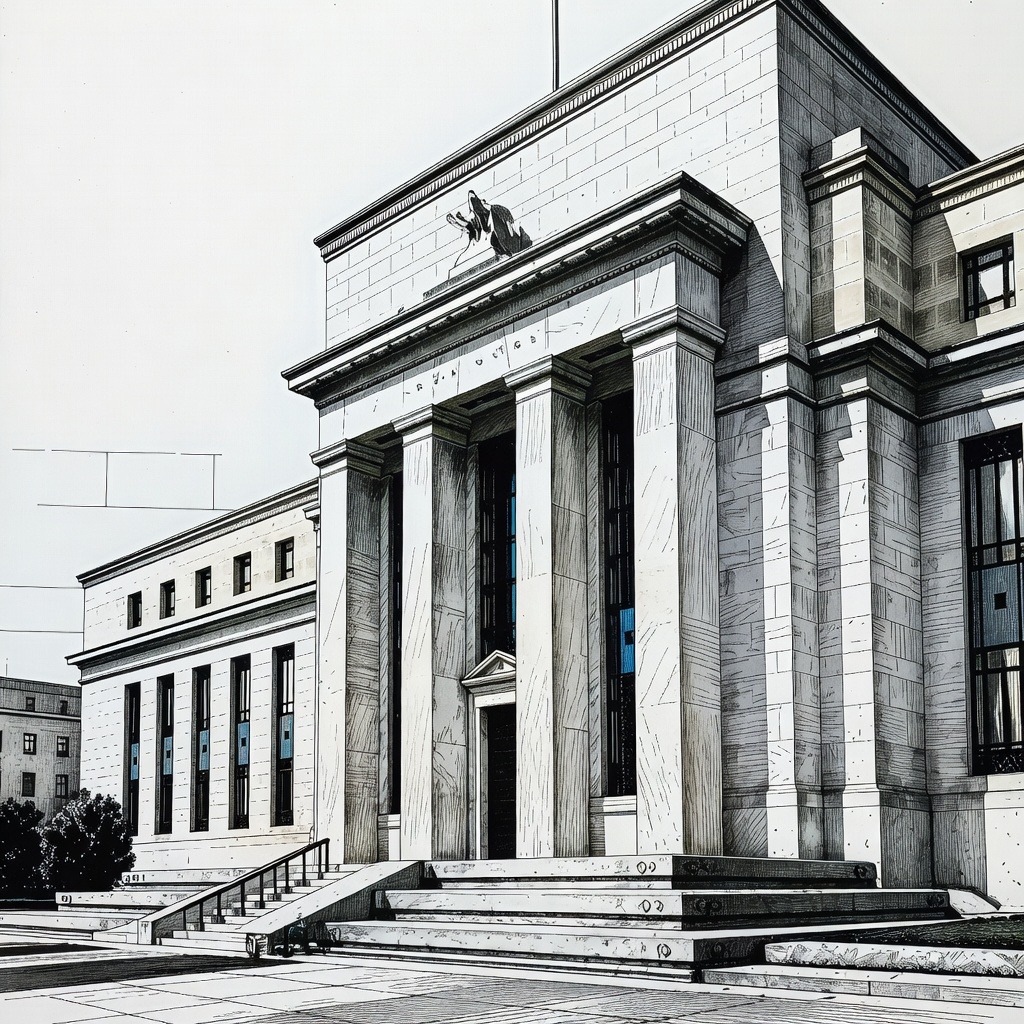
AI-generated illustration. Visual interpretation does not represent real individuals or scenes.
Federal Reserve Expected to Maintain Interest Rates in First Meeting Under Chair Warsh
2026-06-17
The BareStory
The Federal Reserve is scheduled to conclude its latest policy meeting on Wednesday, marking the first interest rate decision under new Chair Kevin Warsh. Futures markets broadly anticipate the central bank will keep interest rates paused amid ongoing concerns over elevated inflation.
Ahead of the release of the central bank's quarterly economic projections, economists from Bank of America and Goldman Sachs predicted Warsh may decline to submit his individual interest rate forecast. Warsh previously argued during his April confirmation hearing that public forward guidance restricts the institution's decision-making flexibility.
Former Federal Reserve Chair Jerome Powell stated he will remain on the policymaking board and participate in the upcoming rate vote. Powell additionally claimed that a recent criminal investigation into his congressional testimony was a politically motivated effort to influence monetary policy, an allegation President Donald Trump denied.
Meanwhile, Trump announced Monday that the United States and Iran have reached an agreement to reopen the Strait of Hormuz. Iranian Deputy Foreign Minister Kazem Gharibabadi confirmed the finalized accord, stating it will be officially signed Friday in Switzerland.
Left Perspective
Shielding Public Financial Transparency
Defending Central Bank Independence
The Consumer Debt Chokehold
Right Perspective
Restoring Agile Monetary Flexibility
Enforcing Necessary Fiscal Discipline
Securing Global Supply Arteries
Left Perspective
• Shielding Public Financial Transparency
Institutional transparency is a fundamental prerequisite for economic fairness and government accountability. Warsh’s reported intention to withhold his individual interest rate forecast represents a severe rollback of public visibility into the central bank's machinery. Eliminating this forward guidance leaves small businesses and working-class borrowers guessing about their financial futures, while well-resourced institutional investors can still afford the analytical tools needed to anticipate and exploit policy shifts.
• Defending Central Bank Independence
Protecting monetary policy from political manipulation is essential to prevent the systematic devaluation of working-class wages. Powell's claim that a criminal investigation is being used by the Trump administration to influence the rate vote signals a dangerous attempt to prioritize short-term political expediency over consumer stability. Forcing the central bank to alter its inflation strategy under the threat of prosecution risks unleashing unchecked price hikes, effectively acting as a regressive tax on the most vulnerable.
• The Consumer Debt Chokehold
Broad economic prosperity requires an environment where capital is accessible rather than structurally restricted. The decision to keep interest rates paused amid elevated inflation leaves everyday consumers trapped in a destructive economic vice. While sustained high rates are intended to cool prices, they systematically lock middle-class families out of the housing market and dramatically inflate consumer debt burdens without directly resolving the corporate price-gouging and supply issues driving the inflation.
Right Perspective
• Restoring Agile Monetary Flexibility
Systemic market stability requires a central bank capable of reacting instantaneously to real-world data without being paralyzed by past projections. Warsh’s argument against public forward guidance and his likely refusal to issue a rate forecast heralds a vital return to rigorous monetary discipline. Pre-committing to specific rate paths creates dangerous market distortions; abandoning this practice forces markets to properly price in risk rather than relying on the Federal Reserve as an artificial safety net.
• Enforcing Necessary Fiscal Discipline
Long-term prosperity is fundamentally built on unyielding fiscal discipline and the aggressive defense of currency valuation. The broad market anticipation of a sustained rate pause demonstrates a necessary institutional commitment to suffocating entrenched inflation. Maintaining tight monetary conditions corrects prolonged macroeconomic imbalances, operating on the premise that temporary borrowing pain is the unavoidable cost of restoring broad purchasing power and true capital efficiency.
• Securing Global Supply Arteries
Global market efficiency and domestic price stability are heavily reliant on unencumbered international trade routes. The finalized US-Iran agreement to reopen the Strait of Hormuz directly targets a massive supply-side inflationary pressure. By securing one of the globe's most critical energy chokepoints, this diplomatic maneuver injects immediate systemic relief into global markets, organically easing energy costs and bolstering the central bank's fight against inflation without requiring further domestic rate hikes.
How it may affect me
As a U.S. reader:
• The Federal Reserve's expected decision to maintain current interest rates means short-term borrowing costs for credit cards, personal loans, and mortgages will remain elevated, continuing to make housing and consumer debt expensive.
• The diplomatic agreement between the United States and Iran to reopen the Strait of Hormuz is expected to provide immediate relief to global energy markets, potentially lowering fuel costs and easing supply-driven inflation for everyday goods.
• The possibility that the new Federal Reserve Chair will withhold future rate forecasts may complicate long-term financial planning for working-class borrowers and small business owners, as they will have less public guidance to anticipate economic shifts compared to large investors.
• Sustained high interest rates and the defense of the central bank against alleged political interference are intended to cool long-term inflation, carrying the ultimate goal of stabilizing prices and restoring broad purchasing power over time despite immediate economic friction.