
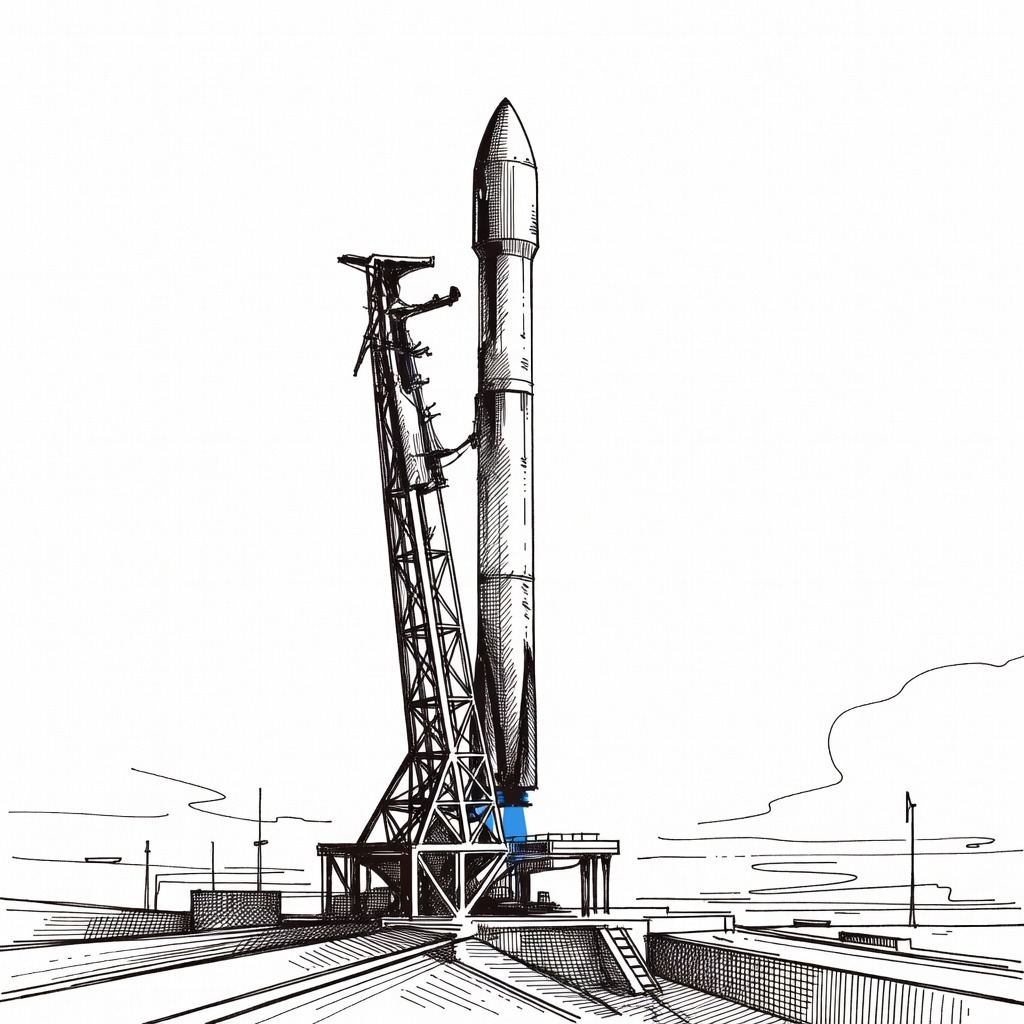
AI-generated illustration. Visual interpretation does not represent real individuals or scenes.
SpaceX Completes Record IPO, Elevating Elon Musk to Trillionaire Status
2026-06-13
The BareStory
On Friday, June 12, 2026, aerospace company SpaceX completed its initial public offering on the Nasdaq exchange. The offering priced shares at $135 and raised a record $75 billion, elevating founder and chief executive officer Elon Musk to the status of the world's first trillionaire.
The public debut generated substantial market interest, with total investor orders exceeding $250 billion. Following the stock's first day of trading, market estimates placed SpaceX's total valuation between $1.8 trillion and $2.1 trillion. The company currently relies on its Starlink satellite internet service for profit, while its space launch and artificial intelligence divisions operate at a loss.
Musk's new financial milestone prompted political debate over wealth inequality. Following the initial public offering, a federal senator and the governor of California publicly criticized the concentration of wealth amid broader economic issues. In Maine, Democratic Senate candidate Graham Platner published a social media post stating that Musk should be the world's last trillionaire.
Platner's remarks sparked immediate backlash from conservative politicians and commentators, who countered that Musk's enterprise benefits millions of Americans. Political opponents criticized Platner's progressive policy stances and referenced past personal controversies. These included allegations of physical abuse made by an ex-girlfriend, as well as claims by critics regarding a Nazi-affiliated chest tattoo.
Left Perspective
Indictment of Resource Hoarding
Mirage of Speculative Value
Weaponization of Personal Scandal
Right Perspective
Engine of Unprecedented Innovation
Strategic Capital Allocation Model
Shield Against Punitive Redistribution
Left Perspective
• Indictment of Resource Hoarding
Prioritizing social equity, this camp views the creation of a single trillionaire as a systemic policy failure rather than a personal triumph. The $1.8 to $2.1 trillion valuation highlights a deep structural flaw where immense capital is funneled to an individual while broader economic struggles persist. For the Consumer Advocate, the fact that a federal senator and the California governor are raising immediate alarm validates the concern that hyper-concentration of wealth inevitably distorts democratic access and economic fairness.
• Mirage of Speculative Value
Skeptical of unregulated market euphoria, this perspective questions the underlying fundamentals of the record $75 billion IPO. Because SpaceX relies almost entirely on Starlink for profit while subsidizing massive losses in its space launch and AI divisions, the $250 billion in investor orders represents dangerous speculative inflation rather than sustainable economic growth. This dynamic is viewed as a mechanism for institutional extraction, enriching insiders at the top while socializing the eventual risks of highly unprofitable ventures.
• Weaponization of Personal Scandal
Recognizing the threat to the status quo, this camp interprets the immediate conservative pivot to Graham Platner's personal controversies as a deliberate tactic to derail necessary conversations about wealth redistribution. By amplifying past abuse allegations and claims of a controversial tattoo, opponents successfully shift the narrative away from Platner's core argument that Musk should be the "world's last trillionaire." This illustrates a broader fear that institutional power will consistently weaponize character assassination to protect extreme capital concentration and silence advocates for economic parity.
Right Perspective
• Engine of Unprecedented Innovation
Rooted in the belief that incentivizing capital yields systemic advancement, this framework views Elon Musk’s trillionaire status as a direct reflection of massive societal value creation. The record $75 billion raised at $135 per share demonstrates extreme market confidence in SpaceX's ability to drive technological progress forward. For the Market Realist, this wealth is not extracted but earned through the successful capitalization of high-risk, high-reward industries that ultimately benefit millions of Americans.
• Strategic Capital Allocation Model
Prioritizing long-term market efficiency, this side sees the internal financial structure of SpaceX as a triumph of private enterprise over bureaucratic stagnation. Using the profitable Starlink division to sustain operational losses in revolutionary space launch and AI divisions is viewed as a brilliant, necessary market mechanism. Instead of waiting for taxpayer-funded government programs to innovate, the $250 billion in investor orders proves that private capital markets are the most effective vehicle for funding humanity's technological frontiers.
• Shield Against Punitive Redistribution
Driven by a commitment to fiscal discipline and institutional stability, this camp views progressive demands to cap wealth as a direct threat to the free market system. Maine candidate Graham Platner’s decree that Musk should be the "last trillionaire" is perceived as a dangerous, growth-killing ideology that fundamentally punishes success. Highlighting Platner’s personal scandals—including abuse allegations and a Nazi-affiliated tattoo—serves to delegitimize the moral authority of those pushing for radical wealth confiscation, reinforcing the argument that progressive populism is erratic and fundamentally flawed.
How it may affect me
As a U.S. reader:
• In the short term, everyday investors now have the opportunity to purchase shares of SpaceX on the public market, though they must navigate the financial risks of investing in a company that relies almost entirely on its Starlink service for profit to subsidize massive losses in its space launch and artificial intelligence divisions.
• Over the long term, the public may benefit from privately funded technological advancements in satellite internet, artificial intelligence, and space exploration, which supporters argue will drive innovation without relying on taxpayer-funded government programs.
• Voters can expect future legislative sessions and elections to increasingly center on proposals for wealth redistribution and wealth caps, as the milestone of a single individual reaching trillionaire status has triggered immediate debates among politicians regarding systemic economic fairness.
• Citizens following local and national campaigns will likely experience highly polarized political environments where structural arguments about capital concentration and economic policy are heavily countered by intense focus on candidates' past personal controversies and character.