
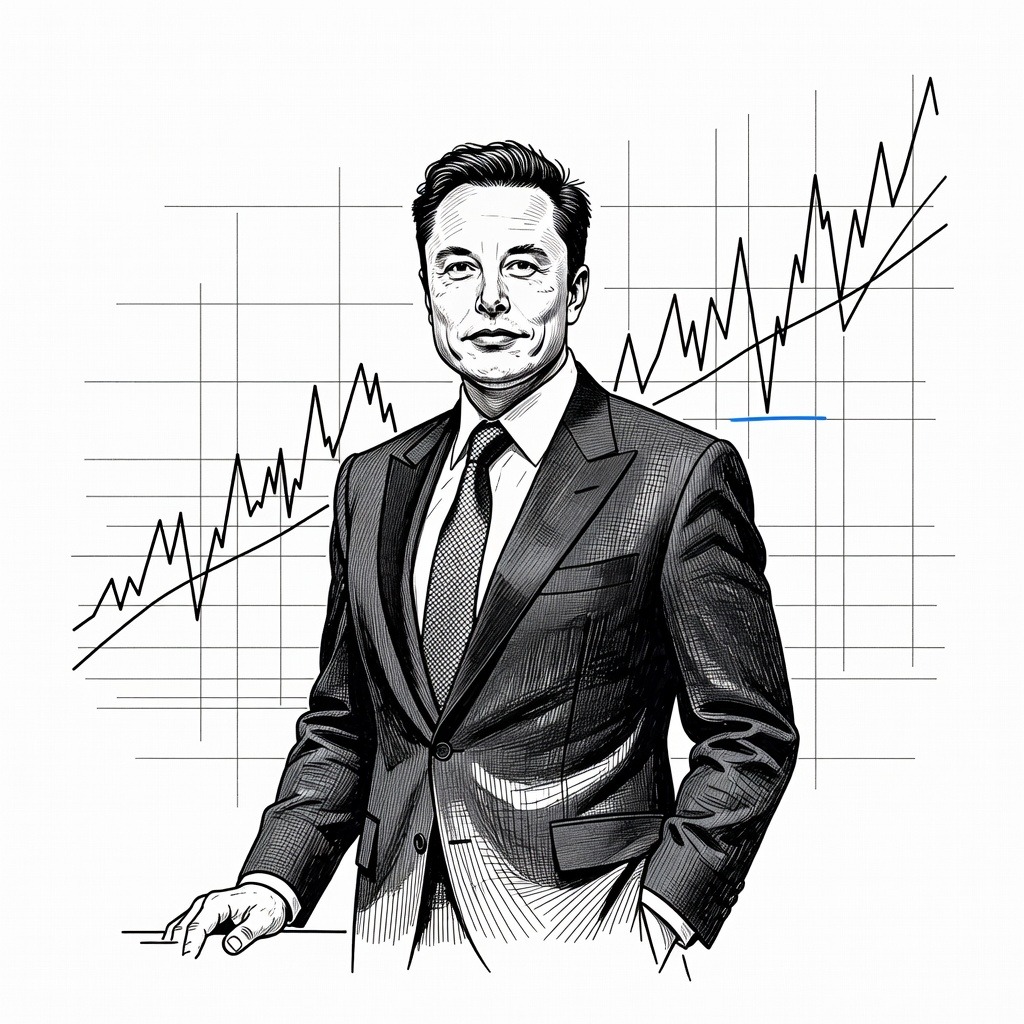
• Amplifying Extreme Wealth Concentration The creation of the world's first trillionaire underscores a hyper-financialized system designed to extract and concentrate capital at the absolute top of the economic pyramid. Musk’s personal net worth eclipsing $1 trillion, alongside Goldman Sachs and Morgan Stanley pocketing $100 million in single-day fees, highlights a deeply inequitable distribution of societal resources. This staggering accumulation of wealth occurs not through broad economic productivity that benefits consumers, but through exclusive financial mechanisms that disproportionately enrich institutional gatekeepers and mega-billionaires.
• Architecting an Unaccountable Oligopoly The overt moves toward unprecedented corporate consolidation threaten to establish an unaccountable, monopolistic chokehold over future critical infrastructure. Merging SpaceX with Tesla, after already absorbing the social network X and the artificial intelligence startup xAI to build "orbital data centers," effectively privatizes the public commons of space and digital communication. This rapid consolidation bypasses traditional anti-trust safeguards, leaving society highly vulnerable to the unchecked market dominance and extraction strategies of a single, centralized corporate empire.
• Fueling a Speculative Bubble The severe disconnect between the $2 trillion market capitalization and the reality of ongoing financial losses poses a systemic risk to broader economic stability. Pushing a stock from $150 to $176 on its debut day based primarily on the promises of future space exploration creates a precarious financial environment driven by institutional hype rather than solid fundamentals. Skeptics rightly recognize that everyday retail investors and broader markets will ultimately bear the catastrophic risk when a multi-trillion-dollar valuation outpaces its actual financial performance.
How it may affect me
As a U.S. reader:
• You now have the ability to invest in SpaceX through public markets, but you face potential short-term and long-term financial risks by participating in a multi-trillion-dollar valuation that currently operates at a loss and relies heavily on future projections.
• Your access to internet and digital communications could change in the long term, as the company's ongoing expansion of broadband and construction of orbital data centers aims to significantly centralize global communication infrastructure.
• You may encounter reduced market competition and consumer choice if SpaceX ultimately merges with Tesla, X, and xAI, placing aerospace, automotive, artificial intelligence, and social media services under the control of a single corporate entity.
• Your broader economic environment could be impacted by shifting market stability, as massive amounts of private capital are diverted away from broad consumer productivity and concentrated into high-risk, long-term space exploration initiatives.