
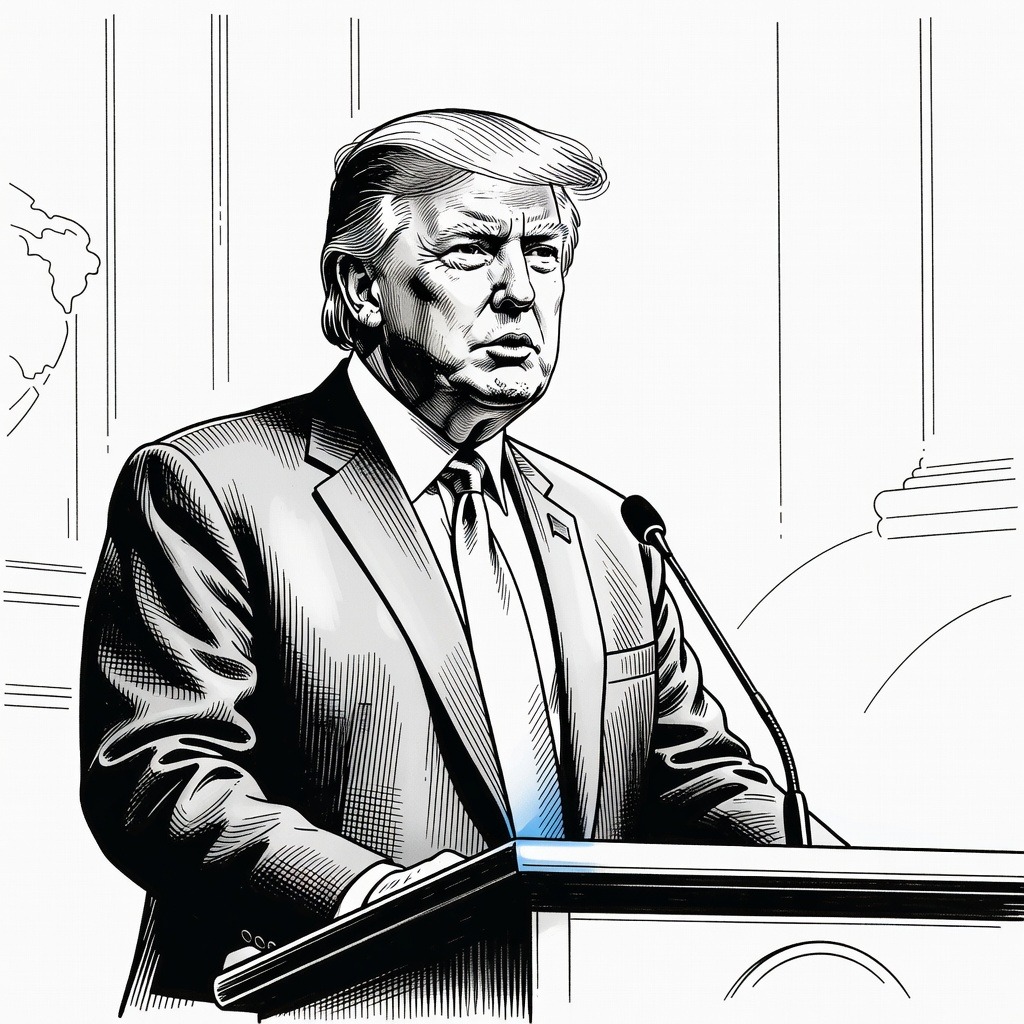
AI-generated illustration. Visual interpretation does not represent real individuals or scenes.
US Consumer Prices Hit Three-Year High Amid Iran Conflict
2026-06-10
The BareStory
The U.S. annual consumer price index rose to 4.2 percent in May, marking a three-year high, while core inflation reached 2.9 percent. The increase was primarily driven by surging energy costs and airfares stemming from the ongoing U.S. war with Iran, which has disrupted oil supplies passing through the Strait of Hormuz.
Following the data release, President Donald Trump expressed approval of the inflation numbers, stating that prices will decline rapidly once the conflict concludes. The president claimed the United States has been extracting millions of barrels of oil to help provide economic relief, and he stated the military had eliminated 22 ships operating without lights or radar. However, Energy Secretary Chris Wright testified before Congress that he was unaware of the U.S. removing oil from Iran, noting instead that the military has been assisting oil tankers transiting the Strait.
Trump's remarks regarding the inflation data drew pushback from political opponents. Several Democrats, including Illinois Governor JB Pritzker, criticized the president's statements, arguing that he is dismissing Americans' financial difficulties while citizens struggle to afford basic food and necessities.
The elevated inflation data and rising oil prices have shifted market expectations regarding U.S. monetary policy. While Trump has publicly advocated for lower interest rates, economists suggest the Federal Reserve may delay rate cuts or implement rate hikes in response to the pricing data. Newly sworn-in Federal Reserve Chair Kevin Warsh is scheduled to hold his first policy meeting next week to address the economic conditions.
Left Perspective
Shielding the Vulnerable Consumer
Rejecting the Geopolitical Premium
Fearing Compounded Economic Pain
Right Perspective
Absorbing Supply-Side Shocks
Enforcing Strict Monetary Discipline
Insulating Central Bank Independence
Left Perspective
• Shielding the Vulnerable Consumer
Prioritizing social equity, this camp views the 4.2 percent CPI spike and 2.9 percent core inflation as a regressive tax that disproportionately harms low-income households. While the administration casually promises that prices will decline after the conflict, consumer advocates align with Governor JB Pritzker’s critique that such rhetoric ignores the immediate reality of citizens struggling to afford basic food and necessities. The underlying priority is protecting the purchasing power of the working class from sudden, external economic shocks.
• Rejecting the Geopolitical Premium
Valuing government accountability, this framework sees the surging energy costs and airfares as an unjust transfer of geopolitical costs directly onto the backs of domestic consumers. The stark contradiction between the president’s claims of extracting millions of barrels of oil and Energy Secretary Chris Wright’s testimony highlights a concerning lack of institutional transparency. Left advocates view the economic fallout of the Iran war not as an inevitable market fluctuation, but as a punitive burden imposed on the public by hawkish foreign policy.
• Fearing Compounded Economic Pain
Looking ahead at monetary policy, consumer advocates worry that the traditional systemic fixes will further punish the working class. If newly sworn-in Federal Reserve Chair Kevin Warsh implements rate hikes to combat this inflation, everyday Americans will face the double penalty of high borrowing costs alongside sustained high prices at the grocery store and gas pump. The long-term risk they fear is a manufactured recession, where central bankers suppress demand and trigger job losses to correct inflation that was actually caused by overseas military intervention.
Right Perspective
• Absorbing Supply-Side Shocks
Prioritizing market efficiency and systemic stability, this camp interprets the three-year high inflation data as a mechanical, textbook response to disrupted oil supplies in the Strait of Hormuz. Rather than viewing the 4.2 percent inflation as a permanent structural failure, market realists see it as a temporary supply-side shock that markets must naturally absorb while the military assists tankers in restoring global trade routes. The priority is maintaining economic resilience until the geopolitical friction is resolved and baseline energy flows return.
• Enforcing Strict Monetary Discipline
Valuing macroeconomic fundamentals, this perspective champions the anticipated pivot by economists to delay rate cuts or implement rate hikes in response to the pricing data. Market realists rely on Federal Reserve Chair Kevin Warsh to utilize the upcoming policy meeting to anchor inflation expectations, explicitly rejecting the president’s public advocacy for lower interest rates. The core logic dictates that central banks must address the data objectively, using restrictive monetary tools to prevent temporary energy inflation from seeping into broader economic sectors.
• Insulating Central Bank Independence
The primary risk identified by this camp is the threat of executive interference in monetary policy during a period of macroeconomic vulnerability. If the Federal Reserve yields to political pressure from the administration to cut rates while inflation runs at 4.2 percent, market realists warn it will destroy institutional credibility and overheat the economy. The long-term implication they seek to avoid is a complete unmooring of the U.S. dollar's stability, protecting the rule of law and institutional continuity over the short-term political desires of the executive branch.
How it may affect me
As a U.S. reader:
• In the short term, you will encounter higher out-of-pocket costs for everyday expenses, specifically at the gas pump, for air travel, and when purchasing basic food and necessities.
• You may experience increased borrowing costs on loans and credit in the near future if the Federal Reserve decides to hike interest rates or delay rate cuts to combat the rising inflation data.
• Over the long term, if the central bank raises interest rates to suppress demand, you could face an economic recession that increases the risk of domestic job losses.
• Alternatively, if the Federal Reserve lowers interest rates during this period of high inflation, you could face the long-term financial consequences of an overheated economy and a destabilized U.S. dollar.
• Your timeline for financial relief from these elevated prices is dependent on the ongoing overseas conflict, meaning costs are expected to remain high until the military secures trade routes and standard oil supplies are restored.