
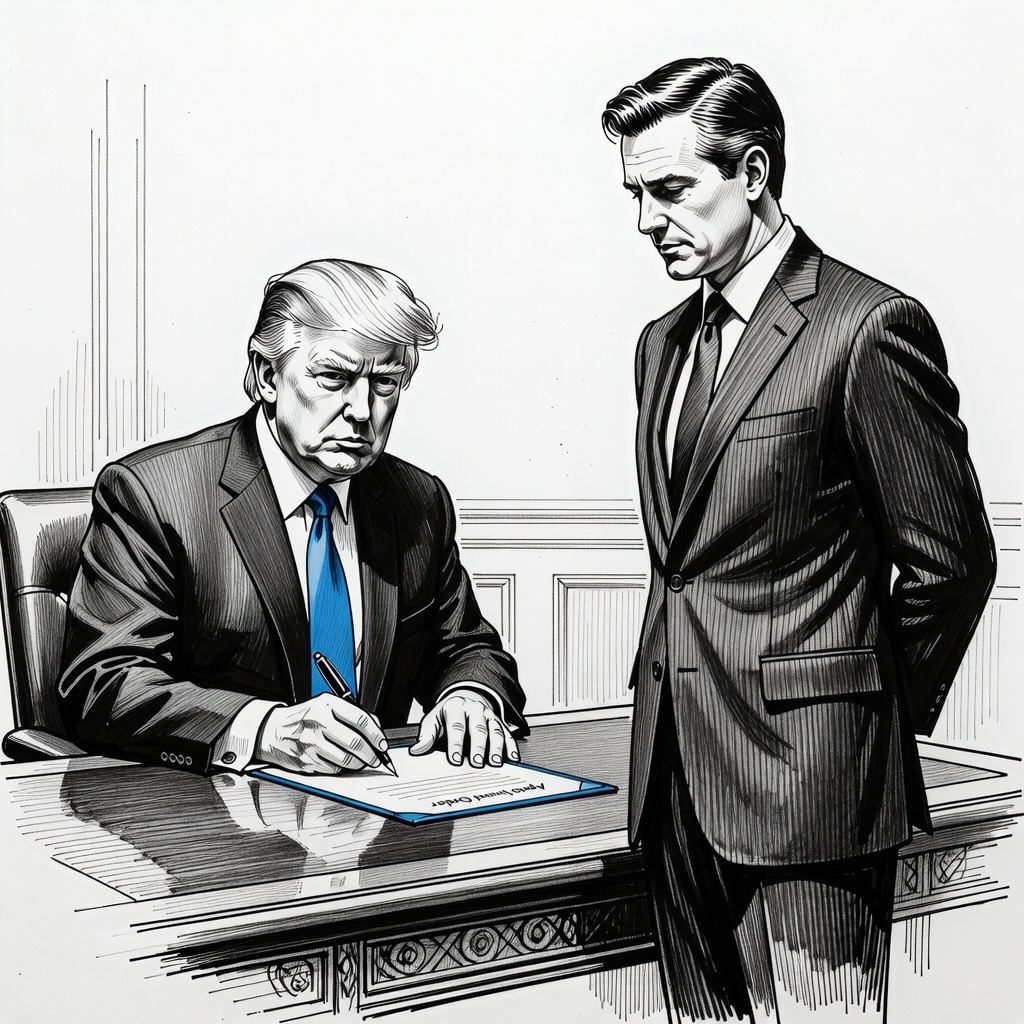
AI-generated illustration. Visual interpretation does not represent real individuals or scenes.
Trump Appoints Bill Pulte as Acting Intelligence Director Amid FISA Renewal Debate
2026-06-08
The BareStory
President Donald Trump has appointed Bill Pulte to serve as the acting director of national intelligence. Pulte, who currently directs the Federal Housing Finance Agency, replaces outgoing director Tulsi Gabbard. The appointment coincides with an approaching Friday deadline in the U.S. Senate to extend Section 702 of the Foreign Intelligence Surveillance Act (FISA).
The leadership change has complicated the surveillance program's renewal, with Democratic lawmakers demanding Pulte's removal before they will support the extension. Senator Mark Warner stated that securing the necessary Democratic votes will be difficult if Pulte controls the intelligence tool. Following Democratic opposition to a procedural vote, Republican Senators Chuck Grassley and Tom Cotton advised the administration to prepare for the surveillance power to lapse. Grassley claimed that opposing the extension endangers American safety ahead of upcoming international events.
Pulte’s selection has generated debate over his qualifications and mandate. Former Senate Republican Leader Mitch McConnell and Representative Brian Fitzpatrick argued that Pulte lacks the statutory national security experience required for the position. Conversely, White House communications director Steven Cheung stated Pulte will advance the president's agenda, while Representative Anna Paulina Luna argued he will assist with declassification efforts. Trump has publicly stated his intention for Pulte to reduce the size of the intelligence bureaucracy and initiate mass employee dismissals.
The transition follows public disagreements between the president and the outgoing director. Gabbard had previously concluded in an intelligence assessment that Iran was not developing a nuclear weapon. Trump publicly rejected this conclusion as his administration considered potential military action against Tehran. By installing Pulte in an acting capacity, the administration allows him to assume the role and its authorities without immediate Senate confirmation.
Left Perspective
Shield Against Executive Overreach
Defense of Technocratic Competence
Peril of Politicized Intelligence
Right Perspective
Anchor of National Sovereignty
Engine of Democratic Mandate
Pivot to Strategic Realism
Left Perspective
• Shield Against Executive Overreach
Prioritizing civil liberties, this framework views the appointment of a political loyalist to oversee FISA Section 702 as a direct threat to constitutional protections. Senator Warner’s refusal to supply Democratic votes for the extension stems from the conviction that an unchecked executive could weaponize surveillance tools against the public. Allowing a housing official like Pulte to command vast intelligence powers is thus seen not as a mere staffing change, but as a severe degradation of government accountability.
• Defense of Technocratic Competence
Valuing government oversight and institutional expertise, this perspective shares McConnell and Fitzpatrick’s critique that Pulte completely lacks statutory national security experience. The deliberate use of an "acting" capacity is understood as a constitutional workaround designed to bypass immediate Senate confirmation. This circumvention intentionally strips the legislative branch of its mandate to vet leadership, eroding the established guardrails required for responsible intelligence gathering.
• Peril of Politicized Intelligence
The paramount risk identified here is the corruption of fact-based national security assessments to justify ideological or military ends. Gabbard’s removal following her conclusion that Iran was not developing a nuclear weapon suggests to this camp an administration intolerant of inconvenient truths. Consequently, Trump’s mandate for Pulte to enact mass dismissals is interpreted as a retaliatory purge intended to replace objective civil servants with compliant loyalists.
Right Perspective
• Anchor of National Sovereignty
Prioritizing national security and civic order, this camp views the potential expiration of FISA Section 702 as an unacceptable strategic vulnerability. As Senator Grassley warns, allowing a vital intelligence-gathering tool to lapse over a personnel dispute directly endangers American safety ahead of critical international events. From this vantage point, legislative brinkmanship over an executive appointment represents a dangerous prioritization of partisan politics over the fundamental duty to protect the homeland.
• Engine of Democratic Mandate
Emphasizing the constitutional rule of law, this perspective maintains that the intelligence apparatus must remain fiercely subordinate to the elected executive. Cheung and Luna’s defense of Pulte highlights his willingness to advance the president’s agenda and push declassification, restoring democratic control over an opaque system. Trump’s directive to significantly reduce the bureaucracy and initiate dismissals is therefore justified as a necessary dismantling of an entrenched, unelected administrative state.
• Pivot to Strategic Realism
The long-term necessity for this camp is ensuring that national security leadership operates in total synchronicity with the commander-in-chief’s geopolitical posture. Gabbard’s assessment regarding Iran’s nuclear ambitions was viewed as dangerously conflicting with the administration’s readiness for potential military action against Tehran. By utilizing an acting appointment, the executive branch bypasses protracted Senate delays to swiftly install a director capable of aggressively realigning the intelligence community with the president's strategic vision.
How it may affect me
As a U.S. reader:
• In the short term, the political dispute over this appointment could cause the expiration of FISA Section 702, which lawmakers caution may limit vital intelligence gathering and pose a risk to public safety ahead of international events.
• Oversight of federal surveillance programs is shifting to an acting director who bypassed Senate confirmation, raising practical concerns about civil liberties and whether unchecked intelligence tools could be directed against the public.
• Long-term national security operations could be fundamentally altered by the mandate to shrink the intelligence bureaucracy and initiate mass dismissals, which would replace career civil servants with personnel aligned with the executive agenda.
• The leadership change may influence the likelihood of future military engagement, as the previous director was replaced after providing a nuclear assessment on Iran that conflicted with the administration's readiness for military action.
• The general public may experience increased access to previously undisclosed government documents, as the new director is tasked with advancing the administration's declassification efforts.