
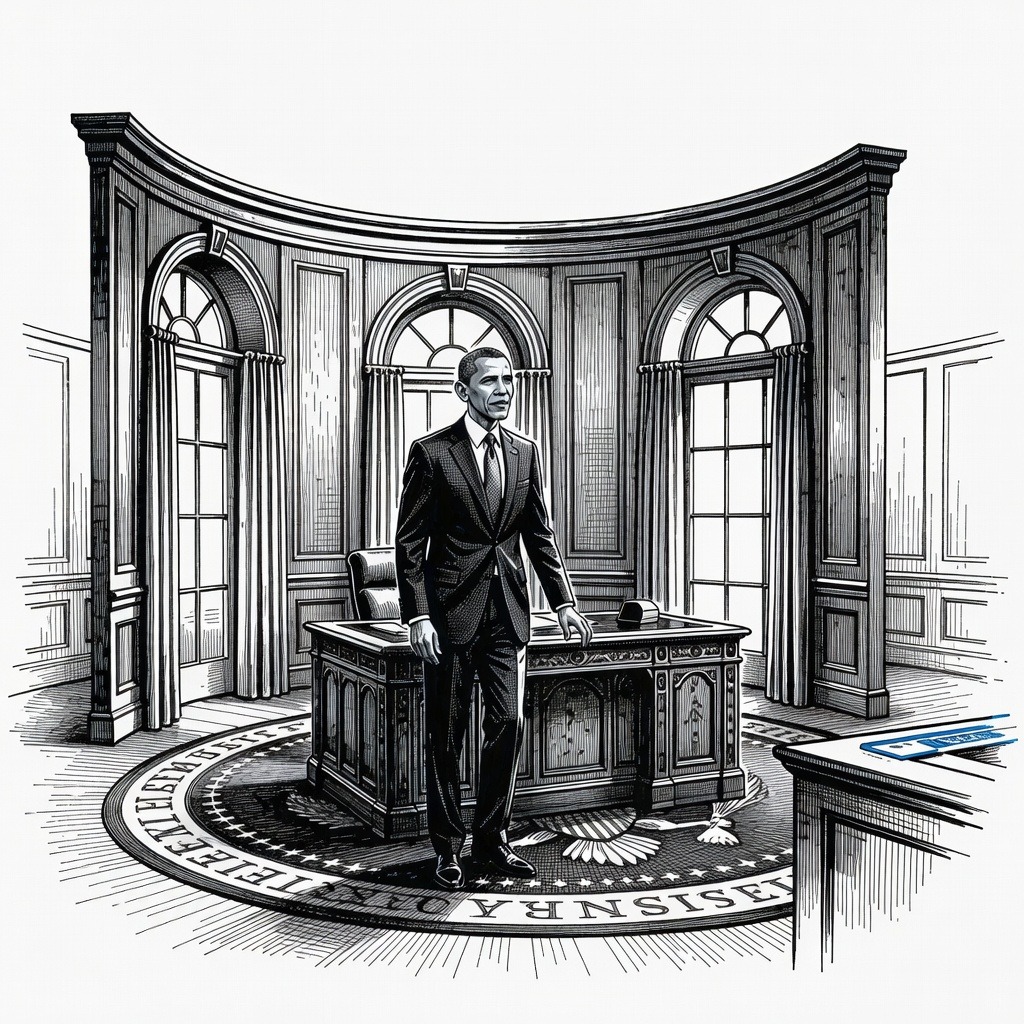
AI-generated illustration. Visual interpretation does not represent real individuals or scenes.
Obama Presidential Center Prepares for June Opening in Chicago
2026-06-04
The BareStory
The Obama Presidential Center is scheduled to open to the public on June 19 on the South Side of Chicago. Ahead of the Juneteenth launch, previews revealed a campus featuring a museum that chronicles former President Barack Obama’s political rise and administration, alongside various community amenities.
The 19.3-acre development, which cost $850 million to construct, includes a new branch of the Chicago Public Library, basketball courts, and a playground. Inside the multi-story museum, visitors can view a replica of the Oval Office, contemporary art installations, and items from former First Lady Michelle Obama’s wardrobe. An exterior statue of the former president and first lady is also displayed on the grounds.
Valerie Jarrett, CEO of the Obama Foundation, stated that the museum intertwines the nation's history—including the civil rights and suffrage movements—with the Obamas' personal trajectory. The interior exhibits feature artifacts such as Obama's Nobel Peace Prize and a timeline of administrative actions, including the passage of the Affordable Care Act and policies that were subsequently reversed by the Trump administration.
Unlike other modern presidential libraries typically managed by the National Archives and Records Administration, the center will be privately operated by the Obama Foundation. General admission to the museum will cost $30. According to project plans, the campus is intended to function as an economic engine by drawing new financial investment into Chicago's South and West side neighborhoods.
Left Perspective
Engine of Civic Equity
Monument to Social Progress
Shield Against Institutional Reversal
Right Perspective
Fracture of Institutional Continuity
Monetization of Political Celebrity
Politicization of Public Memory
Left Perspective
• Engine of Civic Equity
Prioritizing localized social progress transforms a presidential monument into a direct economic catalyst for historically marginalized communities. Placing the $850 million, 19.3-acre campus on Chicago's South Side serves as a deliberate intervention designed to draw vital financial investment into the surrounding South and West side neighborhoods. By integrating accessible public goods—such as a new Chicago Public Library branch, basketball courts, and a playground—the center abandons the traditional, passive archive model in favor of active community empowerment.
• Monument to Social Progress
Anchoring the center's public launch to Juneteenth reinforces the philosophical stance that the Obama presidency was the direct structural culmination of America's long-standing civil rights struggles. Framing the multi-story museum's exhibits to intertwine the administration's trajectory with the broader civil rights and suffrage movements validates a progressive interpretation of history. Highlighting the passage of the Affordable Care Act centers the expansion of the social safety net, positioning the administration's legacy around tangible protections for the vulnerable.
• Shield Against Institutional Reversal
Operating the site privately through the Obama Foundation guarantees the ideological and operational autonomy necessary to advocate for continued social reform. Explicitly displaying the policies that were subsequently reversed by the Trump administration serves as a stark historical warning about the fragility of political progress. Maintaining private control frees the institution from restrictive federal neutrality mandates, allowing the foundation to actively fund and manage community-driven initiatives rather than functioning solely as a static repository.
Right Perspective
• Fracture of Institutional Continuity
Bypassing the National Archives and Records Administration (NARA) to operate the center privately undermines the established norms of objective historical preservation. The traditional presidential library system guarantees standardized, non-partisan access to federal records and ensures that a former executive's legacy remains a publicly accountable, federal asset. Shifting control to the private Obama Foundation fundamentally alters this dynamic, replacing rigorous institutional continuity with a privately curated enterprise free from standard governmental oversight.
• Monetization of Political Celebrity
Charging a $30 general admission fee and prioritizing exhibits like the First Lady’s wardrobe signals a departure from civic humility toward the commodification of a political brand. The $850 million price tag and the inclusion of an exterior statue emphasize architectural grandeur and spectacle rather than sober historical reflection. Showcasing premature accolades like the Nobel Peace Prize alongside personal artifacts risks elevating celebrity worship and personal vanity over a rigorous examination of executive governance.
• Politicization of Public Memory
Using the museum to explicitly litigate recent policy battles—specifically pointing to Trump administration reversals—transforms a historical site into an active partisan instrument. Framing the administration as the inevitable, crowning achievement of the civil rights and suffrage movements projects an inherently ideological, rather than objective, view of American history. This curatorial approach risks alienating segments of the populace by weaponizing the legacy of a national office to enforce a specific political orthodoxy instead of fostering unified civic duty.
How it may affect me
As a U.S. reader:
• Visitors planning to tour the Chicago museum will incur a $30 general admission fee to view the historical exhibits and presidential artifacts.
• In the short term, the local public will gain access to new civic and recreational amenities on the campus, including a Chicago Public Library branch, basketball courts, and a playground.
• Over the long term, the $850 million campus development is intended to act as an economic catalyst, potentially bringing new financial investment and community-driven initiatives to neighborhoods on Chicago's South and West sides.
• Researchers and citizens will not interact with a traditional, federally managed presidential library at this location, as the facility is privately operated by the Obama Foundation outside the standardized National Archives and Records Administration system.
• Individuals visiting for historical education will encounter a privately curated museum that explicitly connects the Obama administration to the civil rights movement and highlights recent partisan policy reversals, rather than a non-partisan federal archive.