
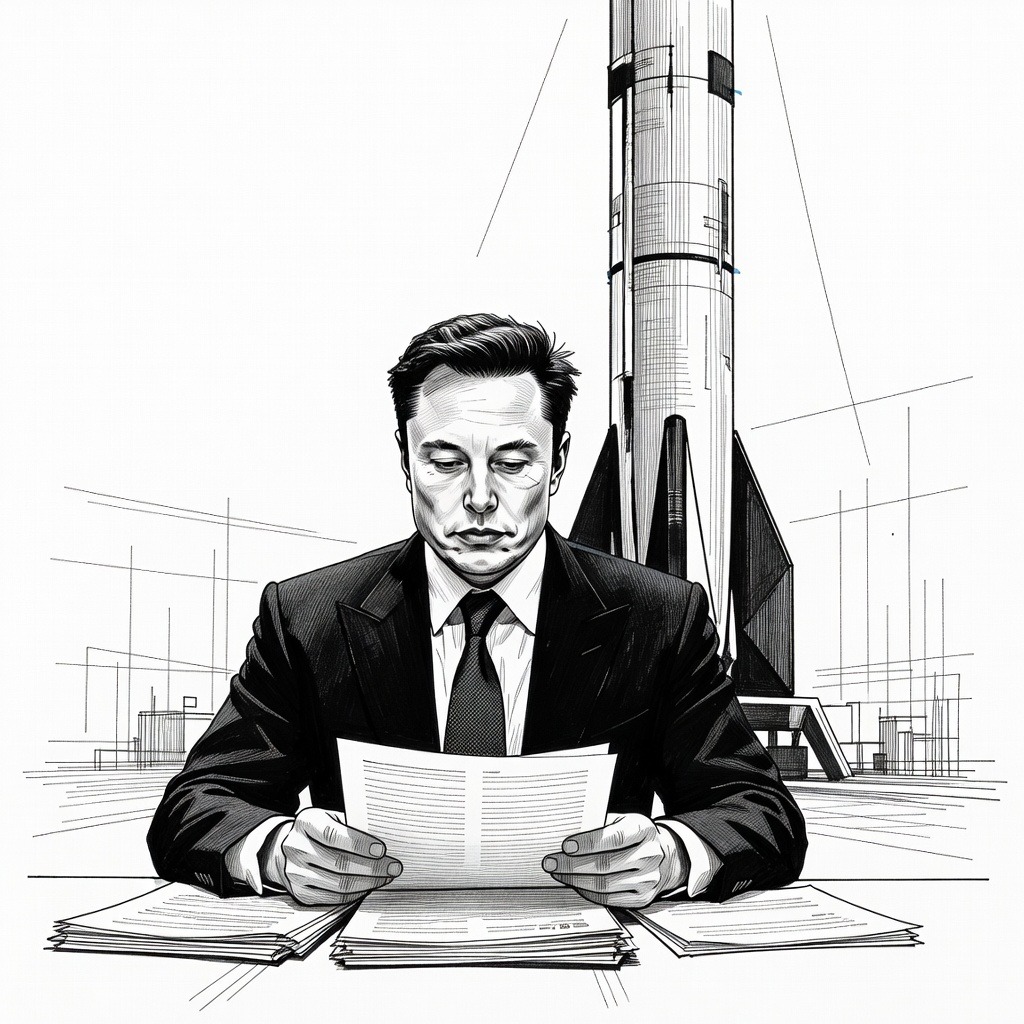
AI-generated illustration. Visual interpretation does not represent real individuals or scenes.
SpaceX Outlines Plans for $1.77 Trillion Initial Public Offering
2026-06-04
The BareStory
Space Exploration Technologies Corp. has filed updated regulatory paperwork for an initial public offering aimed at raising $75 billion. By proposing a price of $135 per share, the aerospace company expects to list on the Nasdaq exchange with a total market valuation of $1.77 trillion.
According to the IPO prospectus, Chief Executive Officer Elon Musk will retain over 82 percent of the company's voting power following the offering. Financial analysts project that the public market debut will increase Musk's net worth to over $1 trillion. The regulatory filings also specify that Musk is subject to a 366-day lock-up period during which he is required to hold all of his shares.
Corporate records indicate that SpaceX generated approximately $18.7 billion in revenue last year, though the company reported an operating loss of $2.6 billion. SpaceX stated it intends to direct the net proceeds from the offering toward expanding its artificial intelligence infrastructure, upgrading its laser-connected satellite networks, and funding long-term ambitions to establish a human colony on Mars.
The anticipated stock listing has already influenced broader market activity. According to market data, options trading volume recently surged for EchoStar, a networking firm that reportedly acquired a three percent equity stake in SpaceX through a recent wireless spectrum agreement. Furthermore, investors and market researchers have speculated that Musk may eventually seek to merge SpaceX with Tesla to consolidate capital and artificial intelligence resources.
Left Perspective
Monopolizing Corporate Governance
Rewarding Speculative Fundamentals
Consolidating Systemic Risk
Right Perspective
Engine for Generational Innovation
Shielding Visionary Continuity
Catalyzing Broader Market Dynamism
Left Perspective
• Monopolizing Corporate Governance
The concentration of absolute corporate authority poses a severe risk to public accountability and economic equity. By structuring the IPO so Elon Musk retains over 82 percent of the voting power, the offering functionally strips public shareholders of their traditional oversight role. Elevating a single individual to a projected $1 trillion net worth while denying basic democratic checks enables unchecked decision-making on foundational global technologies.
• Rewarding Speculative Fundamentals
Valuing an enterprise based on futuristic narratives rather than operational profitability distorts healthy economic markets. Pricing the company at a staggering $1.77 trillion valuation despite reporting a $2.6 billion operating loss demonstrates how capital markets increasingly reward hype over sustainable financial health. This divergence between massive market capitalization and actual operational losses reflects an extraction model that benefits early insiders at the expense of retail investors.
• Consolidating Systemic Risk
Funneling immense technological and financial resources into a single private ecosystem without robust guardrails threatens broader economic stability. The explicit intent to direct $75 billion into unregulated artificial intelligence and speculative Mars colonization, coupled with speculation of a Tesla merger, signals an accelerating monopolization of future infrastructure. This massive centralization of capital into unaccountable, overlapping tech empires risks bypassing civic input and misallocating capital away from pressing terrestrial needs.
Right Perspective
• Engine for Generational Innovation
Capital markets function best when they efficiently direct vast resources toward transformative, high-capital technologies. Raising $75 billion allows the company to aggressively scale capital-intensive priorities like laser-connected satellite networks and artificial intelligence infrastructure. A $1.77 trillion valuation accurately reflects the market's confidence in ambitious, paradigm-shifting technological leadership rather than punishing the necessary short-term operating losses inherent in heavy R&D.
• Shielding Visionary Continuity
Protecting long-term strategic goals from the volatile pressures of quarterly earnings is vital for unprecedented engineering feats. Granting Elon Musk 82 percent voting control ensures that the company's multi-decade timeline for a human colony on Mars cannot be derailed by activist investors demanding immediate dividends. Furthermore, the 366-day lock-up period mathematically aligns the founder’s financial interests with institutional stability, preventing disruptive capital flight while securing the company's trajectory.
• Catalyzing Broader Market Dynamism
Massive public offerings act as economic force multipliers that lift adjacent industries and stimulate broad wealth generation. The immediate surge in options trading for EchoStar, driven by its three percent equity stake, proves that highly valued IPOs inject vital liquidity and growth into the broader ecosystem. Leveraging $18.7 billion in existing revenue alongside potential resource synergies with a Tesla merger demonstrates how aggressive capital consolidation drives systemic market prosperity.
How it may affect me
As a U.S. reader:
• In the short term, everyday investors will have the opportunity to purchase shares of the aerospace company for 135 dollars each, though they will have no meaningful voting power or oversight over company decisions since the CEO will retain 82 percent control.
• The public may experience immediate market shifts and increased trading volatility in adjacent technology stocks, as already demonstrated by the surge in options trading for related companies like EchoStar.
• Retail investors who buy into the IPO take on the financial risk of investing in a company that currently operates at a 2.6 billion dollar loss, meaning their long-term financial returns will depend heavily on the success of ambitious, capital-intensive projects rather than current profitability.
• Over the long term, the influx of 75 billion dollars could accelerate the development of technological infrastructure the public may interact with, such as upgraded satellite networks and artificial intelligence, while simultaneously centralizing control of these systems under a single corporate entity.
• Future speculation regarding a potential merger with Tesla could eventually impact public shareholders in both companies by consolidating their capital and artificial intelligence resources into one overlapping ecosystem.