
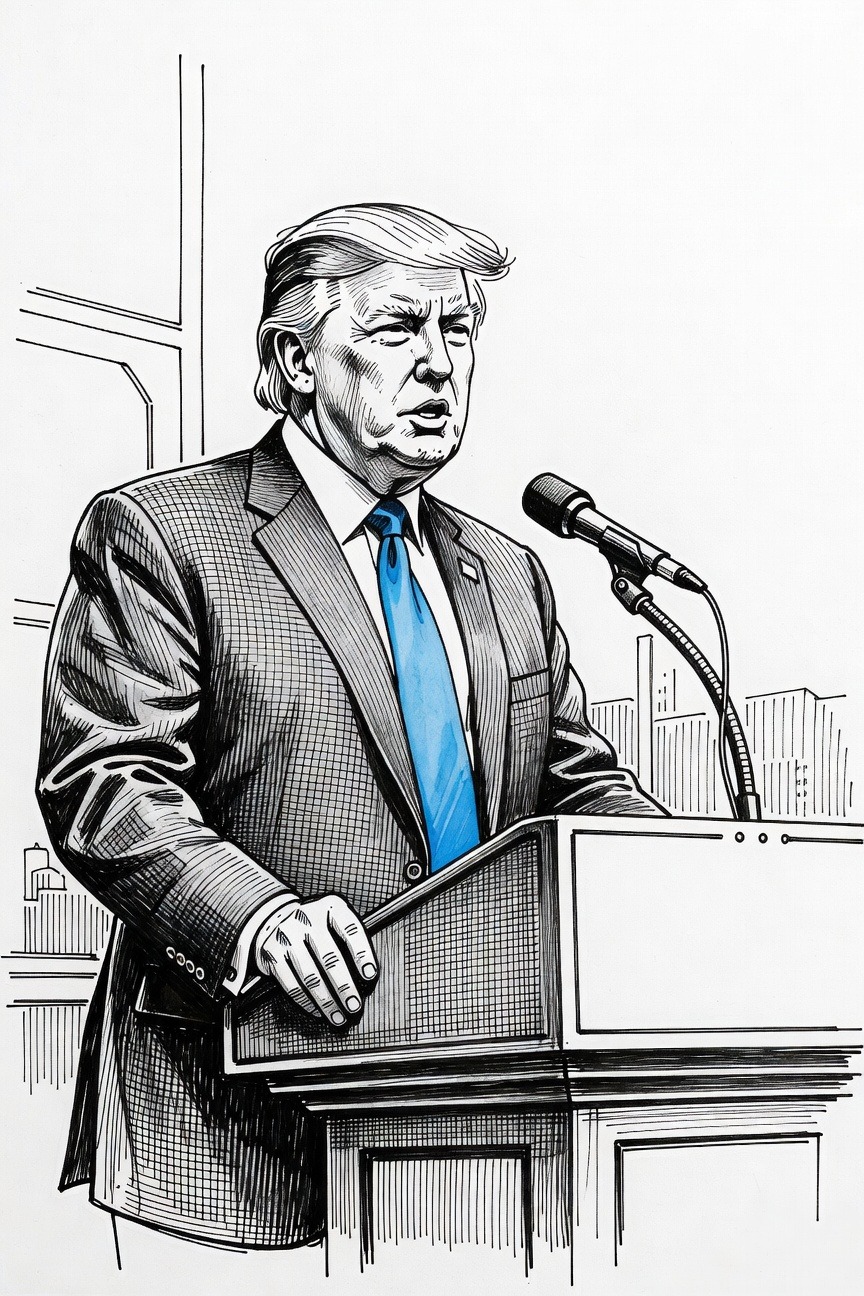
AI-generated illustration. Visual interpretation does not represent real individuals or scenes.
Lahn Defeats Trump-Backed Feenstra in Iowa Republican Gubernatorial Primary
2026-06-03
The BareStory
Businessman and farmer Lahn won the Republican gubernatorial primary in Iowa, defeating three-term U.S. Representative Randy Feenstra. Both political campaigns confirmed that Feenstra, who recently received an endorsement from Donald Trump, officially conceded the race. The primary outcome establishes Lahn as the Republican nominee for the upcoming November general election.
According to primary election results, Lahn will face Democratic nominee Rob Sand, a two-term state auditor. Campaign finance reports indicate Sand enters the general election with approximately $18.3 million on hand, compared to Lahn’s roughly $700,000. During the campaign, Lahn stated his platform focuses on increasing local farmland ownership and addressing state cancer rates. Sand stated his campaign centers on government accountability and universal pre-kindergarten, claiming that Lahn represents a broken political system.
Voters also cast ballots to fill the United States Senate seat currently held by retiring Republican Senator Joni Ernst. According to primary results, Democratic state Representative Josh Turek advanced to the November general election, where he will compete against Republican state Representative Ashley Hinson, who also campaigned with Trump's endorsement. Additionally, the primary contests finalized the candidate matchups for several competitive House districts across the state.
• Weaponizing Stark Financial Asymmetry
Rob Sand’s $18.3 million war chest, dwarfing Lahn’s $700,000, is viewed not just as a campaign advantage, but as a necessary equalizer against entrenched state power. Reformers believe overcoming historical conservative dominance requires overwhelming resources to adequately broadcast progressive messaging and challenge the status quo. This massive financial disparity provides the precise leverage needed to aggressively define Lahn as a symptom of a broken system before he can unify his base.
• Engineering Structural Institutional Accountability
Sand’s platform championing government accountability and universal pre-kindergarten directly aligns with the progressive mandate to protect the vulnerable and optimize institutions for public welfare. By aggressively framing Lahn and the current political apparatus as "broken," the Left seeks to dismantle systemic inequities from the top down. This approach calculates that voters are exhausted by standard partisan governance and will ultimately reward transparent oversight and direct investment in early education.
• Exploiting Factional Conservative Realignment
The primary defeat of Trump-endorsed incumbent Randy Feenstra signals a fracturing within conservative ranks that reformers aim to capitalize on. With Senator Joni Ernst retiring and another Trump-backed candidate, Ashley Hinson, advancing in the Senate race against Democratic state Representative Josh Turek, the Left perceives deep ideological divisions among Republican voters. Nominating reform-minded candidates in this chaotic environment presents a rare strategic opening to flip traditionally conservative seats by offering a unified, policy-focused alternative.
Right Perspective
• Shielding Local Agrarian Sovereignty
Lahn’s victory establishes a clear mandate for community-grounded leadership by elevating a businessman and farmer whose primary focus is local farmland ownership. Traditionalists value this focus on property rights and local resource control as the foundational bedrock of state stability. Shielding agricultural assets from distant corporate interests or progressive state overreach is seen as the ultimate protection of civic duty, self-reliance, and rural heritage.
• Validating Authentic Grassroots Governance
The ouster of three-term Representative Randy Feenstra, despite his Trump endorsement, demonstrates a deliberate conservative pivot toward authentic local governance over nationalized political branding. Traditionalists interpret this primary outcome as a healthy self-correction within the party, rejecting entrenched incumbency in favor of a candidate who mirrors the electorate’s daily, practical realities. Lahn’s localized focus on addressing state cancer rates further cements his image as a pragmatic problem-solver rather than a partisan operative.
• Combating Top-Down Bureaucratic Expansion
Rob Sand’s formidable $18.3 million campaign fund and his push for universal pre-kindergarten represent a direct threat of state-sponsored institutional bloat. The Right views these massive financial resources as a vehicle for forcing progressive, centrally managed social programs onto fundamentally independent constituencies. Securing the gubernatorial seat and backing candidates like Ashley Hinson in the Senate are viewed as critical fortifications to protect the state from highly funded efforts to alter its traditional civic structures.
How it may affect me
As a U.S. reader:
• In the short term, the primary defeat of a Trump-endorsed incumbent indicates a potential shift in conservative voter behavior, suggesting that grassroots candidates focused on practical, local issues can successfully challenge nationalized political branding.
• The upcoming general election for the U.S. Senate seat vacated by retiring Republican Joni Ernst will have long-term implications for national politics, as the race between Josh Turek and Ashley Hinson will decide whether reformers can flip a traditionally conservative seat or if traditionalists will retain it.
• The significant financial disparity in the gubernatorial race will serve as a test case for whether overwhelming campaign funding can advance progressive, centrally managed social platforms in a conservative state, or if a localized campaign can resist what opponents view as institutional bloat.
• Over the long term, the gubernatorial election will determine the state's direct policy impacts on its residents, deciding between Rob Sand's push for universal pre-kindergarten and systemic reform versus Lahn's focus on local farmland ownership and addressing state cancer rates.