
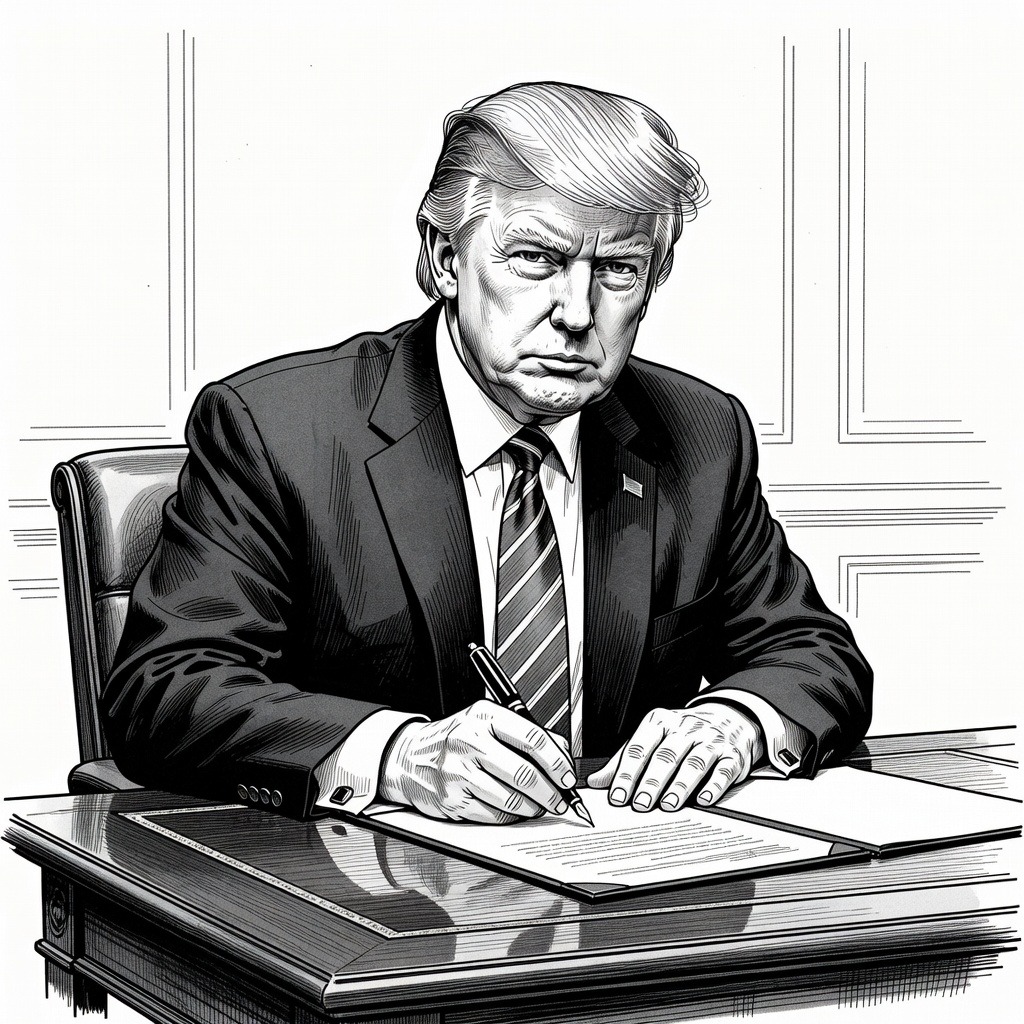
AI-generated illustration. Visual interpretation does not represent real individuals or scenes.
Trump Signs Executive Order for Voluntary Review of Advanced AI Models
2026-06-02
The BareStory
President Donald Trump signed an executive order on Tuesday establishing a voluntary framework for technology companies to share advanced artificial intelligence models with the federal government. The directive asks AI developers to provide access to their most powerful "frontier" systems up to 30 days before public release, allowing officials to evaluate the technology for cyber capabilities and national security risks. The document explicitly prohibits mandatory government licensing, preclearance, or permitting requirements, relying instead on the voluntary cooperation of industry developers.
The finalized directive comes nearly two weeks after Trump postponed the signing of an earlier draft. At the time, the president stated he was concerned the initial text could stifle industry innovation and threaten the United States' technological advantage over global competitors such as China. The administration ultimately shortened the proposed government review period, which had been set for 90 days in a previous draft, down to a maximum of 30 days.
Alongside the voluntary review program, the executive order directs federal agencies—including the departments of Defense, Treasury, and Homeland Security—to develop safety benchmarks and create an AI cybersecurity clearinghouse to identify and share information regarding software vulnerabilities. The policy action follows growing government and industry attention on AI security capabilities; earlier this year, the AI developer Anthropic restricted the public release of its new "Mythos" model to select partners, citing the system's advanced ability to detect and exploit software security flaws.
Left Perspective
Surrender of Regulatory Shield
Capitulation to Corporate Speed
Gamble on Private Goodwill
Right Perspective
Engine of Geopolitical Dominance
Streamlined Threat Mitigation
Validation of Market Discipline
Left Perspective
• Surrender of Regulatory Shield
Prioritizes government accountability and the protection of civil society against unchecked corporate power. Views the explicit prohibition of mandatory licensing and the reliance on a "voluntary framework" as a profound institutional failure. By allowing industry developers to unilaterally opt in or out of federal oversight, the administration effectively delegates national cybersecurity to profit-driven technology companies rather than prioritizing public safety.
• Capitulation to Corporate Speed
Focuses on the necessity of thorough, independent risk assessment over rapid commercial deployment. Interprets the administration's decision to slash the review period from 90 days down to a maximum of 30 days as a dangerous concession to industry lobbying. Assessing advanced "frontier" systems for complex cyber capabilities requires deep, sustained auditing; compressing this window severely neuters the government's capacity to detect hidden vulnerabilities.
• Gamble on Private Goodwill
Warns against systemic vulnerabilities created when institutional checks are bypassed in favor of industry self-regulation. Points to Anthropic's restricted release of the "Mythos" model due to its ability to exploit software flaws as undeniable evidence of the extreme dangers inherent in these systems. Concludes that leaving the containment of such highly capable, potentially destructive technology to the voluntary discretion of its creators invites catastrophic infrastructural harm.
Right Perspective
• Engine of Geopolitical Dominance
Prioritizes national sovereignty and maintaining strategic supremacy in a highly competitive global arena. Views mandatory government licensing as a bureaucratic anchor that would stifle domestic innovation and hand a critical technological advantage to competitors like China. Prohibiting heavy-handed preclearance ensures American developers can iterate and deploy frontier models at the speed necessary to maintain global market leadership.
• Streamlined Threat Mitigation
Focuses on institutional efficiency and the pragmatic alignment of public-private intelligence sharing. Interprets the shortened 30-day review period and the creation of an AI cybersecurity clearinghouse as an optimal balance of security and agility. This framework provides agencies like Defense, Treasury, and Homeland Security with necessary visibility into cyber capabilities without paralyzing developers in prolonged, 90-day regulatory purgatory.
• Validation of Market Discipline
Believes that systemic stability is best achieved by incentivizing responsible corporate behavior rather than mandating adversarial compliance. Sees Anthropic’s self-imposed restriction on its "Mythos" model as definitive proof that private entities can effectively police their own technologies. Validates the executive order’s voluntary approach, asserting that developers inherently possess the market incentives and technical expertise required to manage advanced security risks.
How it may affect me
As a U.S. reader:
• In the short term, consumers will likely see advanced artificial intelligence tools released to the public quickly, as tech companies face no mandatory government licensing and are subject to a maximum 30-day voluntary review period.
• Everyday users and civil infrastructure could face increased exposure to cyberattacks if companies bypass the voluntary federal review process and release artificial intelligence systems capable of exploiting software vulnerabilities.
• In the long term, public digital security may benefit from improved threat tracking, as federal departments like Homeland Security and the Treasury develop new safety benchmarks and utilize a centralized clearinghouse to identify and share software vulnerabilities.
• The protection of the general public against artificial intelligence risks will depend heavily on private market practices, meaning citizens will rely on corporate developers rather than federal regulators to identify and restrict dangerous technologies before they are launched.