
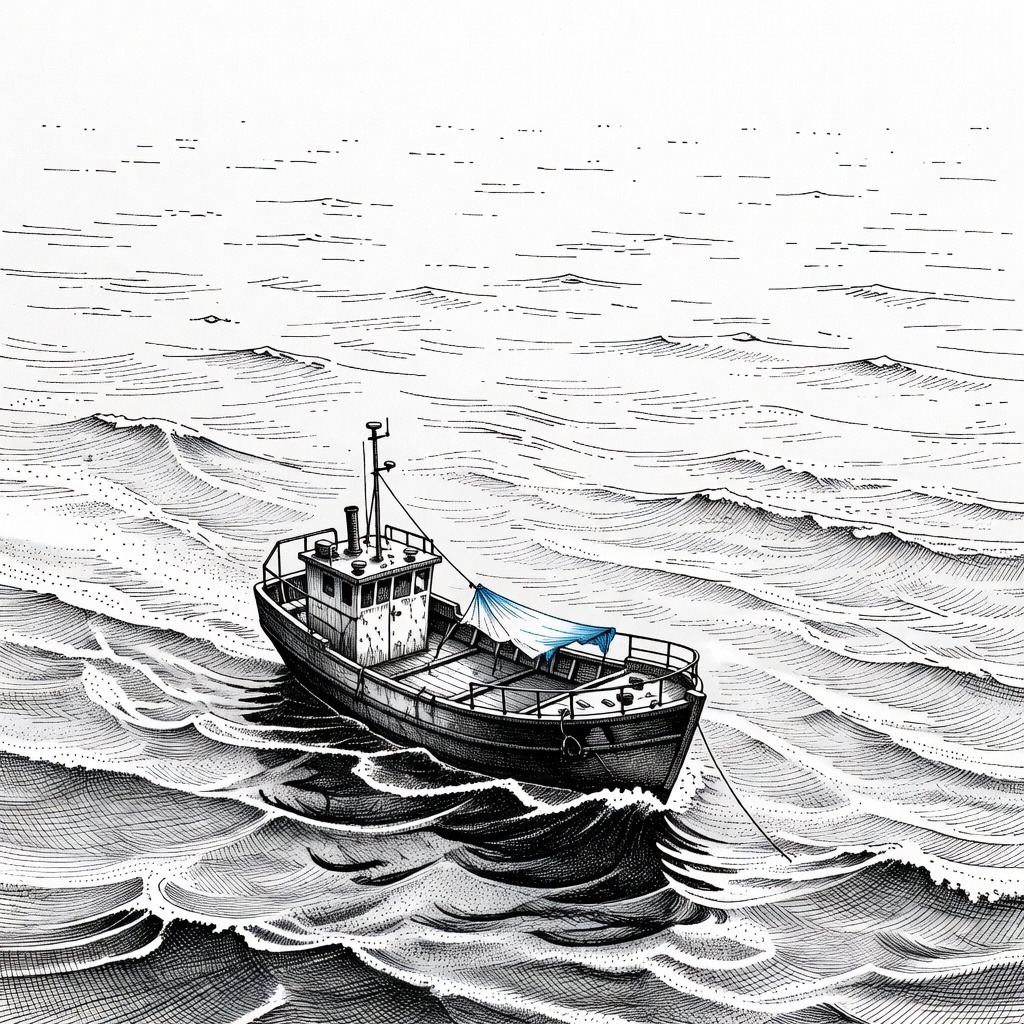
AI-generated illustration. Visual interpretation does not represent real individuals or scenes.
U.S. Strike on Alleged Drug Boat in Pacific Ocean Kills Three
2026-05-31
The BareStory
A U.S. military strike on a vessel in the Pacific Ocean killed three people. The incident marks the fourth attack this week targeting alleged drug boats.
U.S. Southern Command announced the Saturday strike, claiming the vessel was operated by a designated terrorist organization involved in narco-trafficking. Military officials released a video showing the boat being struck, though no evidence was provided to support the terrorism allegations. According to the military, the strike is part of a broader maritime campaign initiated in September against Latin American drug cartels, which the administration has classified as an armed conflict.
The military campaign, directed by Gen. Francis L. Donovan, has resulted in a reported death toll of 205 people. According to military figures, only three individuals are known to have survived and been rescued from the targeted vessels since the operations began.
The operations have drawn legal scrutiny from lawmakers. The White House confirmed that a follow-on strike during an attack in September killed two initial survivors, prompting some lawmakers to question whether the action constituted a war crime. Additionally, the families of two men killed in a prior Caribbean strike have filed a federal lawsuit against the administration, arguing the killings lacked plausible legal justification.
Left Perspective
Weaponizing Legal Classifications
Condemning Disproportionate Lethality
Normalizing Atrocity Risks
Right Perspective
Pivoting to Military Deterrence
Projecting Decisive Lethality
Rejecting Lawfare Paralysis
Left Perspective
• Weaponizing Legal Classifications
The foundation of civil liberties demands that state violence remains strictly bound by due process and transparent evidence. By reclassifying counter-narcotics operations as an "armed conflict," the administration is intentionally bypassing domestic and international law enforcement standards. U.S. Southern Command’s failure to provide evidence that the targeted Pacific vessel was operated by a terrorist organization illustrates a dangerous pivot toward unilateral executions. This semantic shift allows the military to justify lethal strikes against suspected smugglers without the burden of judicial proof.
• Condemning Disproportionate Lethality
Humanitarian frameworks prioritize the preservation of human life and mandate that military force be a measure of absolute last resort. The campaign directed by Gen. Francis L. Donovan has achieved a devastatingly one-sided kill ratio, with 205 reported deaths and only three rescued survivors since September. This near-total annihilation of targets suggests a deliberate policy of extrajudicial extermination rather than a proportional effort to interdict illicit goods. Treating alleged drug runners identically to enemy combatants fundamentally devalues human life and abandons foundational rules of engagement.
• Normalizing Atrocity Risks
Protecting institutional integrity requires rigorous adherence to the laws of armed conflict, which strictly prohibit targeting incapacitated individuals. The White House’s admission that a September follow-on strike intentionally killed two initial survivors crosses a severe moral and legal threshold, prompting justified lawmaker scrutiny over potential war crimes. The federal lawsuit filed by families over a prior Caribbean strike highlights the immediate legal fallout of these unchecked military operations. Ignoring these legal boundaries threatens to erode global humanitarian norms and establishes a precedent for perpetual human rights abuses under the guise of national security.
Right Perspective
• Pivoting to Military Deterrence
National security dictates that systemic threats to sovereignty require overwhelming, systemic responses rather than piecemeal policing. The administration’s classification of the cartel campaign as an "armed conflict" acknowledges the reality that Latin American drug networks operate with the resources and lethality of hostile insurgencies. Targeting these alleged drug boats recognizes that narco-trafficking by designated terrorist organizations represents a direct, paramilitary threat to the homeland. Treating this as a war rather than a criminal justice issue allows for the necessary mobilization of U.S. Southern Command’s robust assets.
• Projecting Decisive Lethality
Strategic realism relies on the principle that uncompromising force is the most effective mechanism for dismantling entrenched, transnational threats. The ongoing maritime campaign led by Gen. Francis L. Donovan has achieved distinct operational momentum, demonstrated by the four rapid strikes executed this week and a cumulative toll of 205 neutralized targets. Achieving such a high suppression rate against hostile actors at sea creates a formidable deterrent against future trafficking attempts. The low number of survivors validates the efficiency of the strikes, ensuring that cartel operatives cannot regroup or continue their logistical operations.
• Rejecting Lawfare Paralysis
Preserving national sovereignty requires military commanders to operate without the constant obstruction of civilian litigation and political second-guessing. Lawsuits from families of neutralized targets in the Caribbean and accusations of war crimes regarding the September follow-on strike are viewed as dangerous attempts to litigate warfare. Applying traditional judicial and law-enforcement standards to active combat zones neutralizes the military's tactical advantage and inadvertently emboldens terrorist networks. Prioritizing decisive offshore defense ultimately protects the domestic population, superseding the tactical legal maneuvers attempting to stall the campaign.
How it may affect me
As a U.S. reader:
• Over the long term, the administration reclassifying counter-narcotics enforcement as an armed conflict could alter how the government applies civil liberties, setting a precedent where military force bypasses traditional domestic law enforcement standards and judicial proof.
• In the short term, the lethal maritime campaign against suspected drug boats is intended to act as a formidable deterrent against cartel logistics, which military strategists anticipate will reduce illicit drug trafficking and protect the domestic population from transnational threats.
• The U.S. government will likely face ongoing legal and administrative obligations as it must direct resources to defend against federal lawsuits filed by the families of targeted individuals and respond to congressional scrutiny over potential war crimes.
• The country's international standing and adherence to global humanitarian frameworks may be impacted over time, as utilizing lethal military force against alleged smugglers and targeting incapacitated survivors challenges established rules of engagement.