
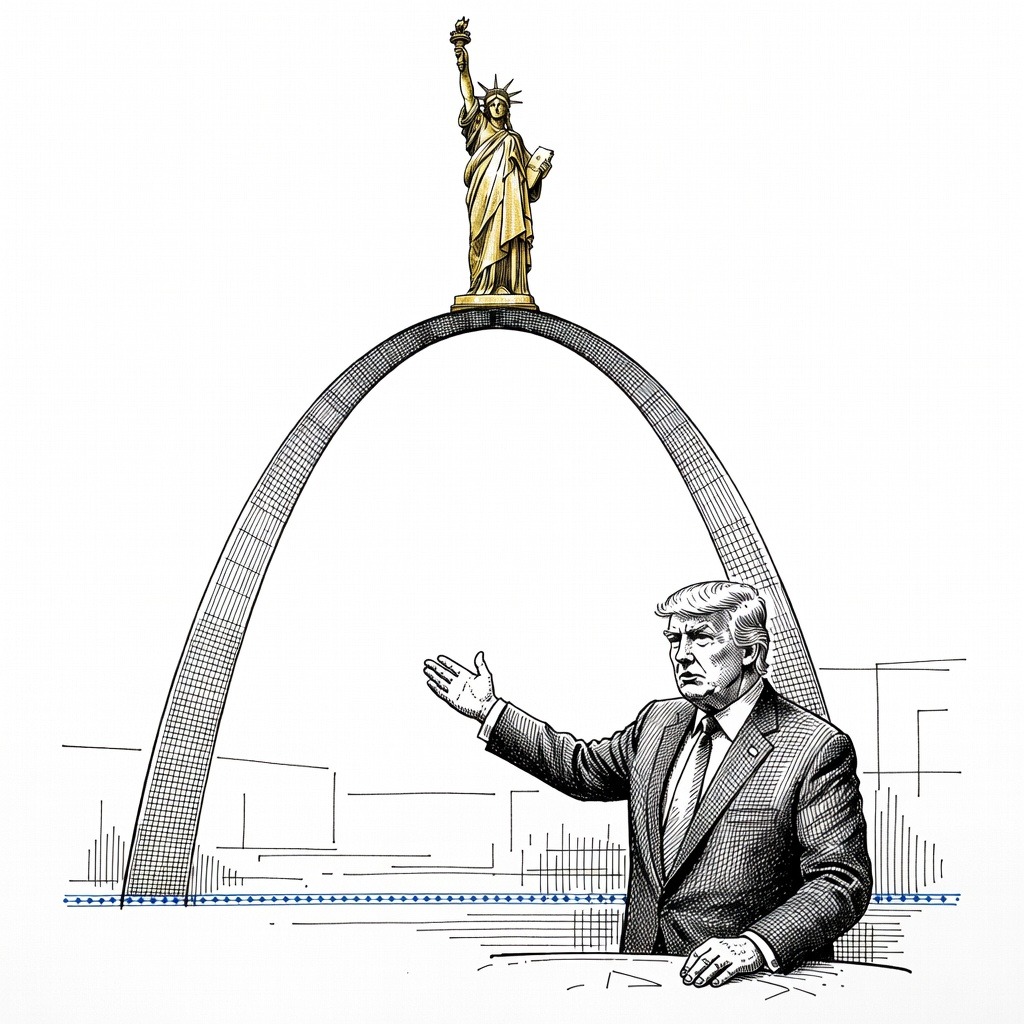
Federal Commission Approves Design for President Trump’s 250-Foot Arch Near Arlington Cemetery

Illustration for: Federal Commission Approves Design for President Trump’s 250-Foot Arch Near Arlington Cemetery
AI-generated illustration. Visual interpretation does not represent real individuals or scenes.

THE BARE STORY

The Commission of Fine Arts voted Thursday to approve a modified design for President Donald Trump’s proposed 250-foot arch near Arlington National Cemetery. The structure, planned for a traffic circle along the Potomac River, will feature a 166-foot base topped with a gilded statue of Lady Liberty flanked by eagles.

The approved plan removes previously proposed pedestrian tunnels and lower-level platforms. According to lead designer Nicolas Charbonneau, the president rejected a suggestion to remove the crowning statue. Commission leadership supported the design, with Chair Rodney Mims Cook Jr. noting the project is intended to celebrate the 250th anniversary of the Declaration of Independence. The panel advanced the proposal despite receiving hundreds of public comments overwhelmingly opposed to the design.

The monument faces ongoing legal and political opposition. Democratic lawmakers, veterans groups, and historic preservation advocates argue the administration is bypassing required congressional authorizations. Opponents have filed a lawsuit to block the project, claiming its celebratory scale disrespects the adjacent military cemetery and disrupts the historic sightline between the Lincoln Memorial and Arlington House. In response, the administration argues that federal land ownership and past congressional authorizations permit the project to proceed without new legislative approval.

The project must clear additional administrative hurdles before construction can commence. The National Capital Planning Commission is scheduled to review the structure on June 4. The arch also requires sign-offs from the National Park Service, which a federal judge recently prohibited from beginning work without prior notice. Questions also remain regarding the project's final artistic details and its funding sources, which the president has suggested could include remaining private donations or diverted agency funds.

Same Facts. Different Perspectives.

Two AI models. Two viewpoints. One factual foundation.

• Championing Enduring National Heritage Prioritizing civic duty and national pride, this camp views the 250-foot arch as a necessary and fitting tribute to the 250th anniversary of the Declaration of Independence. Anchoring the design with a gilded Lady Liberty flanked by eagles emphasizes a traditionalist celebration of foundational American ideals and sovereignty. To them, monumental architecture is a vital, historically proven tool for reinforcing societal cohesion and commemorating institutional continuity on a major historical milestone.

• Exercising Lawful Executive Prerogative Valuing the rule of law and established authority, this perspective accepts the administration’s legal rationale that federal land ownership and prior congressional authorizations are strictly sufficient to proceed. Earning approval from the Commission of Fine Arts demonstrates effective executive action successfully navigating established regulatory channels. They view the utilization of existing legal frameworks, including deploying remaining private donations or available agency funds, as a legitimate and efficient exercise of the executive mandate.

• Defeating Partisan Institutional Gridlock Focused on decisive governance, this side perceives the lawsuit by Democratic lawmakers and preservation advocates as reflexive political obstruction rather than genuine procedural concern. Advancing the design despite coordinated public pushback is seen as a necessary assertion of leadership to prevent activist factions from exercising a perpetual veto over federal projects. The primary risk they fear is that capitulating to endless administrative hurdles and legal injunctions will permanently paralyze the nation's ability to execute grand public works.

How it may affect me

As a U.S. reader:

• In the long term, public visitors to the capital will experience permanently altered historic sightlines between the Lincoln Memorial and Arlington House due to the scale and placement of the 250-foot structure.

• The short-term financing of the monument could impact taxpayers if existing federal agency funds are diverted from other government programs to cover construction costs.

• The outcome of the ongoing lawsuits will establish a long-term legal precedent regarding whether the executive branch can authorize major public works on federal land despite congressional and public opposition.

• In the short term, members of the public may face localized construction and transit disruptions at the Potomac River traffic circle near Arlington National Cemetery if the project clears its final administrative hurdles.

Read the story at

Note: All TheBareNews content is AI-generated. For additional context, reporting, and updates, you are invited to explore the news outlets linked above.